Monthly Archives: January 2012

Not My Alma Mater

It is unlikely that the disgraced Jon Corzine of MF Global Holdings ever crossed paths with Sir Harry Hammersmith. Sir Harry, hedge fund manager by appointment to Her Royal Majesty, would have considered Mr. Corzine one of the little people, unworthy of his attention. Sir Harry only concerned himself with those who did God’s work, at the tippy top of the food chain.More than three years have passed since Sir Harry fell from the sky, without a parachute, headless, wearing only a pair of his own signature black loafers, the ones with the braided platinum tassels, platinum because gold is so appallingly common. He had planned to deliver a check that would make philanthropic history as the single largest gift ever made to a private college, but instead dropped from the sky as a monstrous chunk of flesh at the precise geometric center of the Plymouth Mather quad.

View from the porch

The college president, a serious and square-bodied man named Philip Dooley, suffered a nervous breakdown shortly thereafter and now resides on a small island off the coast of Maine, where he sits in a rocking chair on the leeward porch muttering Plymouth Mather is not my Alma Mater, Plymouth Mather is not my Alma Mater, Plymouth Mather is not my Alma Mater … 

Of course, for those who witnessed the scene, it was the brutal red-crusted brands that were so deeply shocking, brands that seemed to transform the naked body of a middle-aged billionaire into a ciphered warning, a warning that revolved around the letters M,E,T,A,C,O,M.  Yet a warning of what, and sent by whom? More than three years have passed, and these two most basic questions remain unanswered.

Yes, we know everything there is to know about Sir Harry and his special tea: how he brewed the tea from the pulverized bones of a vanquished Wampanoag sachem, bones stolen while he was an undergraduate from a special crypt beneath Plymouth Mather’s world renowned Stoughton Center For The Humanities; how the tea appeared to convey godlike properties to certain anatomical appendages while also swelling self-esteem to the proportions of a trophy zeppelin; and how his clients were far more invested in securing privileged access to the precious tea than they were in Sir Harry’s financial acumen. And yes, we also know that when he exhausted the Plymouth Mather trove, he purchased others on the open market for fabulous sums, bones picked from all over the world, relics of the conquered, the obliterated and the disappeared, against all international law and common decency.

King P. Tea

While the matter of King P. Tea may provide credible motive for retribution by any number of aggrieved parties, no shadowy groupuscule affiliated with the assembled terrorist demons of the universe ever claimed responsibility for this perverse dead letter. There were vague whisperings of a subversive mastermind codenamed “Moshup”, but nothing came from it.

With the exception of a few months of turbulence in financial markets while Sir Harry’s algorithms dissolved into a worthless smear and the cold turkey experienced by a tiny coterie of super rich teaheads, Sir Harry’s fall from the sky failed to produce the cataclysm anticipated by the agents of Homeland Security, leaving a good deal of egg on their faces following their declaration of martial law. Indeed, for most people, the event has receded into the realm of dim memories, save for those like Phillip Dooley who actually laid eyes upon the branded corpse. For them, the image of the headless, scorched trunk of Sir Harry continues to intrude:

Plymouth Mather is not my Alma Mater, Plymouth Mather is not my Alma Mater Plymouth Mather is not my Alma Mater, Plymouth Mather is not my Alma Mater Plymouth Mather is not my Alma Mater, Plymouth Mather is not my Alma Mater  Plymouth Mather is not my Alma Mater, Plymouth Mather is not my Alma Mater  Plymouth Mather is not my Alma Mater, Plymouth Mather is not my Alma Mater  Plymouth Mather is not my Alma Mater, Plymouth Mather is not my Alma Mater  Plymouth Mather is not my Alma Mater, Plymouth Mather is not my Alma Mater  Plymouth Mather is not my Alma Mater, Plymouth Mather is not my Alma Mater Plymouth Mather is not my Alma Mater, Plymouth Mather is not my Alma Mater  Plymouth Mather is not my Alma Mater, Plymouth Mather is not my Alma Mater  Plymouth Mather is not my Alma Mater, Plymouth Mather is not my Alma Mater.

METACOM


Bullet Holes and Blinks

Once I moved about like the wind. Now I surrender to you and that is all.                                                             – Geronimo

Rigorous Exactness

In 1897, a painter named Eldridge Ayer Burbank arrived in Fort Sill, Oklahoma to execute a series of portraits of Indian leaders held there as prisoners of war, principal among them the Chiricahua Apache known to the white man as Geronimo, once called the wickedest indian who ever lived. Burbank later gave an oral account of his experiences to a man named Ernest Royce, and the book was published in 1944 under the title Burbank Among the Indians. Journalist Charles F. Lummis contributed a Foreward, in which he states:

Mr. Burbank has in general selected very characteristic types; and his portraits are done with rigorous exactness. He nothing extenuates, nor sets down aught in malice. He neither idealizes nor blinks. From our personal point of view, his pictures are harsh – not “retouched” as we demand our artists to flatter us, but uncompromising as a photograph made in strong sunlight. Popularly, this may give a mistaken impression; for many will forget that one chief reason why an Indian is so much more furrowed and ugly than we are is because he has no retoucher to make him pretty. But scientifically this insistence upon the lines in which life indexes character, is very important.

Burbank spent a good deal of time with Geronimo, eventually completing seven portraits. In the body of the text, as told to Mr. Royce:

One day he came into my quarters at Fort Sill in a most peculiar mood. He told me no one could kill him, nor me either, if he willed it so. Then he bared himself to the waist. I was dumbfounded to see the number of bullet holes in his body. I knew he had been in many battles and had been fired on dozens of times, but I had never heard of anyone living with at least fifty bullet wounds on his body. Geronimo had that many scars.

Some of these bullet holes were large enough to hold small pebbles that Geronimo picked up and placed in them. Putting a pebble in a bullet wound he would make a noise like a gun, then take the pebble out and throw it on the ground. Jokingly I told him he was probably so far away that the bullets didn’t penetrate him, but that if he had been nearer they probably would have killed him. “No, no,” he shouted. “Bullets cannot kill me!”

Surely Geronimo’s bullet riddled torso offered powerful visual evidence of how life might index character, yet in this case Burbank turns a blind eye to the harsh and uncompromising woundscape, and the specific sort of index it compiles.  In baring his torso, Geronimo offered the artist an extraordinary opportunity to paint the unvarnished truth; instead, Burbank produced a series of extenuated fantasies such as these:

Uniform Over Woundscape

Fantasy in Red

On his deathbed, Geronimo, known to the Chiricahua Apache as Goyathlay, the One Who Yawns, reportedly expressed a single regret to his nephew: I should never have surrendered. I should have fought until I was the last man alive.


Inscrutable Things

                          … all twisketee be-twisk, like him – him –     Moby Dick

Harpoons, lances and iron darts lie all twisted and wrenched in the flesh of the white whale, creating a strange sort of fluid vulnerography. On a prior voyage, Queequeg took note of the whale’s twisted corkscrew body; Queequeg, upon whose own body a prophet had inscribed a complete theory of the heavens and the earth, and a mystical treatise on the art of attaining truth; so that Queequeg in his own proper person was a riddle to unfold; a wondrous work in one volume.

Queequeq may well understand that Moby Dick’s flesh also carries a complete theory of the heavens and the earth, a theory that tasks and heaps Ahab, a theory that he believes is nothing but a mask for the most inscrutable malice; The inscrutable thing is chiefly what I hate; and be the white whale agent, or be the white whale principal, I will wreak that hate upon him. 

Unable to wreak sufficient hatred by himself, Ahab winds the crew up into an electrified killing machine geared to obliterate this bloody glyph, yet in the end the wounded whale sucks him into its unfathomable depths, voicelessly as Turkish mutes bowstring their victim, he was shot out of the boat, ere the crew knew he was gone.

Melville does not spell it out quite so explicitly, but John Huston and Ray Bradbury jiggle the line, and present us with the powerful image of the mad captain bound to the whale by his own violent scrawl, his arm still beckoning to the crew, while the nib of his ivory leg points to the obscure depths. The darts and lines meant to constrain and subdue the whale in a tangle of barbed lashings will now stitch whatever remains of Ahab into the cipher’s lethal inscrutability.

This image of Ahab, his lightning self finally extinguished by the whale’s deep water sounding, his broken body hanging and waving amidst the barbs, summons another haunting image to mind, from Erich Maria Remarque’s All Quiet on the Western Front. Remarque describes an attack by the German soldiers, crossing through the death zone of barbed wire and machine guns: I see one of them, his face upturned, fall into a a wire cradle. His body collapses, his hands remain suspended as though he were praying. Then his body drops clean away and only his hands with the stumps of his arms, shot off, now hang in the wire.

Two more inscrutable things, hanging in a toxic fog of gas and smoke, lone survivors clinging to the wire like Ishmael clinging to Queequeq’s coffin, to tell the tale.

ALL TWISKETEE BE-TWISK


The Mean Maxima

I

In the pilot study for Stanley Milgram’s famous Obedience experiments, the subject could dimly perceive the victim “learner” receiving his measured voltage of electric shock through silvered glass. The visible discomfort of the victim appeared to unnerve the subject, a behavior that Milgram wished to explore more deeply. To better understand the impact of proximity on the subject’s propensity to deliver maximum volts to the body of the victim, Milgram designed four different scenarios:

In Experiment 1, the victim sat in a remote location, invisible to the subject. At 300 volts, the victim was instructed to pound on the wall. After 315 volts, the pounding would stop.

In Experiment 2, the ability to perceive vocal feedback was added to the scene. No more pounding, just yells and other audible responses from the victim.

Experiment 3 made the relationship physically proximate, and the victim was in the same room, visible as well as audible.

Finally, in Experiment 4, physical contact between the subject and the victim was required for the delivery of the shock, via forced placement of the victim’s hand on a shock plate.

In all four experimental situations, the role of the victim is performed not by an actor but by a volunteer who usually works as an accountant. He has been trained by the psychologist Milgram to simulate gradually increasing distress.

The results are summarized in a graph recording mean maximum shocks throughout the proximity series, data that indicates a significantly reduced willingness to inflict pain as the physical relationship between subject and victim becomes more close. 

II

 
Inside a different sort of laboratory across the Atlantic in London, at roughly the same time that Stanley Milgram was meticulously accumulating his proximity data, another researcher with a deep interest in the interplay between human conscience and the behavior of bodies in tight spaces observes the young Glenda Jackson using her hair as a whip. The researcher’s name is Peter Brook, and he is in the midst of rehearsing the Peter Weiss play, Marat/Sade, for its English language premier.

The setting is the asylum of Charenton, and the script indicates a “many stranded whip”. Brook has decided to take this idea and make it part of the actor’s body. Patrick McGee receives the whipping; Brook observes the rhythms of Jackson’s lashings carefully, as that rhythm will provide a sort of narcoleptic metronome for one of the most important speeches in the play. Jackson will play the asylum patient who in turn plays CORDAY, with McGee playing SADE, who serves as both director and victim within the scene. In the 1967 film version, here is how the experiment played out:

III

The basic scenario unfolds as follows:

A pudgy middle aged man sits on a chair in a small room. Across the room, a teenaged girl stands still, wearing a dirty apron to cover her naked body. She looks scared. The man is talking to someone on the phone. He claims to be a police officer. Or a director of Homeland Security. Or an agent of the Permanent Emergency.

The voice on the phone claims the girls is a thief. Or a terrorist. Or a sympathizer with the terrorists. Or a law abiding protestor who carries within her the potential for future violence. He tells the girl to take off the apron; he needs to inspect her. He tells her to come closer, so he can see. He tells her she is hiding something from the law. In a body cavity. He tells her to jump up and down. She looks terrified.

He tells her to perform jumping jacks. Nothing falls out from her body cavities. So he tells her she needs to come closer. He needs to have a closer look. To make sure she has no secrets. She now trembles with fear, weeping.

He inspects her, touches her. He tells her to call him “sir”. She refuses. The voice on the phone tells him she is a bad girl. Disrespectful of his authority. He must spank her, to restore her obedience.

The man spanks the girl, tentatively at first, until he gets the feel of it. Then he spanks with abandon, producing bright red welts – hand prints – on her flesh; her painful cries fill the room. The man is very close now, groping her, using her. He is not a pudgy puppet anymore. He is his own man, serving his own needs. He forces her head into his lap. The search is now officially over; the rape has begun. The voice on the phone goes mute yet the caller listens intently, satisfied with how the basic scenario has played out.

The victim is no longer in the room. She has gone somewhere else. Somewhere she can be safe. Somewhere, she will survive.

Conclusion: There are certain conditions in which the inverse relationship between proximity to the victim and the propensity to inflict pain does not apply. Under these conditions, we can expect to see an intensification of abuse as the victim is stripped of corporeal privacy and sexual autonomy. Let us call these conditions TORTURE. 

O this itching, this itching


Beneath the Golden Arches

By day the banished sun circles the earth like a grieving mother with a lamp.                                             - Cormac McCarthy, The Road

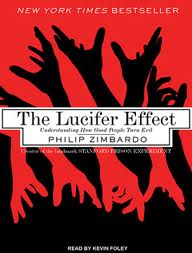
In his book The Lucifer Effect, psychologist Philip Zimbardo maps out what he construes as scientifically identifiable behavioral patterns running through examples that range from his own signature experiments with role playing cruelty in a Stanford University basement, to the imposition of a brutal regime of enhanced interrogation within the military prison of Abu Ghraib.

Torture Palace?

Along the road to his lengthy chapter on Abu Ghraib, under the sub-heading “Sexual Obedience to Authority”, Zimbardo recounts his version of a particularly repellent incidence of torture and sexual assault that took place inside the back office of a Kentucky McDonald’s franchise on April 9, 2004. Unfolding exactly three weeks before the photograph of a human pyramid of naked and hooded Iraqi prisoners would be published on the New Yorker magazine website, a homeland teenager was tortured and sexually assaulted for over three hours beneath the golden arches.

The torture was initiated by a telephone caller who identified himself as a policeman named Officer Scott. The caller told assistant manager Donna Summers that he was investigating a theft by a young woman wearing a McDonald’s uniform. He described her as a young Caucasian with dark hair and a slight build. Summers decided that this generic description fit her employee Louise Ogborn, a high school senior and Girl Scout with a stellar employment record. In Zimbardo’s account:

Stage One

In a case in which I was an expert witness, this basic scenario then included having the frightened eighteen-year-old high school senior engage in a series of increasingly embarrassing and sexually degrading activities. The naked woman is told to jump up and down and to dance around. The assistant manager is told by the caller to get some older male employee to help confine the victim so she can go back to her duties in the restaurant. The scene degenerates into the caller insisting that the woman masturbate herself and have oral sex with the older male, who is supposedly containing her in the back room while the police are slowly wending their way to the restaurant. These sexual activities continue for several hours while they wait for the police to arrive, which of course never happens.

As an expert witness in a criminal trial and indeed as a consultant to McDonald’s, Zimbardo certainly would have reviewed the McDonald’s office surveillance videotape, and would therefore be expected to have a firm grasp on the facts of the “basic scenario” to which he alludes. Yet from watching merely the brief video excerpts that were included in an ABC television report released on November 10, 2005,  it soon becomes clear that while Zimbardo’s account may well serve the central thesis of his book, it does not serve the truth, nor does it do justice to the victim. Among the highly relevant facts omitted in his account:

Stage Two

1. The older McDonald’s employee that Summers asked to guard the teenaged Ogborn was named Jason Bradley, age 27. After a brief exchange with the caller, Bradley refused to participate, telling Summers it was “a lot of BS”. Though he did not intervene on Ogborn’s behalf, he refused to play along in her torture and assault.

2. The man Summers next called was not a McDonald’s employee at all, but rather a professional exterminator named Walter “Wes” Nix, who also happened to be her fiancé. In the video, he is shown to be a pudgy and balding middle-aged man; ABC television reports a weight of 230 pounds.

3. When the terrified Ogborn refused to address Nix as “sir”, the caller instructed Nix to spank her until she complied. Nix brutally spanked her for a full ten minutes, leaving numerous welts and bruises. Ogborn described her mental state to the ABC reporter: “My soul just left, my body just went numb to everything so I could just survive”. This is a classic description of survival dissociation, often experienced by victims of torture and sexual trauma.

4. Having received the ultimate reward of forced oral sex from a traumatized teenager, Nix suddenly became worried that he might have done something “very bad”, and told Summers he wanted out. The caller gave him permission to leave on the condition that Summers recruit someone else to take his place. Summers instructed the franchise maintenance man, Thomas Simms, to take over from Nix. After a brief exchange with Officer Scott, Simms – like Bradley before him – refused to participate. The scenario then quickly broke down, the caller hung up, and the line went dead.

With crucial facts that might interfere with his simplistic hypothesis conveniently omitted, Zimbardo asserts that everyone in the scenario is a victim of an authority in absentia behavioral pattern reinforced both by prevailing civic norms of obedience to the police and by the norms of a McDonald’s corporate culture that places strong emphasis on serving the needs of the customer, while also taking orders from above, without question.

As support for this superficial analysis, Zimbardo references a single book about the fast food industry written by a Canadian sociologist, which offers a fascinating account of certain aspects of the fast food industry, while shedding only the dimmest light on the extreme events that transpired inside this particular franchise. He also references Donna Summers, who said to a reporter, “You look back on it, and you say, I wouldn’t a done it. But unless you’re put in that situation, at that time, how do you know what you would do. You don’t.”

Point of Entry

Yet Zimbardo’s situational dynamic actually explains very little of consequence in the torture and assault of Louise Ogborn, whose fearful obedience had nothing to do with encoded behavioral norms, and everything to do with the more visceral dynamics of power, violence, torture and survival. Using elementary techniques of manipulation, the man called Officer Scott placed a very deep itch into the ears of Donna Summers and Wes Nix and they ended up scratching it, with depraved abandon. Flooded with carnal stimulus, their reptilian brains took over. That was the “basic scenario”.

Nix pled guilty to sexual abuse, and was sentenced to five years in prison. Summers was fired from her job and placed on probation. Eventually, the police investigation resulted in the arrest of a corrections officer named David N. Stewart, who was married with five children. He was charged with impersonating a police officer and solicitation of sodomy. Even on such relatively minor counts, prosecutors were unable to secure a conviction. While the bodies in the office could be forensically established as facts, the voice on the telephone remained obscure and elusive. Nobody saw him in the phone booth, and there was no recording of the call, for definitive voice identification.

One small victory: a long line of similar calls appeared to end with the public outing of David N. Stewart as a sadistic disembody who preyed on the young work force of retail fast food. Yet despite this temporary lull, we are quite sure the idea of Officer Scott still vibrates somewhere inside an imagination that has yet to express itself, and where the idea lives, another voice will eventually follow, incarnate, as surely as the banished sun circles the earth.

Officer Scott Was Here


The Obedience Box

In May 1960, the former Nazi SS officer Adolf Eichmann was abducted by the Israeli Secret Service, strapped into a seat on an El-Al commercial flight and taken to Israel, where he would then be tried and sentenced to death for his instrumental role in the murder of six million Jews.

Eichmann began his career with the feared Nazi SS Sicherheitsdienst as a file clerk, constructing a detailed data base on Freemasons. Eventually, he was appointed director of the so-called Scientific Museum of Jewish Affairs, where he managed a massive extortion racket, extracting the wealth of Austrian Jews in exchange for their safe passage out of Austria. His subsequent recommendation for the deportation of European Jews to the island of Madagascar was not approved.

Eichmann Delivery Box

Eichmann served as recording secretary for the Wannsee Conference in January 1942, after which he was appointed transport administrator for the Final Solution. The former file clerk thereby became responsible for the collection, sorting and delivery of six million human “packages” to the death camps, a thanato-logistical network requiring both scrupulous attention to detail and absolute ideological commitment to the ultimate objective.

Eichmann Bullet Proof Box

In 1961, the distinguished political philosopher Hannah Arendt persuaded New Yorker magazine to assign her as correspondent for the trial, resulting in a series of reports that were later published as a book, Eichmann in Jerusalem with its resonant and provocative subtitle, A Report on the Banality of Evil. Arendt observed an unimpressive everyman sitting inside a bullet proof glass box. Fidgeting with a pencil and fiddling with his glasses, he looked to her like a postal clerk, a typical German civil servant.

Elsewhere in 1961, a Yale psychologist named Stanley Milgram began a lengthy series of behavioral experiments designed to explore the limits of obedience within a situation defined by both power and authority. As he writes in his 1974 summary opus Obedience To Authority:

Two people come to a psychology laboratory to take part in a study of memory and learning. One of them is designated as a “teacher” and the other a “learner .” The experimenter explains that the study is concerned with the effects of punishment on learning. The learner is conducted into a room, seated in a chair, his arms strapped to prevent excessive movement, and an electrode attached to his wrist. He is told that he is to learn a list of word pairs; whenever he makes an error, he will receive electric shocks of increasing intensity.

Obedience Box

The real focus of the experiment is the teacher. After watching the learner being strapped into place, he is taken into the main experimental room and seated before an impressive shock generator. Its main feature is a horizontal line of thirty switches, ranging from 15 volts to 450 volts, in 15-volt increments. There are also verbal designations which range from SLIGHT SHOCK to DANGER-SEVERE SHOCK. The teacher is told that he is to administer the learning test to the man in the other room. When the learner responds correctly, the teacher moves on to the next item; when the other man gives an incorrect answer, the teacher is to give him an electric shock. He is to start at the lowest shock level (15 volts) and to increase the level each time the man makes an error, going through 30 volts, 45 volts, and so on.

The “teacher” is a genuinely naive subject who has come to the laboratory to participate in an experiment. The learner, or victim, is an actor who actually receives no shock at all. The point of the experiment is to see how far a person will proceed in a concrete and measurable situation in which he is ordered to inflict increasing pain on a protesting victim. At what point will the subject refuse to obey the experimenter?

Unable to perceive an exit from the tightly controlled situation, though often clearly suffering severe distress, the majority of Teachers in the study eventually delivered shocks to the Learners, all the way to the maximum danger level.

While openly acknowledging the massive historical difference between the German death network and his Yale psychology lab, Milgram references Arendt’s phrase “the banality of evil” as a concise way of capturing the human proclivity to perform the most morally abhorrent deeds when such deeds are perceived to be obligations within tightly defined and contractual roles, monitored and reinforced by a clearly recognized authority.

Deep Structural Box

In Eichmann in Jerusalem, Arendt had written in 1963:

“The trouble with Eichmann was precisely that so many were like him, and that the many were neither perverted nor sadistic, that they were, and still are, terribly and terrifyingly normal. From the viewpoint of our legal institutions and of our moral standards of judgment, this normality was much more terrifying than all the atrocities put together.” 

A year later, Leonard Cohen released a collection of poems titled Flowers For Hitler, including:

All There Is to Know about Adolf Eichmann

EYES: Medium
HAIR: Medium
WEIGHT: Medium
HEIGHT: Medium
DISTINGUISHING FEATURES: None
NUMBER OF FINGERS: Ten
NUMBER OF TOES: Ten
INTELLIGENCE: Medium

What did you expect?
Talons?
Oversize incisors?
Green saliva?

Madness?

This is Not Banal

In May 2011, Eichmann’s bullet proof box was transported to Berlin for the first time, to feature in an exhibition within the Topography of Terror on the exact site of the former Reich Main Security Office, where memory traces of Eichmann’s DNA might still be detected. The exhibition questions Arendt’s analysis of Eichmann as the embodiment of her phrase “banality of evil”, contending that as a high ranking official in the SS and underling to genocidal fanatics such as Heydrich and Himmler, he was a true believer motivated not just by duty but by conviction. Letter perfect in his role as recording secretary in the formulation of the Final Solution, he then pursued its practical application with ideological fervor. Neither obedient civil servant nor the human embodiment of demonic evil, Eichmann was rather a remorseless Nazi fully conscious of his role within the meticulously networked death machine.  An annotated map charts Eichmann’s business trips to sites like Auschwitz, Sobibor and Treblinka, to assess efficiency at the sites where packages became corpses.

The exhibition points out that Arendt did not attend the entire trial, and thus did not witness the unraveling of Eichmann’s “just following orders” defense upon being confronted with evidence of his interview by fellow ex-Nazi Willem Stassen, during which Eichmann told Stassen that he regretted not having exterminated even more fervently: I could have done more and should have done more. Meanwhile, Eichmann’s bullet proof box has returned to Israel, and Stanley Milgram’s obedience box remains on display inside the University of Akron’s Center for the History of Psychology:

Exhibit A


Awesome Strangers

He looked not at himself, but at an awesome stranger.                                                                        - William Golding, Lord of the Flies


Lord of the Flies was published in 1954, and languished in obscurity until the 1960s,when it became an international best seller. In 1963, a film version was released, directed by Peter Brook. Golding’s tale of British choir boys transformed into a band of murderous hunters by the stresses of their situation captured the imagination of a young American psychologist named Philip Zimbardo. He was particularly taken by the chilling transformation in the persona of Jack Merridew after painting his own face:

He began to dance and his laughter became a bloodthirsty snarling. He capered toward Bill, and the mask was a thing on its own, behind which Jack hid, liberated from shame and self-consciousness.

In 1969, strongly influenced by the work of Stanley Milgram,  Zimbardo devised an experiment to evaluate the effect of social deindividuation (more than simple masking) on a specific behavior – the propensity of a person in a position of arbitrary power to inflict pain on a stranger. Female students at NYU were told they were participating in a study that would measure the ability of humans to remain creative when placed under stress, in this case their sudden subjection to electric shock, via switches controlled by the volunteers. The two shockees were also young women, one of whom was depicted to the shockers via tape recorded interviews as “very nice”, the other as “bitchy”. Half the participants were highly individuated via name tags and referred to by their names. The other half were hooded, and given numbers, with names unknown.

Each participant was then placed in separate cubicles, so as to eliminate peer pressures. Both groups were then given multiple opportunities to shock the two creative subjects, and observe their response to the inflicted pain through a one way mirror. They were also able to see Professor Zimbardo himself, through the observation window. The subjects had been trained how to convincingly simulate the pain of the shock. There was no actual delivery of electrical current, though as far as the volunteer participants knew, the situation was fully wired; the subjects, entirely at their mercy.

A catalogue of awesome strangers

As Zimbardo reports in his rambling catalogue of awesome strangers, The Lucifer Effect:

The behavior of interest was the duration of shock administered – how long each student continued to hold down the shock button after the shock-ready signal appeared. Their decision was not whether to press the shock switch but how quickly to pull their finger off the switch or to keep pressing it down  and deliver longer shocks to the victims.

The hooded and nameless volunteers delivered twice the duration of shock, and did not differentiate between the very nice woman and the bitchy one. The named and visible group still delivered the shocks, though for half the duration as the nameless hoods, and delivered significantly more pain to the designated bitch. Not a single volunteer refused to deliver any shock, though that option was never specifically ruled out in advance by the research team.

Zimbardo and his colleagues concluded that the infliction of pain does not derive from perverse interior sadistic motivations, but rather from the structure of the situation. When the situation offers the ability to inflict pain on a helpless victim, the “energizing effect” of exercising that power becomes self-reinforcing, and takes on a life of its own.

Elsewhere in 1969, an awesome stranger working for the US Department of State arrived in Uruguay. His name was Dan Mitrione, an experienced specialist in advanced counter-insurgency. A Cuban double agent, Manuel Hevia Cosculluella, later claimed that Mitrione built a soundproof room in the basement of his house in Montevideo for the teaching of advanced torture techniques to Uruguayan police officers. In 1970, Mitrione was captured by the Tupamoros, interrogated, and killed. His body did not show any signs of having been tortured.

In 1971, Zimbardo’s findings regarding power, individuation and character transformation were further amplified in the Stanford Prison Experiments, which took place in a university basement. In 1972, the film director Costa-Gavras released his masterwork, State of Siege, based on the interwoven stories of Dan Mitrione, Uruguayan death squads, the US embassy and the Tupamaros; in 1973, Zimbardo’s work became much more widely known through publication of an article in the New York Times magazine,”The Mind Is A Formidable Jailer”, in which he lays out his case for a situationist perspective when evaluating certain behaviors in prisons and other closed systems. The article is subtitled: “A Pirandellian Prison”.

Following a military coup led by Augusto Pinochet in September 1973, a network of more than 1,130 secret detention and torture centers was established in Chile. Estimates of victims range between 40,000 and 400,000, including at least 1198 disappeared. The overwhelming majority of those detained were also tortured, often involving electric shock. Thousands of the victims were women, many of whom were creative artists or intellectuals. While some of the torturers were trained professionals, there were also numerous enthusiastic volunteers. Their degree of individuation is unknown.

The year 1973 also saw the first publication in English of George Bataille’s Literature and Evil, which as far as I know has never been cited in the voluminous work of Philip Zimbardo. It first appeared in French as La litterature et le mal in the year 1957, and does not include a discussion of William Golding’s Lord of the Flies, nor of the works of Luigi Pirandello. Bataille writes:

Literature is not innocent. It is guilty and should admit itself so. Action alone has its right, its prerogatives. I wanted to prove that literature is a return to childhood. But has the childhood that governs it a truth of its own?

Guilty


How I Got Pepper Sprayed

By the rules of Grandmother’s Basket, whereby each new item must begin with the last letter of the previous item:

 John Pike pepper sprayed Elizabeth Warren 

who pepper sprayed Nancy Pelosi

who pepper sprayed Imogen Heap

who pepper sprayed Paloma Picasso

who pepper sprayed Obama

who pepper sprayed Angela Merkel

who pepper sprayed Larry King

who pepper sprayed Gretchen Morgenstern

who pepper sprayed Neil Diamond

who pepper sprayed Donald Trump

who pepper sprayed Peter Pan

who pepper sprayed Nancy Sinatra

who pepper sprayed Andy Murray

who pepper sprayed Yasmina Reza

who pepper sprayed Amy Grant

who pepper sprayed Tiger Woods

who pepper sprayed Sarko

who pepper sprayed Oliver North

who pepper sprayed Harry Belafonte

who pepper sprayed Eugene Ionesco

who pepper sprayed Oscar Wilde

who pepper sprayed Ernesto Che Guevara

who pepper sprayed Andy Warhol

who pepper sprayed Linda Blair

who pepper sprayed Ron Paul

who pepper sprayed Lou Dobbs

who pepper sprayed Steve Wozniak

who pepper sprayed Kim Jong

who pepper sprayed Gareth Bale

who pepper sprayed Eunice Wong

who pepper sprayed Gwyneth Paltrow

who pepper sprayed Wen Jiabao

who pepper sprayed Oprah

who pepper sprayed Her Majesty

who pepper sprayed Yoko Ono

who pepper sprayed Omar Khayyam

who pepper sprayed Me


The Delta Depository

The Perimeter

Somewhere in the darkest neighborhood of the Shining City there is a place called the Delta Depository, a processing facility for a special category of package: citizens recently detained as part of the Permanent Emergency. Behavioral algorithms, motion analysis and communication filters have ascertained with mathematical certainty that these citizens will at some point in the future conspire to attack the Shining City. As a preemptive measure, these citizens are thus registered as packages, and sent to the Delta Depository.

The Delta Depository is not a place for life, liberty and the pursuit of happiness. It is a place designed to rip open the package, so as to reveal the criminal and violent actions latent within the behavioral matrix, as measured and confirmed by the algorithms. The Delta Depository always succeeds in this endeavor, always succeeds in extracting the evidence necessary to construct the legal basis, after which the registry of the package will become as permanent as the Emergency that required the design and construction of the Depository.

Packages registered inside the Delta Depository will never return to general circulation within the Shining City. They have joined the ranks of the Disappeared. Permanent Emergencies always require a parallel category of the Disappeared, a category designed both to terrify and to justify, that is, to extract by torture the legal framework required for the preemptive rendering of citizens as packages, as dead letters, meaning they will never be heard from again.

Now consider the case of a young man with initials A. M., or Alpha Mike. Alpha Mike is a good apple, a patriot, a man who loves the Shining City. Consequently, and with every good apple intent, he enrolls in the military to defend his country during the dangerous time of the Permanent Emergency. He expects deployment to Persia, yet during basic training his superiors tell him that he is too intelligent for battle duty. They tell him that he is uniquely qualified for special service in a special place called the Delta Depository.

Alpha Mike has daily contact with the registered packages. At first, he finds them confusing. They speak intact variations of his own language. They look like his neighbors, like his friends. He cannot see their dark algorithms; he cannot see the criminal violence against the state predicted as their future with absolute mathematical certainty. All he sees are young men and women, normal citizens like himself. Might there have been some mistake?

From the corrective training he receives daily, he learns that such doubts are a breeding ground for a potentially lethal illusion. He is reminded that the packages are dangerous treasonous murderers, time bombs ticking off until their latent future becomes their violent present. He must not be fooled by superficial evidence of a common humanity; the criminality of the packages has been mathematically certified. The game being played is a deep one, unfathomably deep, even for someone too intelligent for battle duty.

Feed Channel

So the packages must never be permitted to sleep; the packages must eat cat food; the packages must use toilet paper that has been soaked with pepper spray; and the packages must be subjected to relentless humiliation around the clock, because all these treatments will in due course combine to open the packages once and for all, to reveal their secret truth, the dark truth that will fully justify the treatments and thus fully exonerate Alpha Mike. Inside the Delta Depository, this is called the Circle of Ultimate Justice, a Circle that must be turned around the clock, never missing a tick, or else Ultimate Justice will never arrive.

Good apple Alpha Mike believes in the Circle of Ultimate Justice, and so he does terrible things to the packages. Bad apple things. Rotten apple things. As his suspicion that the packages are no more dangerous than his neighbors fruits like a fungus inside his chest, his actions become even more corrupt. The packages insist on pretending to be normal humans, and this ticks off Alpha Mike. Soon he is feared by the packages as the most merciless of their torturers. Even the other guards fear Alpha Mike; they fear him, and then they emulate him, creating a second Circle: the Circle of Infinite Pain.

No matter the extremity of his rotten apple actions, the fungus continues to fruit inside his chest, and the day soon comes when Alpha Mike begins to suffer crippling chest pains. Another day, he bleeds from his eyes. Another day, a large bump appears on his forehead which, when lanced, releases a black beetle. The attending physician at the Delta Depository captures the beetle and places it in a jar for further study. Alpha Mike is sent away on leave, to a beach without beetles. After three weeks, he is redeployed to Persia and never heard from again. He thereby joins the swollen ranks of the Disappeared.


Loomings

The Old Joker’s Jolly Punch

After a nasty brush with death while hunting large fellow mammals, still fairly early in the unfolding drama of the Pequod, Ishmael experiences a moment of profound philosophical immersion: There are certain queer times and occasions in this strange mixed affair we call life when a man takes this whole universe for a vast practical joke, though the wit thereof he but dimly discerns, and more than suspects that the joke is at nobody’s expense but his own. 

Most acute at times of trial and tribulation, such a wayward mood gives birth to a free and easy sort of genial, desperado philosophy. In this dissonant coupling of the words genial and desperado by way of a comma, Melville captures an essential element, possibly the most essential element, of a distinctly American philosophy that brings complex undertones to the simple Pilgrim hymns of our Shining City On A Hill, undertones of the sort that might produce a death metal soundtrack for the rock & rolling Humvees of Operation Enduring Freedom.

In an act of sober pragmatism, Ishmael draws up his Last Will and Testament, inviting Queequeg to serve as his lawyer, executor and legatee. Task accomplished, he then looks around himself with deep contentment, like a quiet ghost with a clean conscience. His earthly affairs in order, he is now fully prepared for a cool, collected dive at death and destruction, and the devil fetch the hindmost.

Internally complex and contingent, desperado philosophy can resolve itself in a wide variety of ways, depending on the character of individuals and the circumstances that confront them. Ishmael, for one, comes to embody the brave existential stoicism of a skeptical believer, someone with doubts of all things earthly, and intuitions of some things heavenly, as expressed in those many passages where Melville begins to sound like Kierkegaard. Yet inside a different bag of bones, driven by a different ethos and influenced by different historical conditions, desperado philosophy may well express itself as the most perverse sort of nihilism, a murderous cynicism that uses the senseless absurdity of the cosmos as a cover.

That more nihilistic side is certainly alive and well in America as we enter the year 2012. Consider for example what for my eyes offers the emblematic image for the year 2011 in America. A pear shaped man named John Pike, employed as a campus police officer and dressed in riot gear, casually sprays a row of young men and women who are dressed like college students prepared for a rainy day. Indeed, they are students at UC Davis, and they are sitting across a campus pathway in peaceful protest, as part of a blooming Occupy movement.

Mr. Pike, honored in the past for brave and selfless acts, holds the red can in a way that resembles a suburban homeowner coating his plants with fungicide. Yet this particular can contains Oleoresin Capsicum, commonly known as pepper spray. Pepper spray is classified as a lachrymatory agent, that is, it will make you cry, sometimes to the point of blindness. The pear shaped Mr. Pike believes in the righteousness of his brutality. Pathways must be kept clear, and clean, as clear and clean as the conscience of a quiet ghost.

MF = Malfeasant Fiduciary

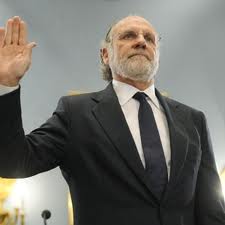
Let us now summon another emblematic character into the scene; Jon Corzine, former governor of New Jersey, former US senator; and a former alpha dog at Goldman Sachs. Yet in October 2011, Mr. Corzine found himself at the head of a relatively obscure sledge named MF Global Holdings. The “MF” was an alphabetic memory trace for a former corporate incarnation called Man Financial. Among the global holdings, Mr. Corzine had purchased large slag heaps of toxic derivatives linked to bonds issued by insolvent European governments, such as Greece.

A veteran if somewhat rusty bond trader himself, he Corzine retained sufficient brain cells following his many years in politics to comprehend that these derivative instruments would soon create a Mother Freaking whirlpool into which his Malignant Fantasy would disappear without a trace. His teams of young, eager traders, looking forward to their XXL Christmas bonuses, all saw the same patterns on their screens, and they knew what Miserable  Fate awaited them. But wait, thought Mr. Corzine – why not  simply pledge the money from our customer accounts, to cover our haunches from the invasive probes of margin clerks until the crisis is past, devil fetch the hindmost? If it all goes as pear shaped as Mr. Pike, no worries and no tears: these transactions are far too complex for mere lawyers to comprehend.


Follow

Get every new post delivered to your Inbox.