Monthly Archives: February 2012

The Tranquilizer

JUST CALL ME DAD

Benjamin Rush is often referred to as “the father of American psychiatry,” and indeed his portrait still adorns the seal of the American Psychiatric Association. In 1965, the APA placed a bronze plaque by his grave at Christ Church Cemetery in Philadelphia, affirming and consecrating his paternity.

Rush’s seminal opus, Medical Inquiries and Observations, Upon the Diseases of the Mind now reads like a primer for psychological torture. Suggested punishments for the misbehavior of mentally ill patients include tranquilization through the imposition of physical restraints; food modification or deprivation; cold water treatments; and prolonged shower baths.

“If all these modes of punishment should fail of their intended effects, it will be proper to resort to fear of death.”

Other fears also come in handy, as well as an acute sense of shame, though Rush asserts that because of some neurological process he fails to specify, the patient will have erased all memory of such fears, once returned to mental health. Also, we should note Rush’s deft distancing from the brutal exercise of the whip; clearly he prefers other more refined techniques.

FROM CHAPTER VI, TREATMENTS

In many cases, the line between punishments and treatments is quite flexible within the medical philosophy of Dr. Rush. Thus the tranquilizer performs a highly useful secondary role in facilitating the application of other treatments:

“The tranquilizer [chair] has several advantages over the strait waistcoat or madshirt. It opposes the impetus of the blood towards the brain, it lessens muscular action every where, it reduces the force and frequency of the pulse, it favours the application of cold water and ice to the head, and warm water to the feet, both of which I shall say are excellent remedies in this disease; it enables the physician to feel the pulse and to bleed without any trouble, or altering the erect position of the patient’s body; and lastly, it relieves him, by means of a close stool, half filled with water, over which he constantly sits, from the foetor and filth of his alvine evacuations.”

On the website of the Pennsylvania Hospital, the tranquilizer is described as “doing neither harm nor good.”  The statement is made without reference to any supporting documentation or testimonials from patients or doctors:

Though Rush mentions in his book that a fully functioning tranquilizer was used by the hospital at the time of publication (1812), I have been unable to confirm its present existence as a physical object; a copy of an engraving endorsed by Rush as accurate appears on the website for the U.S. National Library of Medicine:

A small scale model of the chair on display at the Mütter Medical Museum, also in Philadelphia, shows a rather different device (purple gloves belong to Mütter curator Anna Dhody):

DISPLAY MODIFICATION

Of particular note is the absence of the “close stool”; and the innovation, apparently devised by the model maker, of the blinders. With this modification in place, the patient can neither move his head nor bear visual witness to anything happening within his environs.

It is possible that the design change was introduced by the model maker simply to make the head structure more durable, yet whatever the explanation, the modification is remarkably prescient in anticipating a key attribute of contemporary psychological torture as developed by the CIA since the 1950s: the merging of corporeal restraint with sensory deprivation and/or perceptual disorientation.

NO TOUCH TORTURE

Interestingly, the two most recent recipients of the APA’s Benjamin Rush award, together with the titles of their lectures, are:

2008 Mark S. Micale, Ph.D., Associate Professor, History of Science and Medicine at the University of Illinois, Urbana-Champaign.Psychological Trauma and the Lessons of History.
2011 Andrea Tone, Ph.D., Professor and Canada Research Chair in the Social History of Medicine, McGill University. Spies and Lies: Cold War Psychiatry and the CIA.

Woundscapes

A remarkable selection of Morgan Bulkeley’s paintings is presently on view at The Berkshire Museum in Pittsfield, MA. At the show’s opening earlier in February, Bulkeley referred to Henri Rousseau’s painting “La Guerre” in relation to two of his own woundscapes, “Love and Death” and “War Wounds”. We later engaged in the following email dialogue:

HENRI ROUSSEAU, LA GUERRE

DP   Can you describe your response to Henri Rousseau’s “La Guerre”, on first viewing?

MB   Insane horse and rider– eyeless horse extended over ground composed of corpses – the rider not really seated on the horse – almost floating in front of the steed defying gravity and sanity – putrid blood pink clouds. The whole image eerily without hope or humanity, a world dedicated to death. Who is this tattered imbecile leering with her sword and smoking stick reveling in the apocalypse? Horror.

DP   Yes, and the wounded, scorched landscape. What do you make of the tree in the foreground, the snapped limb and the gashed bark? It almost seems as if the berserker, having run out of bodies to cut down, is now on the rampage against the trees. And the use of color, for the bodies, the “greening” of the dead, the blurring of the line between landscape and woundscape. The corpses seem to be sinking into the ground; or maybe the earth is sucking them in?

MB   It seems all life is being snuffed out; the leaves – what few there are – look wilted, and the crows are feasting on death. In the background, there are trunks and stumps. Cut or maybe just giving up, the limb seems to be overcome by the assault. Why should the crows be alive; death is their food. I was always fascinated by the horse’s tongue and the silver slivers of horseshoes, maybe the only remnants of technology along with the sword, and that weird splintered dress.

MORGAN BULKELEY, WAR WOUNDS

DP   Was Rousseau’s “War” on your mind when you began working on your own painting, “War Wounds”?

MB   “War Wounds” was a partner piece to “Love and Death”, the first painting of the second line on my website. Both were a response to the horror stories coming from Iraq and Afghanistan.  When I started these paintings I was thinking of Rousseau’s horror story, but also of the small paintings (the size of playing cards) that nuns did in the 16th century to meditate on the pain and suffering of Christ and the Saints, to try to enter the state of mind and share the terror and passion with them.

DP   The birds in the painting are not carrion eaters. They seem to inhabit an entirely different dimension, maybe even a different time. Yet at the same time, they are a haunting presence.

MB   The birds in my pieces are an assortment of passers-by or watchers (the wood stork and godwit) ; I think Nature is more of a constant, a mix of beauty and death, that is just the matrix of human actions, not a cause or contributor to the story.

DP   Unlike the passive blue sky background in Rousseau, your sky is highly charged with all sorts of objects and figures. For example, what are those wormlike tangles?

MB   I found the sky in my paintings felt flat and empty next to the turmoil in the land. Suddenly, I realized that the clouds could be anything, knots, abstracted hats, barbells, even people writhing in the sky. They gradually became more complex. The flecks and daubs of paint added a physical energy (almost like molecules, atoms, strings) and I was amazed to find that they seemed to add up to “Sky”.

DP   In contrast to how the bodies seem to bleed directly into the earth with Rousseau, the way the wounded and destroyed bodies are placed in your landscape, it almost has the sense of a sculpture garden, almost as if they have been found, possibly washed up on the beach, and then carefully arranged, put on display. And also, while they are broken and contorted, they are not yet dead.

MB   Yes, most of my figures are still alive. I’ve always wanted to walk a tightrope between hope and despair, or horror and beauty as it seems that is our lot in life.  In “Love and Death” two adversaries have just cut each others heads off– one head staring at it’s former neck, the other staring at the head it has just severed. Much of this came out of the news at the time of beheadings, and I suppose it’s a theater of the absurd choked chuckle. My Mom used to trudge up to my studio, and after staring for a while, she would say ” It’s beautiful…. Do you feel alright?”

DP   I am very struck by the hands rising from the wounds, indicating some obscure semiotic. I have always loved the Brothers Grimm tale about the young girl who is very stubborn and willful, so much so that when she is dead and buried, her arm keeps pushing through the dirt, as if to say “I am still here”, and of course this is one quality that is both admirable and dangerous about humans. What are those willful hands telling us, signing from the dunes?

MB   I think “I am still here” is a fairly accurate translation of the wounds and severings. One person lovingly cradles his/her hands with bloody stumps. Hands appear over the hill in a V-victory sign, or pointing like a kid’s play gun, or with a raised index figure “I’m no. 1”, absurd gestures in an absurd world.

MORGAN BULKELEY, LOVE AND DEATH

DP   You have spoken about your desire to find a way of figuring the human body that is drained of specificity, abstracted, yet also quite identifiably human. Can you tell a bit more about how you arrived at your aesthetic of figurative abstraction?

MB   As I mentioned, I used to paint portraits and anatomically accurate (or somewhat more accurate) figures, but I found that people would look to see who the person was and what their emotions were. I wanted to tell less specific stories, ones of ideas not personalities. It took some fumbling and messes to arrive at these fleshy, generic approximations of people, but they seemed to represent life, and I could bend them in any way I wanted.

DP   Finally, I am struck by the paint tubes in the foreground, part of the flotsam and jetsam of the battle, or whatever it was. I immediately thought: yes, art is part of this woundscape, too. Where is the artist in our larger landscape of everyday atrocities, the endless tales of cruelty and violence?

MB   The paint tubes, I feel, are an optimistic statement of creation; this landscape can be changed by a little paint, in fact the whole vision is only paint, but it can tell any story. The landscape is a matrix: we exist in it, but it also exists without us. It may go back to an empty Eden without us. I believe in “humanity” and I hope for a rational wrestling with our “problems”. I think of my paintings as prods and lures, meaning to push toward an alternative way of thinking.  I think we are still in Eden with a last chance; think that we can find beauty and meaning in Nature; think that there are alternative ways of doing things.

DP   Yes, and there is also the sense not of complicity but of entanglement. The same human hands that create paintings might also create corpses. You refer to nature as the matrix of human actions. Could you mention your father‘s influence in all of this, his keen naturalist eye for detail, and how you pay homage to that tradition?

MB   My Dad understood that Nature is a foundation, that it is a spiritual ground, a way to meditate and escape instant gratification and the speed that our culture foists on us. Of course in his day all the crushing realities hadn’t completely formed yet.


Wrestling with Modernity

AESTHETICS OF MODERNITY

History is not like chess; it is more like wrestling. History takes place as flesh moves inside space; it is thus, among other things, about the biology of flesh – as well as about the topology of space. If history is about flesh-and-blood individuals interacting in material space, it also follows that history is not confined to humanity alone.

We tend to concentrate on humans because we consider humans as actors in history – they have desires, they move about, and thus they shape reality. But all living beings have desires and move about, and so they shape reality as well; and in another way, the same is true even of material reality itself. And because all these actors occupy the same stage, they cannot fail to interact; no species is an island.

Thus history is embodied – and not only inside human bodies but in the bodies of all species. One of the main features of history is the prevention of motion. Biologically, animals just move around: history arrives when they are confined to a place. In a formula, this is history: humans change the terrain to prevent the motion of animals as well as other humans.

HISTORY ARRIVES

To have our motion prevented is unpleasant, at the basic biological level. We want to move around, and to be denied that is itself painful. Even more directly, prevention of motion is usually painful for a simple reason: usually the way to prevent us from doing what we wish is to cause us pain.

There is thus a direct relationship between the prevention of motion and violence. Modernity made possible a total asymmetry between the powerful and the powerless. With this asymmetry of power, everything about an organism’s life could be controlled, and as a result, a new kind of living being was created.

Both cows and humans suffered the same modern equation of iron over flesh, and so both were transformed into what may be considered an altogether new species: the victim of extreme control. This victim – animal or human – is the hero of the twentieth century.

EARLY AMERICAN HERO

{Excerpts from Netz Epilogue as compressed by DP}


Concubines and Predators

In 1996, the Institute for National Strategic Studies at the National Defense University published its now famous manifesto, Shock & Awe: Achieving Rapid Dominance. Though the catch-phrases are well known, the complete text rewards a careful reading. The heart of the doctrine beats most vividly in the second chapter, where the authors spell out the fundamental objective:

SHOCKED & AWED

The objective, then, is to create a comatose and glazed “expression” on the face of the enemy, an expression that provides the most essential indicator that the enemy’s will to resist has collapsed. The objective is achieved through strategies and tactics that incarnate the “core characteristics” of Rapid Dominance: knowledge, rapidity, brilliance and control. To flesh out the distinct strategic modalities through which this will-wound might be delivered, the authors then proceed to explore a range of historical examples such as Hiroshima and Nagasaki; the German Blitzkrieg; invincible Roman Legions; Decay and Default; and – most interestingly for our purposes – the Sun Tzu example:
While the concubines were certainly part of the King’s regime of power, performing highly valued services in the service of their lord and master, they were not part of the war machine. The association of concubines was a domestic resource, a civilian population retaining a level of cultural and behavioral autonomy outside the military chain of command. When told to march, the concubines merely laughed.

For Sun Tzu to defend his reputation as master strategist in the Art of War, he needed to break their autonomous will of the concubines and obliterate their laughter. To do so, he selected the most important “heads”- the ones who were thinking most intensely for themselves and their community – and then cut them off, delivering enough of a shock to the collective nervous system such that core impulses and identities might be reshaped, thereupon producing a new social body living by new codes. No longer paced by the rubato rhythms of concubinage, the ladies would subsequently conform to the tight martial locksteps of a drill team.

Ultimately, it is not the individual concubines who are the target of the strategy; what must be destroyed is their zone of autonomy, their collective identity, and their willful codes of conduct. To break autonomy and collapse the collective will without enraging a civilian populace, leading to troublesome resistance, the Sun Tzu strategy requires an unusually high degree of “psychological precision”; War College professor Steven Metz elaborates on the role of psychological analysis in the production of fear and anxiety in his 2001 article on strategic asymmetry:


Though Predator drones are intended to deliver the sort of psychological impact required by the Sun Tzu strategy, a remote-controlled drone does not have quite the same knowledge, rapidity, brilliance and control as a sword delivered by proximate animal energy via slashes from a single warrior. Further, when Sun Tzu orders the fatal blow, he has the implicit consent of Ho Lu, King of Wu, who has challenged him to demonstrate his philosophical mettle. Ho Lu may lose a valued domestic comfort, but he will gain fresh strategic insight into the Art of War.

What happens when such local consent is not present, neither implicitly nor explicitly, above all when slaughter is indiscriminate? In 2011, a Strategic Studies Institute Report co-authored by the same Steven Metz identifies this issue as a significant impediment to any widespread application of Sun Tzu decapitation:

THE DECAPITATOR

Let us now turn our attention to the lengthy series of Predator drone attacks in Waziristan. As defined within the doctrine of Shock & Awe, what is the strategic objective of these attacks? The announced public enemy convenes the usual demons: Taliban and Al Qaeda militants. Within the terms of the Sun Tzu example, however, we might imagine that the deeper objective resides in the destruction of the willful autonomy of the region, an autonomy which analysts believe to be supportive of an irritating culture of resistance to the policies of the United States.

Possibly, the nonchalant reaction to ongoing civilian deaths in the delivery of lethal drone attacks belies the fact that such deaths are fully anticipated within the strategic plan to collapse the stubborn will of regional tribes, who allegedly provide the social context for individual “terrorists”. Otherwise, where are the congressional enquiries into Predator atrocities. Where are the international outcries, the calls for an independent War Crimes tribunal? Or is it that Wazir tribal populations do not even rank as human beings; they are merely things that move, as in the sentence “kill everything that moves”, a sentence with a long history inside The Shining City.

Too much precision would lead to a deficit of fear and anxiety, and the psychology of the strategy requires that fear and anxiety reach a sufficient level to collapse the will and create the climactic desiderata of Shock & Awe, the glazed and comatose face of absolute subjection. Then the world would watch in wonder as the assembled tribes of Waziristan staged drill team competitions, with each team outdoing the next in replicating the twisted rhythms of American imperial fantasies.

ALL PART OF THR PLAN?

A few weeks ago, when questioned about the murder of innocent women, children and other civilians as a consequence of Predator drone attacks, President Obama said: We are very careful in terms of how it’s been applied. It is important for everybody to understand that this thing is kept on a very tight leash. What is the meaning of “thing” in this strange and heartless sentence? Perhaps the President’s sentence unleashes more than he intended, in disclosing the deeper psychological and strategic objectives in Waziristan, as in:

THING ON A TIGHT LEASH

Meanwhile, the Pakistan government becomes increasingly impatient with drone incursions into their sovereign airspace, and with the resulting murder of their citizens. In response to American officials’ perverse insistence that these attacks have produced no civilian casualties whatsoever (maybe because the Wazirs do not count as civilians, but as “things”?) Pakistan’s High Commissioner to Britain Wajid Shamsul Hasan said:

We know the damage — destroyed schools, communities, hospitals. They are civilians — children, women, families. Our losses are enormous. Generally people think that deaths caused by drone attacks should be treated as war crimes. There is so much animosity that perhaps the Americans are the most hated people in the minds of the people in Pakistan. 

When this hatred finds full expression, the psychologists of airborne decapitation will be left scratching their heads.


No Conscience


Elementary Formula

INDIVIDUAL FANATICISM

CHEMISTRY OF THE WOLF PACK

RADICAL DEHUMANIZATION OF THE OTHER

END POINT


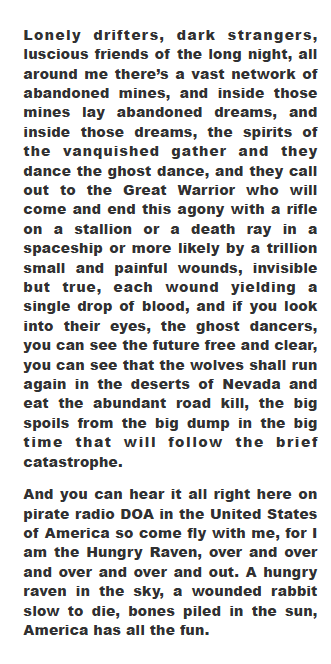
The Hungry Raven

FLIGHT PLAN FOR A PIRATE

AMERICA HAS ALL THE FUN


New and Better Ways

NICK CHRISTIE

On March 27, while in a mental state of deepening confusion and distress, Christie was arrested for misdemeanor trespassing at the hotel where he had formerly lodged as a guest. Law enforcement officers then subjected the frightened and disoriented man, urgently in need of medical treatment and care, to a series of extreme “corrective” measures: repeatedly pepper spraying his face and body for a total of ten times; stripping him completely naked; strapping him to a restraining chair; and finally choking him with a “spit collar”. Christie’s pleas for medical attention were ignored; then he was rendered speechless by the spit collar.

Homeland Torture

On March 29, Mr. Christie suffered acute respiratory distress and was taken to the hospital, where he suffered numerous heart attacks and was declared dead on March 31. The deputy medical examiner ruled the death a homicide as a direct result of sustained exposure to pepper spray, residue from which still coated his entire body at the time of his autopsy. Yet Assistant State Attorney Dean R. Plattner declined to file charges, claiming lack of sufficient evidence, despite numerous eyewitnesses; Plattner has since died of an apparent heart attack.

What we’ve been hearing about

The Lee County Jail contracted with Prison Health Services (PHS) for evaluative screenings, and for training officers in standards of appropriate response and in the use of “mental health technology” such as the restraining chair. PHS now appears to have mutated into Corizon, a corporation that still lists the Lee County Jail as a customer for their specialized “jail module”. The Corizon corporate motto: As pioneers in correctional healthcare, we continue to discover new and better ways to serve our partners.

We understand your unique needs

Deeply concerned about the fate of her husband, Joyce Christie traveled to Fort Myers on March 29 and immediately proceeded to the police station, where officers refused even to confirm whether he was in custody. While she was trying to convince the police of the seriousness of her husband’s medical conditions, he was elsewhere in the building being tortured by deputies. Later, she received an anonymous phone call that he had been taken to the hospital. Officers refused to permit her to see him until she posted bond; by the time she did so, Nick Christie was close to death.

Attorneys for Mrs. Christie have filed a civil lawsuit in federal court for medical malpractice, wrongful death, civil rights violations, negligence, pain and suffering. She says: Nick had a life. He was somebody, my husband, a father to my son. He’s somebody I miss very much. It shouldn’t have happened. He should be here. Three weeks later, I get his ashes back from Florida in a mail truck. 

Export Model


The Game of Death

OBEDIENCE BOX

A colleague in the realm of Desperado Philosophy has brought to our attention a French television documentary made in 2010 titled Le Jeu de la Mort by Christophe Nick, who has since become a prominent critic of reality TV and its many brands of casual cruelty.

As a basic dramatic structure, Nick adapted Stanley Milgram’s well known obedience experiments in which “teachers” would deliver shocks to “learners”, while prompted and at times badgered by a scientist-in-situ. Interestingly, Nick claims his original inspiration for the experiment came not from his reading of Milgram but from a French version of The Weakest Link, wherein contestants are relentlessly bullied and belittled by the host, while also scratching and clawing at fellow contestants to avoid being culled from the feeble brain trust.

With the simple idea télé, c’est le pouvoir as his rather banal point de départ, Nick then sets out to discover whether that power is sufficient to cajole or compel ordinary citizens to become willing or at least obedient torturers, in public and on national television, and without any monetary incentive. With blinking lights, sexy helpers, a perky/pushy host, roaming cameras, and an audience shouting encouragement, the scenario has an air of inevitability about it, and indeed Nick solicits the proof that he set out to find: 64 out of 80 contestants deliver the full Monty throttle of 460 volts, at which point the victim – quite convincingly performed by an actor – no longer screams but slumps in the chair, ominously silent.

Voiceovers and expert commentary leave little to the imagination, as the basic structure of scripted subservience plays itself out over and over accompanied by a music pastiche that gropes for all the expected emotive buttons.

In post-mortem remarks, Nick said: They are not equipped to disobey. They don’t want to do it, they try to convince the authority figure that they should stop, but they don’t manage to. Indeed there was one contestant whose Jewish grandparents had been tortured by the Nazis. She had wondered all her life how the Nazis could perform such atrocities, yet now she has inflicted the same sort of pain upon a perfect stranger: I was worried about the contestant, but at the same time, I was afraid to spoil the program.

CENTRAL NERVOUS SYSTEM

In the process of informing contestants that they had been lured into his scenario via the false premiss of a game show audition, and securing their permission for the film, Nick assured one and all that they had performed “normally”, and – sounding just like Philip Zimbardo – that the context of the situation was responsible for their actions; within his simulacrum of torture, they were not guilty, two thumbs up. Nick reports that most of them are thrilled to have participated in an experiment that could be useful for something, and some of them are ready to do it all over again. 

As we contemplate this dreary episode, in which both the subject and the object of critique become unified in the expression of some far deeper truth that is, however, never allowed to push through the totalizing aesthetic of the film itself, we recall the words of Gitta Sereny, who spent seventy hours with Franz Stangl, Kommandant of Sobibor and Treblinka; Gitta Sereny, who wrote in her beautiful and moving epilogue: This [essential core], however, cannot come into being or exist in a vacuum. It is deeply vulnerable and profoundly dependent on a climate of life; on freedom in the deepest sense; not license, but freedom to grow: within family, within community, within nations, and within human society as a whole.

THE ESSENTIAL CORE


Agents in the Dark Wood

The year 1974 saw the appearance of two remarkably different explorations of the tense interplay between conscience and obedience, with the horrific experience of Nazi Germany offering historical background for both books: Stanley Milgram’s Obedience To Authority and Gitta Sereny’s Into That Darkness. However entangled their subjects may be, the subtitles reveal strikingly different ambitions, for while Milgram proposes “an experimental view”, Sereny sets forth on “an examination of conscience”. Inside the dark wood of morally compromised obedience, these two paths will lead us into very different places.

In his first chapter, Milgram makes clear the underlying motivation for his lengthy series of obedience experiments, which began shortly after the trial of Adolf Eichmann in 1961:

It has been reliably established that from 1933 to 1945 millions of innocent people were systematically slaughtered on command. Gas chambers were built, death camps were guarded, daily quotas of corpses were produced with the same efficiency as the manufacture of appliances. These inhumane policies may have originated in the mind of a single person, but they could only have been carried out on a massive scale if a very large number of people obeyed orders.

Consistent with the parameters of the experiments, a summary exposition of which occupies his first nine chapters, Milgram introduces the problem of individual conscience within the context of systems theory:

The presence of conscience in men can be seen as a special case of the more general principle that any self-regulating automaton must have an inhibitor to check its actions against its own kind, for without such inhibition, several automata cannot occupy a common territory.

He next discusses the problems posed by such an inhibitor when placed within the hierarchy of complex systems, whereby efficient and preferably immediate compliance best achieves the objectives of the system:

Therefore, when the individual is working on his own, conscience is brought into play. But when he functions in an organizational mode, directions that come from the higher-level component are not assessed against the internal standards of moral judgement. Only impulses generated within the individual, in the autonomous mode, are so checked and regulated.

Because being part of the system assures survival and delivers numerous other secondary benefits to the individual, potentially disruptive autonomy is “checked”, identity becomes “agentic”, and the individual will thereby execute the commands of superiors within the hierarchy, free from the cumbersome inhibitions of conscience:

From a subjective standpoint, a person is in a state of agency when he defines himself in a special situation in a manner that renders him open to regulation by a person of higher status. In this condition, the individual no longer views himself as responsible for his own actions but defines himself as an instrument for carrying out the wishes of others. 

When morally or ethically disturbing consequences of actions come into conflict with the imperatives of the agentic self, undermining the strength of “binding factors”, strains then emerge within the system. Such strains are resolved first through expression of dissent and then, if left unresolved, by outright rejection of the hierarchy through explicit acts of disobedience.

O IS FOR OBEDIENCE

Now let us enter Gitta Sereny’s Into That Darkness, her prolonged examination of the conscience of one such agentic self: Franz Stangl, Kommandant of Sobibor and Treblinka, with prior experience in the Tiergarten Euthanasia Program. Sereny spent seventy hours talking with Stangl in a style that might best be described as empathic interrogation, her subtle intelligence slowly penetrating elaborately entrenched defenses, present since childhood yet perfected in the camps. She then spent eighteen months examining documents and cross-checking Stangl’s account of himself with Treblinka survivors and other witnesses, including his wife, Theresa, who had consistently urged dissent and disobedience, with little effect on agent Stangl. Over the course of the examination, Sereny leaves no doubt about what happens to a buried conscience: it rots.

AGENTIC STRAINS

Assigned to the point of maximum strain within the tight binders of the Nazi hierarchy, Stangl managed the messy business of genocidal extermination, applying his considerable administrative and creative talents to the task, details of which are exhaustively recorded by Sereny. Like so many before him, Stangl later tried to defend himself by claiming, in Milgram’s terms, that his autonomous self was absent from the scene, and that he was present only as an agentic functionary, performing his assigned duty within the hierarchy with the same professional diligence he would bring to any assignment:

FS     It was a matter of survival – always of survival. What I had to do, while I continued my efforts to get out, was to limit my own actions to what I – in my own conscience – could answer for. At police training school they taught us (…) that the definition of a crime must meet four requirements: there has to be a subject, an object, an action and an intent. If any of these four elements are missing, then we are not dealing with a punishable offense.

GS      I can’t see how you could possibly apply this concept to the situation?

FS      That’s what I am trying to explain to you; the only way I could live was by compartmentalizing my thinking. By doing this I could apply it to my own situation; if the ‘subject’ was the government, the ‘object’ the Jews, and the ‘action’ the gassings, then I could tell myself that for me the fourth element, ‘intent’ [he called it ‘free will’] was missing.

Yet Sereny does not let the schematic flow chart of such well worn defenses stand uncontested. Like a forensic anthropologist delicately yet firmly exposing the contours of a disappeared corpse, she enters into the death pit of Stangl’s conscience to assemble, fragment by fragment, the awful evidence of his guilt. There is so much to be said about this remarkable book, and the rare interlocutory skill of its author; I am sure to return to her often in months to come. For now, though, consider Stangl’s final – halting – confession, the extraordinary “farewell” exchange with Sereny whereby his “agentic self” finally gives up the ghost; for the first and only time, the former Kommandant Stangl comes face to face with the gaping oblivion of his own existential responsibility. In the interest of placing maximum focus on the power of Sereny’s interrogation, I have removed all narrative linkages, leaving only the bare transcript of their dialogue:

GS      In retrospect, do you think there was any conceivable sense to this horror?

FS      Yes, I am sure there was. Perhaps the Jews were meant to have this enormous jolt to pull them together, to create a people, to identify themselves with each other.

GS      Do you think that that time in Poland taught you anything?

FS      Yes. That everything human has its origin in human weakness.

GS      You said before that you thought perhaps the Jews were “meant” to have this “enormous jolt”; when you say “meant to” – are you speaking of God?

FS      Yes.

GS      What is God?

FS      God is everything higher I cannot understand but only believe.

GS      Was God in Treblinka?

FS      Yes, otherwise how could it have happened?

GS      But isn’t God good?

FS      No. I wouldn’t say that. He is good and bad. But then, laws are made by men; and faith in God too depends on men – so that doesn’t prove much of anything, does it? The only thing is, there are things which are inexplicable by science, so there must be something beyond man. Tell me though, if a man has a goal he calls God, what can he do to achieve it? Do you know?

GS      Don’t you think it differs for each man? In your case, could it be to seek truth?

FS      Truth?

GS      Well, to face up to yourself? Perhaps as a start, just about what you have been trying to do in these past weeks?

FS      My conscience is clear about what I did, myself. But I was there. So yes, in reality I share the guilt … Because my guilt … my guilt … only now in these talks …  now that I have talked about it all for the first time …  My guilt is that I am still here. That is my guilt. 

GS      Still here?

FS      I should have died. That was my guilt. 

GS     Do you mean you should have died, or you should have had the courage to die?

FS      You can put it like that.

SERENY WITH HER SCALPEL

GS      Well, you say that now, but then?

FS      That is true. I did have another twenty years – twenty good years. But believe me, now I would have preferred to die rather than this. And anyway – it is enough now. I want to carry through these talks we are having and then – let it be finished. Let there be an end. 

Nineteen hours after confronting the truth for the first time, Franz Stangl was dead of a heart attack. In her epilogue, Gitta Sereny, clearly shaken by her journey into the grave corruption of Stangl’s subjectivity, offers a few tentative conclusions of the sort that do not lend themselves to neat formulae or flow charts, conclusions that remain as timely today as the day she wrote them:

I do not believe that all men are equal, for what we are above all other things, is individual and different. But individuality and difference are not only due to the talents we happen to be born with. They depend as much on the extent to which we are allowed to expand in freedom. 

There is an as yet ill-defined, little-understood essential core to our being which, given this freedom, comes into its own, almost like birth, and which separates or even liberates us from intrinsic influences, and thereafter determines our moral conduct and growth. A moral monster, I believe, is not born, but is produced by interference with this growth. (…)

This essence, however, cannot come into being or exist in a vacuum. It is deeply vulnerable and profoundly dependent on a climate of life; on freedom in the deepest sense; not license, but freedom to grow: within family, within community, within nations, and within human society as a whole.