Now comes Nicholas Carr, with a few salient paragraphs from his New Cartographies substack, always worth close consideration:
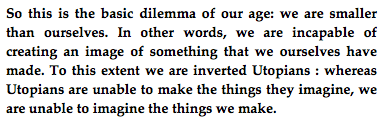
We find ourselves today, Anders wrote in The Obsolescence of the Human, surrounded by products that don’t appear to us as having been produced by us. We have handed off so much of their design and production to industrial technologies that we can no longer take a shared pride in their invention and manufacture. Indeed, they have come to project an otherness that seems not just separate from us but superior to us. They mock us as outdated masses of meat and bone. Today’s products, Anders observed,
are simply “there.” We encounter them primarily as necessary, desirable, superfluous, affordable, or unaffordable consumer goods that become “mine” only after I have bought them. As such, they are much more likely to be proof of one’s own insufficiency than evidence of one’s power.
This sense of insufficiency transformed “Promethean pride” into “Promethean shame”—the shame contemporary man feels at having been born instead of made, of being a product of natural processes rather than technological ones. “He despises himself,” wrote Anders, “in the same way that things would despise him if they could.” The shame, he went on, becomes particularly sharp when a person first sees a so-called thinking machine:
As for the man who is for the first time confronted with a working computing machine, self-aggrandizement and pride are even more alien to him. An observer who erupts with the exclamation, “My goodness, aren’t we great guys, to be capable of this!” when encountering such a machine is a clown, a figment of the imagination. Quite the contrary! He rather murmurs with a shake of his head, “My god, it’s incredible what it—the machine—can do!” At the same time, he feels highly ill at ease in his creaturely skin, for the machine half gives him the creeps and half puts him to shame.
Though it was written seventy-five years ago, that last sentence strikes me as one of the more perceptive descriptions of man’s confrontation with generative AI: “he feels highly ill at ease in his creaturely skin, for the machine half gives him the creeps and half puts him to shame.”
______________________
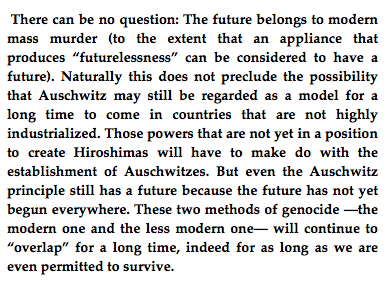
So where does Promethean Shame end? As Anders writes elsewhere: in a world without us!

˜˜˜˜˜