
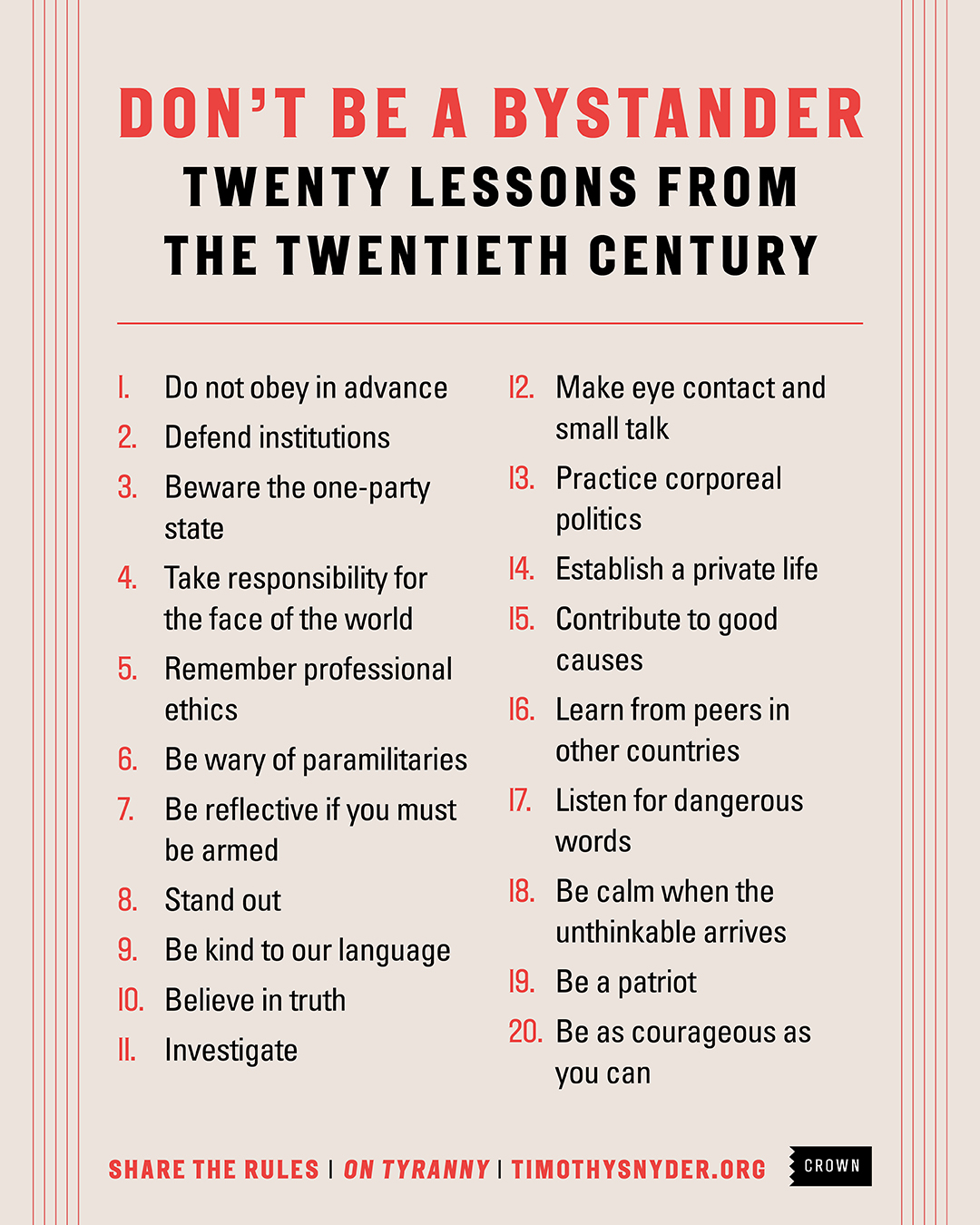
Available as a free download from Timothy Snyder’s website:
˜˜˜˜˜˜
Today, as a small group of extremist fanatics continues to attack the legal foundations of our Constitutional Republic, we serve to relay an excerpt from a recent post by the ever-vigilant Timothy Snyder.


˜˜˜˜˜
Now comes John K. Glenn, senior director at the International Forum for Democratic Studies at the National Endowment for Democracy, relayed from a recent substack post by Timothy Snyder, with all links active:
We need to renew the story of why freedom and democracy matter: not in the abstract but here and now and why it matters for the world we hope to build for our children. We cannot hope the facts will become obvious and naturally prevail. As one former policymaker put it recently, “democracy has become the incumbent in an age of anti-incumbency.” We need to show that what could be lost is vital.
People living in democracies are more secure, prosperous, and safe than those in unfree settings – and declines in freedom lead to declines in prosperity and security, and create a more dangerous world.
The evidence is clear:
Democracies are more secure: A large body of research supports the democratic peace axiom that democracies do not fight wars against each other. They are also less prone to civil war compared to autocracies because they are better at absorbing and channeling discontent through legal and institutional means.
Democracies are more prosperous: The link between freedom and well-being is well documented. Countries with greater freedom in 1995 tended to be more prosperous decades later. The reverse holds as well. Venezuela’s decline in freedom since 1999 under Hugo Chávez and Nicolás Maduro has resulted in one of the steepest economic collapses in the world, rivaled only by Syria, Belarus, and Russia.
Democracies are safer: As Amartya Sen observed, there are “no famines in democracies,” because free societies are better equipped to make course corrections that dictatorships cannot. The Freedom and Prosperity Indexshows that democracies consistently outperform autocracies on all human development metrics, including health and education. Notably, this holds among low-income countries as well: democracies rank seventeen places higher than autocracies on the Human Development Index, with 25% lower infant mortality rates and children attending two additional years of school on average.
[…]
We must renew the positive story of democracy and its advantages, and we can do so humbly and with respect for cultural differences. We must elevate and support the vital voices of people around the world fighting for their freedoms and their rights. We must challenge authoritarian narratives and create new opportunities to work together in common cause.
We must make the case that when people around the world live in freedom, they can build more secure, more prosperous, and safer societies for themselves — making the world more secure, more prosperous, and safer for all of us.
This week, we urge consideration of a timely and insightful commentary by historian Timothy Snyder, whose outstanding On Tyranny we featured in a previous post. Two salient excerpts below, with an image from Otto Dix.
˜˜˜˜˜
The Nazis claimed a monopoly on victimhood. Mein Kampf includes a lengthy pout about how Jews and other non-Germans made Hitler’s life as a young man in the Habsburg monarchy difficult. After stormtroopers attacked others in Germany in the early 1930s, they made a great fuss if one of their own was injured. The Horst Wessel Song, recalling a single Nazi who was killed, was on the lips of Germans who killed millions of people. The second world war was for the Nazis’ self-defense against “global Jewry”.
The idea that the powerful must be coddled arose in a setting that recalls the United States of today. The Habsburg monarchy of Hitler’s youth was a multinational country with democratic institutions and a free press. Some Germans, members of the dominant nationality, felt threatened because others could vote and publish. Hitler was an extreme example of this kind of sentiment. Today, some white Americans are similarly threatened by the presence of others in institutions they think of as their own. Among the targets of the accused pipe bomber were four women, five black people and two Jews. Just as (some) Germans were the only serious national problem within the Habsburg monarchy, so today are (some) white Americans the only serious threat to their own republic.
[…]
Naturally, the president denies responsibility when people take him at his word and draw instead from the conspiracy thinking he himself spreads. Trump blames the press for attempts to murder members of the press. He seizes the occasion, as always, to present himself as the true victim. The facts hurt his feelings.
Trump and some of his supporters mount a strategy of deterrence by narcissism: if you note our debts to fascism, we will up the pitch of the whining. Thus Trump can base his rhetoric on the fascist idea of us and them, lead fascist chants at rallies, encourage his supporters to use violence, praise a politician who attacked a journalist, muse that Hillary Clinton should be assassinated, denigrate the intelligence of African Americans, associate migrants with criminality, run an antisemitic advertisement, spread the Nazi trope of Jews as “globalists”, and endorse the antisemitic idea that the Jewish financier George Soros is responsible for political opposition – but he and his followers will puff chests and swell sinuses if anyone points this out.

˜˜˜˜˜
Today we relay excerpts from an exceptionally good Democracy Now interview with Yale historian Timothy Snyder regarding both his important recent book On Tyranny and his related social media posts following the election of Donald Trump.
On resisting complacency:

On the long failure of profit-driven globalization, and its consequences:

On his first “lesson” for resistance:

The above resonates strong with Jeffrey Rosen’s prescient 2004 book, The Naked Crowd, discussed in our 2012 post Nothing to Hide.
On being kind to language:

See also Below the Dead Language, with Solmaz Sharif discussing the role of the poet as caretaker of the language.
On everyday connection and civility:
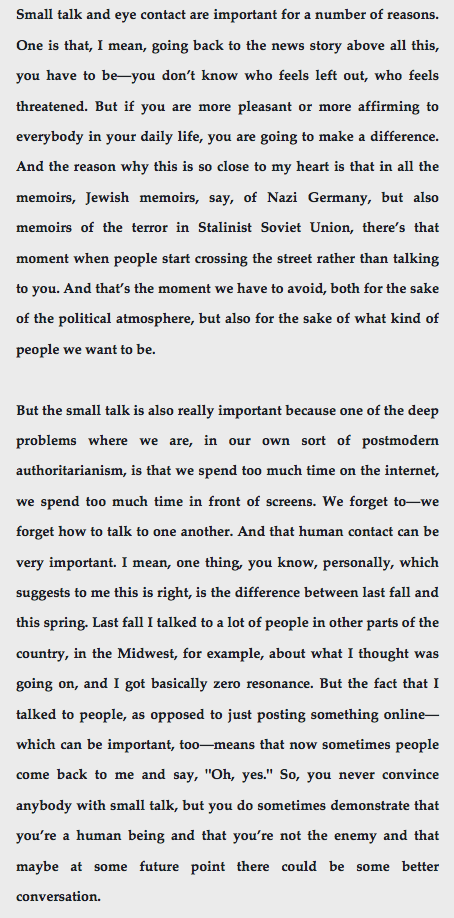
Our coarse and degraded social reality, of which Donald Trump is nothing but a malignant symptom, gains vital sustenance from rage, aggression, rudeness, abusive language, fear and paranoia. Thus simple acts of kindness, civil engagement and calm conversations become essential acts of deep resistance, refusing to let the prevailing ethos take hold of our own souls.



 Desperado Philosophy