Author Archives: DP

Pancakes and Worms

      The worm of conscience still begnaw thy soul.    Margaret, in Richard III

In a brief statement first published on Edge in March, 2005, dramatist Richard Foreman released an impassioned cri de coeur into the flow:

OLD STRUCTURE

The notion that hyperconnectivity creates a diminished subjectivity and reduces the depth of individual intellectual experience has been taken up by several others, most notably by Nicholas Carr in his book The Shallows, in which he persuasively outlines how web-based discourse and enquiry impacts our neurobiology: flattening cognition and emotions, thereby hollowing out our capacity for moral judgement and empathy. In what for me is the most significant passage in the book, Carr references the important work of Antonio Damasio, whose experiments suggest that such judgements and evaluations are inherently slow. As Carr writes:

In one recent experiment, Damasio and his colleagues had subjects listen to stories describing people experiencing physical or psychological pain. The subjects were then put into a magnetic resonance imaging machine and their brains were scanned as they were asked to remember the stories. The experiment revealed that while the human brain reacts very quickly to demonstrations of physical pain – when you see someone injured, the primitive pain centers in your brain activate almost instantaneously – the more sophisticated mental processes of empathizing with psychological suffering unfolds much more slowly. It takes time, the researchers discovered, for the brain “to transcend immediate involvement of the body” and begin to understand and to feel “the psychological and moral dimensions of a situation”. 

In Too Big To Know, David Weinberger argues that our traditional conceptions of authoritative knowledge, and of Foreman’s complex inner density, all derive from qualities and limitations intrinsic to the printed page and book, and that as we pass into “the expertise of clouds”, the nature and structure of knowledge production fundamentally changes. Thus we must rethink our understanding of intelligence within the context of networks, “where the smartest person in the room is the room.”

NEW STRUCTURE

We have no argument with Weinberger, as far as he goes. Indeed, his skillful discussion of how networks dissolve traditional power structures within academia and bureaucracies is accurate and illuminating. Yet strong as he is when discussing the impact of the web on scientific knowledge in particular, he evades the deeper dimensions of Carr’s critique, particularly regarding the “nobler instincts” of moral consciousness.

The worm of conscience needs a rich and dense soil to sustain its penetrations; the lifelong self-examination that is essential to our humanity. What sort of soil does webbed intelligence offer to the worm? Is the network Too Big To Gnaw?

Weinberger’s final chapter focuses on those qualities that make for good netizens, urging us to open access; provide hooks; link everything; include everyone; teach everyone. Laudable as such normative behaviors may be, what about those pesky ancient questions of virtue, justice and wisdom; the conduct of a good life, and the character of a civilization? Or perhaps the new structure of knowledge production is “too smart” for such old fashioned aspirations?

Towards the end of his book, Nicholas Carr writes:

What matters in the end is not our becoming but what we become. In the 1950s, Martin Heidegger observed that the looming “tide of technological revolution” could “so captivate, bewitch, dazzle, and beguile man that calculative thinking may someday come to be accepted and practiced as the only way of thinking.” Our ability to engage in “meditative thinking,” which he saw as the very essence of our humanity, might become a victim of headlong progress. The tumultuous advance of technology could, like the arrival of the locomotive at the Concord station, drown out the refined perceptions, thoughts, and emotions that arise only through contemplation and reflection. The “frenziedness of technology,” Heidegger wrote, threatens to “entrench itself everywhere”. 

It may be that we are now entering the final stage of that entrenchment. We are welcoming the frenziedness into our souls.

Returning briefly to Foreman and his theater: Over the years, we have had several occasions to witness the feverish lumberjacking taking place inside the darkened chambers of Foreman’s Ontological-Hysteric theater. Several of the devices used by Foreman to clear cut the dead wood of previous achievements from our assembled sensoria, including rapid and sudden changes in the intensity and volume of light and sound, all too closely resemble the sort of brutal wood chipping of existential platforms developed by the CIA (among others) within the Total Theater of “no touch” psychological torture.

On each occasion, we left Foreman’s theater of sensual and cognitive disorientation feeling exhausted, rather than illuminated; pacified, rather than provoked; flattened, rather than engaged. Come to think of it, we left his theater as less of a person, and more of a pancake. Could it be that the Ontological-Hysteric theater anticipated and represented for its audience Heidegger’s frenziedness of technology, the final stage of which Foreman now decries? The gods pound on our heads, and play with us all.

WAKE UP MR. SLEEPY

The Hopkins Feet

Somewhere in the misty recesses where the Berkshire foothills converge with a storyteller’s imagination, we find a highly exclusive social club born during the previous Gilded Age, and which now services the social climbing aspirations of an entirely new generation of robber barons.

The Club is also world renowned for its very special art collection, housed in a windowless room adjacent to the library: a collection of sculptures known colloquially as the Hopkins Feet. As special interlocutor for Desperado Philosophy, I recently spoke with the Club’s very own resident docent, Hilary Dillamore:

HILLARY DILLAMORE PREFERS RED

GW What exactly are the Hopkins Feet?

HD Well, they are seven alabaster feet, each missing its little toe, and they were created in 1915 by the famous local sculptress Frieda Hopkins to commemorate one of the Club’s most compelling traditions. To me they represent, in their beauty and in their perfection, even though they are missing pinky toes, something of a higher order, symbols of just such a different time and a different mindset, when women were willing to sacrifice what they sacrificed for their men, and that they gave up a part of their body to create the special moment that for all time – for all time they will exist for us to gaze upon.

GW What do you mean by “sacrifice”?

HD At that time, the women of the Club were eligible for a special honor, the honor of being selected for the Fest of the Winter Equinox, and whomever was selected would donate her left pinky toe to the ceremony.

GW So now can you tell me what you mean by “donate” and “ceremony”?

HD The evening began with a feast of local mushrooms – we have fantastic mushrooms here in the Berkshires – and champagne, plenty of the very finest French champagne, and then a surgeon, Dr. Franklin Pearce-Diddle, would perform the little operation, I mean it was little more than a quick hand gesture, and then the  honoree would be taken to the special bedroom upstairs to rest and recuperate, and then the men would sort of collectively and individually pay tribute to the toe, and this meant at that time, by — I mean I know it sounds impolite, but remember all of this was done with the most pronounced solemnity and respect – and so the fact is, well, each male member of the Club would have a little suck on the toe, and it would pass through the ranks like this, with the more established and senior members getting the early nibbles, and then the morsel would pass on down on to the initiates, les nouveaux, as they were called, so you see it was also a sort of celebration and acknowledgement of all those complex social relationships.

GW More than impolite, this sounds positively barbaric…

ROLE MODEL

HD No, I mean you have to understand and imagine what it was like, they would enter a sort of, I won’t say drunken, but let’s say medicated, there was a medicated trance that people seemed to go into, and it was a tremendous honor for the woman who was selected, and all the ladies would compete for this privilege, compete to make the sacrifice. The one sad bit, I mean once each man had their taste, they then fed whatever was left to that awful dog. There was a club Doberman called Siegfried, and they actually just threw the bones over the side of the porch railing to that beast, and it just breaks my heart because wouldn’t it have been wonderful to have them now? I mean I do have this anthropology side to me that wanted to line those little toe bones up right next to these alabaster feet, it would have been a real coup, from a curatorial perspective. On the other hand, Siggy would always do, you know, his “business”, he would always takes care of his business on the croquet court, and it would fertilize the grass, and there was something really nice about that, because sometimes ladies would play croquet in their bare feet on grass that was nourished by themselves.

GW I understand you have devoted a good deal of your life to the study and stewardship of the Hopkins Feet.

SIGGY IN HIS POMP

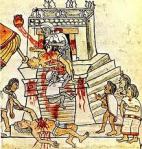
HD It’s something that has just been very personal and moving in my life, to gaze upon these icons really, and people come from all over the world, you have to understand how big this really is, that these feet are just so perfect, they are perfect in their incompleteness. And Frieda Hopkins captures the spirit of the times so perfectly in these seven wounded white feet. I mean each one is missing its little piggy, the one that went wee, wee, wee, all the way home but, they’ve meanwhile become symbols of a time when, I don’t know, they are radical in the truest sense I guess, I mean in so many societies the Mayan and Aztec, I mean that was all part of it, the sacrifice and then, you know, they were eaten. To consume it, to take it internally is all part of a religious experience, isn’t it? I mean it makes perfect sense to me, I can’t even, I mean I don’t even know why all this was outlawed, I guess because it got out of hand.

GW Out of hand?

HD That’s probably what happened. Somebody had to say, you know, this isn’t right, this isn’t what we do. There were a few newspaper editorials and so forth. What a shame, because it is so basic and original and instinctive, probably, is a good word, as instinctive as anything. I don’t mean just to eat flesh but you know, it’s part of one of those wonderful religious experiences that so many societies experienced and ritualized and celebrated – before we stopped it. I mean the simplest things like sitting down to dinner with our families is almost lost now, but back then there were so many traditions and so many rituals, and so many special things that society had, ways to connect with each other, so to come back and gaze upon something that does represent such sacrifice and meaning, and (…) I don’t know – courage.

GW You mentioned that people come from all over the world to see the Hopkins Feet…

HD They have to come in person, because you see we strictly prohibit any photography, you know, to protect the privacy, I mean as a gesture of respect. And so they come, and they sign a guestbook, just in the very first page I have…  people have come from France and Rome and  – Odio! Magnifico! says Betsy August 11 2004. Aahh… moved, I’m so moved by this, says this young man from Brooklyn, New York. What an extraordinary moment. Thank you for doing this. Yes, just little messages they leave… Diana from New Zealand writes, thank you for taking me, thank you for this journey to a different sensibility, to a different time. That was a visitor from July, 2011.

GW To a different time? Yet I have heard there are some members who have tried to revive the tradition.

HD Really? I don’t know, women today, the younger women I know, I’m not sure there is that same spirit of sacrifice. Even the men, I don’t know many who would have the stomach for it. And of course the Doberman, Siegfried, he’s long gone, and now everyone seems to have bichons or toy poodles, and I don’t know how that would work, it wouldn’t be the same, I mean Siggy did have his role to play, in the fête.

GW I notice you have donated a few other items to the collection, obtained in the course of your own journeys. For example, this cage?

WOUNDED BIRD

HD I’ve always loved it, with its sad little bird inside. I’ll just wind it up and let you hear it, if I may (winds up). Because part of the magic is seeing the little bird move its head and sing its little song. And it’s just, I don’t know, it’s just so charming. I guess this is just my own personal foible. And this simply represents to me an earlier time, a time when Frieda Hopkins and all of her feet were created and it just brings warmth and happiness to me because I just love the fact that the little bird can’t fly free, he’s in his little cage, and following the rules, and he sings when I tell him to sing.

GW And what about these little shoes?

HD My husband and I were in Peking, I mean, yes I know, Beijing, and we found these little tiny lotus shoes and I adore them because they are so elegant and perfect as objets and I just love the fact that for women at that point in time, it was fashionable to simply break your foot, remold it and really take control, you know, take control of your body, and come up with something better, which is I guess what I’m saying about all of these things. I mean something better comes from it, when you take control and you say  “let’s do it!”

CHINESE CHANGE AGENT


Dark Eros

BLOOD SPORT

It has been a recurring theme of Desperado Philosophy that explaining violent and sadistic cruelty with reference to normative structures of obedience (Milgram, Zimbardo and many others) fails to account for the fervor of the perpetrators, who incarnate the dark eros of the torturer’s Total Theater. Such theories also fail to adequately recognize or respect the lived experience of the victims, an experience of humiliating and soul-destroying subjugation, often resulting in long term psychological impairment and irreparable damage to the victim’s personality. Further, the situationist perspective sidesteps or marginalizes difficult and complex philosophical issues of ethics and conscience; indeed in some cases, the question of conscience appears to be entirely absent from the scene. Finally, such theories offer a convenient political cover for perpetrators of atrocity, because if evil resides in the normative structure of obedience, then nobody need be held personally accountable.

We recently came across a fascinating essay by philosopher Jerry S. Piven, “Terror, Sexual Arousal, and Torture: The Question of Obedience or Ecstasy Among Perpetrators”. The entire essay is worth careful reading, and is available online here; below, one passage in particular that caught my full attention:

piven1

Deeper into the essay, Piven focuses on the mechanism for the displacement of culpability:

piven2

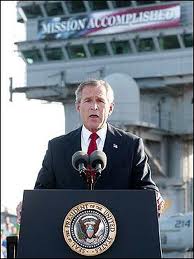
MISSION ACCOMPLISHED


The Perfectionist

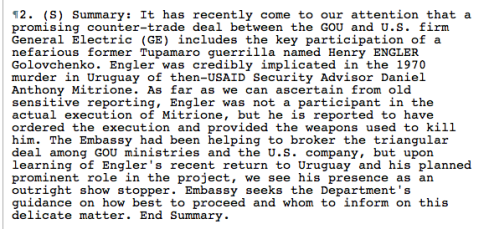
Among the documents released by Wikileaks in 2011, a cable from the American embassy in Montevideo describes a certain “delicate matter” involving a major US corporation:

Medical student Henry Engler was arrested in 1972 and spent the next thirteen years in a Uruguayan prison, including eleven years in solitary confinement. He then moved to Sweden, renewed his studies, and has since become a distinguished researcher and professor in the field of nuclear medicine, with a special interest in the early detection of Alzheimer’s disease.

About his involvement with the Tupamaros, Engler recently stated, “As medical students, we were not able to help patients. When we tried to get more resources, the police shot and killed students.” Asked specifically about Mitrione, he said “This information comes from [members of] the military dictatorship in Uruguay, who are in prison today condemned for the disappearing of 200 persons, kidnapping of children, raping and violation of human rights. Which information can you trust?”

Engler was never charged nor convicted of implication in the execution of Daniel Mitrione; evidence supporting the accusations was extracted through torture administered by Uruguayan police officers, often in collaboration with extremist death squads.

THE PERFECT MAN

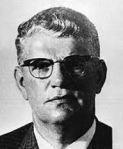
So who was Daniel Mitrione, and what was he doing in Uruguay? At the time of his death, White House spokesperson Ron Ziegler said that Mitrione’s “devoted service to the cause of peaceful progress in an orderly world will remain as an example for free men everywhere.” Frank Sinatra and Jerry Lewis performed a concert in benefit of the family, and his widow later told writer and former New York Times reporter A.J. Langguth that her husband was “the perfect man”.

A police officer from a small town in Indiana, Daniel Mitrione joined the FBI in 1959, and soon became a specialist in counter-insurgency while assigned to a branch of the Agency for International Development with the Orwellian designation Office of Public Safety. First in Brazil and later in Uruguay, Mitrione instructed policemen in advanced anti-subversion and torture techniques, while also directly supervising and participating in the extraction of information from high value prisoners and detainees.

Much of what we know about the specifics of Mitrione’s activities comes from a Cuban double agent named Manuel Hevia Cosculluela, who published a memoir in 1978 titled Passaporte 11333, Eight Years with the CIA. Hevia recounts how Mitrione established his interrogation academy in a soundproof cellar. The first course dealt in descriptions of anatomy and the central nervous system. Test subjects were then introduced into the classroom: homeless beggars from the streets of Montevideo, and a woman kidnapped from the Brazilian border. Mitrione demonstrated the effects of different voltages on different parts of the body, techniques he had practiced and refined during his previous assignment in Brazil. According to Hevia, the test subjects all died as a result of these demonstrations; instructional homicide executed by el maestro within the context of a lethal pedagogy.

Hevia also reconstructs in considerable detail an evening in the winter of 1970, a half year before Mitrione was kidnapped. The two met at Mitrione’s house, over drinks. Mitrione considered Hevia a skilled colleague to whom he could confide his fundamental philosophy and passion for perfection in the art of torture. Detailed quotes from this conversation are translated and published in A.J. Langguth’s well researched Hidden Terrors. We submit them for consideration below as a continuous monologue, without any of the intervening commentary from Hevia:

Interrogation is an art. The precise pain, in the precise place, in the precise amount to achieve the effect. Always leave them some hope, a distant light. 

When you get what you want, and I always get it, it might be good to keep the session going a little longer with more hitting and humiliation. Not to get information now but as a political instrument, to scare him away from any further rebel activity. 

When you receive a subject, the first thing to do is determine his physical state, his degree of resistance, through a medical examination. A premature death means a failure of the technician. 

Another important thing to know is exactly how far you can go, given the political situation and the personality of the prisoner. It is very important to know beforehand if we have the luxury of letting the subject die. 

Before all else, you must be efficient. You must cause only the damage that is strictly necessary, not a bit more. We must control our tempers, in any case. 

You have to act with the efficiency of a surgeon and with the perfection of an artist. This is a war to the death. Those people are my enemy. This is a hard job, and someone has to do it. It’s necessary. Since it’s my turn, I am going to do it to perfection. 

If I were a boxer, I would try to be the world champion. But I’m not. But though I’m not, in this profession, my profession, I’m the best.

To be sure, Daniel Mitrione did not introduce the practice of torturing political prisoners to Uruguay, which had been used by the police since the early 1960s, if not before. Yet according to the former Uruguayan Chief of Police Alejandro Otero, in a 1970 interview for a Brazilian newspaper, Mitrione and other US advisors are responsible for making torture more routine, more scientific (based in anatomy and neurology) and more psychologically refined.

“No touch” innovations for inclusion within the Uruguayan Total Theater included playing an audio recording of women and children screaming in an adjacent room, and then telling the prisoner that it was his own family being tortured, and that only he could stop their suffering. An article in the British journal The New Scientist also refers to a device called “the Mitrione vest” which slowly inflates, constricting the breathing of the subject. We have been unable to find any corroborating evidence for the invention or application of this device, which would seem to deliver the same effect as water boarding, but without the inconvenience and sloppiness of the water.

In contrast to Daniel Mitrione’s achievements in the art and science of torture, the distinguished CV for the “nefarious” Dr. Engler is available here.

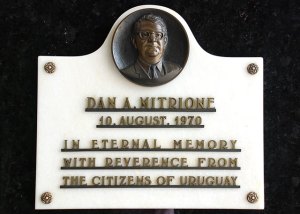
ETERNAL MEMORY FOR WHAT?


Proof Through the Night

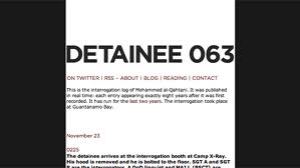
The record of a single day in the life of detainee 063 (Mohammed al-Qahtani), as recorded from the “Secret ORCON” interrogation log; the scene opens with the playing of the Star Spangled Banner. 

INTERROGATION LOG

10 December 2002

0000: Interrogation team entered the booth and played the national anthem. Detainee was made to stand and put his hand over his heart. Lead explained rules to detainee. Ran pride and ego down approach. Played loud music to keep detainee awake.

0230: Detainee taken to bathroom and walked. Corpsman checked vitals – O.K.

0300: Detainee offered food and water – eats crackers, peanut butter, and drinks water with koolaid.

0330: Detainee asked about relationships with women and what his mother would think of him. Detainee said the Saudi government knew he was innocent. Interrogators replied that the Saudi government knows he is guilty and that is why he is here.

0400: Lead established control over detainee by instructing him not to speak and enforcing by playing loud music and yelling. Detainee tried to regain control several times by starting to talk about his cover story. Detainee was not listened to.

0530: Detainee was taken to bathroom and walked for 20 minutes.

0600: Futility approach was run. Rules have changed theme was run. It can get a lot worse theme was run. Detainee attempted to talk but was silenced by interrogator through yelling and loud music. Detainee cursed interrogator and pleaded his innocence. Circumstantial evidence theme was run. Interrogator turned on the music and left the booth for the last 20 minutes of the shift, detainee screamed for the interrogator to come back as he departed the booth.

OH SAY CAN YOU SEE?

0700: Detainee was put to bed.

1030: Detainee woke up on his own and requested to go to the bathroom. He was taken to the bathroom and walked for 10 minutes.1100: 2nd shift began by waking the detainee to music. Interrogators told detainee how happy they were that he was back. Detainee was mostly unresponsive. Reinforced the notion that the detainee would be here a long time.

1215: Detainee was taken to bathroom and walked 10 minutes. Food and water were offered and the detainee ate one MRE and drank a bottle of water. Interrogators engaged the detainee in conversation about marriage and dating. Detainee said that he had a chance to marry but refused. He said that he would like to marry someday. The detainee then stated that he was having emotional problems and needed to see a doctor for this. Detainee stated the Jinns had control of his emotions and only a trained doctor could help him. He stated that he would tell everything to a doctor in the same way that he had previously stated that he would tell all if he was taken back to Cuba. Detainee was told he would have to describe what was wrong before a doctor could be brought in. Detainee became unresponsive upon hearing this.

1400: Detainee was taken to bathroom and walked 10 minutes. Detainee offered water – refused. Interrogators covered the resistance techniques he had used and asked him to perform the “crazy Mohammed” facial expressions again. Detainee began to cry. Interrogators recounted the “emotional Mohammed” from earlier in the session and the detainee became stoic again.

1600: Detainee was taken to bathroom and walked 10 minutes.

1615: Offered water to detainee – refused. Loud music was played and the interrogators began yelling at the detainee. Pride and ego down approach was run. Al Qaida falling apart theme was used.

1715: Offered water to detainee – refused.

1800: Detainee taken to bathroom and exercised 10 minutes.

1830: Detainee became very annoyed with the female invading his personal space. He spit on her several times. He tried to push her away using his head. He attempted to move her chair by using his feet to push her chair away from him. Detainee was offered water but he refused to drink it.

1930: Detainee was offered water but he refused it. He was taken to the latrine. Medical Representative weighed detainee and logged detainee’s weight at 119 pounds. He was 123 pounds with the three piece suit.2000: Detainee ate two cheese filled pretzels and when he was given his meal he accepted it and began to eat. He devoured all of his MRE.

2030: Detainee was exercised for good circulation and overall good health. He was also taken to the latrine. He was offered water but he refused.

2140: Detainee was offered water; he refused to take the water. He was taken to the latrine; he did not use it. He stood at the door and waited until we allowed him to return to the interrogation booth.

2230: Detainee was taken to bathroom. Detainee urinated on himself as he was being taken to the latrine. Detainee was allowed to clean himself while in the bathroom. He was offered water and refused.

2307: Detainee was exercised.

2339: Medical representative took detainee’s pulse rate and vital signs. She said they were all normal. Detainee was taken to the latrine. He refused water.

_______________________________________

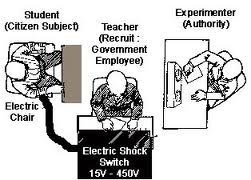
In this single day log record, several core characteristics of the Total Theater of psychological torture are in play: learned helplessness; the three Ds of Dependency, Debility and Dread; sensory disorientation; assault on cultural values. Also, the presence of the corpsman “checking vitals” recalls the structure of the Milgram experiments, in which the assurance of scientific authority is crucial to retaining the unquestioning obedience of other players within the scene.

Of particular note is the minimal amount of time devoted to actual interrogation. Instead, we see the “running” of a number of “approaches” and “themes”. From the structure of this log, it would appear that the experience of detainee 063 has far less to do with intelligence gathering than with recording behavioral data for the future of psychological operations, that is, the breaking of the will to resist. Interrogation provides the structural context for ongoing experiments in the permanent “no touch” disintegration of the psyche.

Other “approaches” used on detainee 063 on other days included forcing him to wear a bra; placing a thong over his head; forcing him to perform dog tricks; forced to submit to an enema; forced nudity in the presence of female torturers; referring to his mother and sisters as whores. A more complete record has been compiled by the detainee’s attorney, Gitanjali S. Gutierrez. Despite substantial documentary evidence of US official complicity, not a single person has been held accountable for this appalling catalogue of abuse.

PSY-OPS: BASIC STRUCTURE


Total Theater

In their frequently cited 1992 study titled “Torture: Psychiatric sequelae and phenomenology”, Otto Doerr-Zegers et al. evaluate the long term psychiatric symptoms resulting from torture experienced by their subjects in Chile during the brutal rule of Augusto Pinochet.

INVOLUNTARY CASTING FOR TOTAL THEATER

Beyond the anticipated acute post-traumatic disorder, they note deep personality changes in numerous cases, with symptoms not unlike those found among patients suffering from schizophrenia, severe depression and psychosis. Such symptoms include a marked impoverishment of psychic life; a significant degradation of various personal and professional competences; “mistrust bordering on paranoia”; and a general loss of willingness to engage in life, resulting in “a tired human being, relatively uninterested and unable to concentrate.”

Doerr-Zegers and his associates are led to the central question:  What in torture makes possible a change of such nature that it appears similar to psychotic processes and to disorders of organic origin?

They then focus on the phenomenology of the torture situation as presenting a sort of Total Theater, a theater in which the victim’s sense of self, time and space all come under extreme stress at the same time. The detention cells and interrogation rooms are highly staged, complete with remotely controlled lighting and sound, and coordinated to induce persistent feelings of dread and disorientation.

Basic human needs are controlled and disrupted to maximize confusion and collapse all autonomous existential platforms, which are then replaced, plank by plank, with a new platform of defenseless dependence and subservience to the theater’s omnipotent directors. Prior conceptions of the the world — such as the strong commitment to the rule of law within Chilean society – are also shattered, leaving the victim even more isolated and displaced.

Critical features within the perverse dramaturgy of Torture Theater include:

STAGE SET FOR TOTAL THEATER

1.   The extreme asymmetry of power.

2.   Victim is known and named; torturer is not.

3.   The painful double bind of either enduring “treatment” or betraying others (often falsely).

4.   The constant infliction of destabilizing fictions such as mock executions and reports of harm to loved ones.

5.   Confinement in spaces chosen or designed to convey entrapment, narrowness, constraint and dehumanization.

6.   Manipulation of time such that treatments appear to be without end; disruption of any sort of structure to days or nights; disturbance of sleep, eating and other basic requirements.

Official denials further exacerbate and perpetuate damage performed within the Torture Theater, once the victim is released from the “play”. Because those who have not attended the theater cannot believe that such things could ever happen in a society purportedly governed by the rule of law, the suffering of the victim is compounded by their inability to testify to their ordeal or to seek justice.

Of course, in Chile and elsewhere, the truth eventually forced its way into the sun, due to the heroic efforts of victims and their families, who refused to accept institutionalized silence.

PINOCHET TOTAL THEATER

Alfred McCoy in A Question of Torture and Michael Otterman in American Torture both meticulously trace the scientific and legal-political genesis of torture as Total Theater, and its implementation and refinement during the years following the events of September 11, 2001. We find it curious that there have been few subsequent studies of torture psychiatric sequelae, given the numerous provocative lines of enquiry opened by Doerr-Zegers et al., as well as the proliferation of victims in recent years. Possibly such research is not considered likely to enhance one’s academic career?

Finally, we are intrigued by the suggestion that torture results in symptoms not dissimilar to those found in subjects whose brains have some organic disorder. Might the impact of the trauma be so severe that post-torture brains actually resemble something closer to a Traumatic Brain Injury?

MIGHT PSYCHOLOGICAL TORTURE INFLICT A TBI?


On a Clear Day

Heliographer-in-chief Nelson Miles

In pursuit of the wily Geronimo and his small band of Chiricahua Apache, General Nelson Miles suffered from a lack of high quality intelligence regarding the movement of hostiles through his geographically complex theater of operations. Chiricahua knowledge of the terrain combined with their high levels of skill in evasion made “hunt and kill” tactics difficult if not impossible to apply, and intelligence gathered by scouts (some of whom were Apache themselves) proved inadequate to the task, or unreliable.

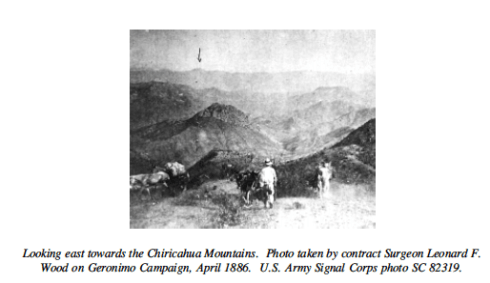
If he was to succeed where General Crook had failed, Miles would need to see and anticipate enemy motion with greater precision and with a perspective as sweeping as the landscape. Thus he set out to establish a regional system of aerial reconnaissance, accomplished by means of the solar-powered heliograph or “sun telegraph”: The signal detachments will be placed upon the highest peaks and prominent lookouts to discover any movements of Indians and to transmit messages between the different camps.

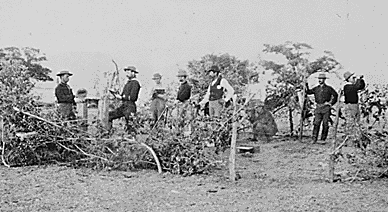
Solar-powered intelligence station circa 1886

Net for catching hostiles

According to a newspaper account written by former signal operator William Niefert:

From the peak in that clear atmosphere we had an interesting view that covered many miles, even beyond the International Border. Nogales 50 miles away, was plainly visible, and away to the eastward one could see a surprisingly distance. The heliograph, or “sun-telegraph” as it was often spoken of on the frontier, is an instrument for signalling by sunlight reflected from a mirror. Metallic mirrors were originally used, but in service, they were hard to keep bright, and hard to replace if broken in the field. Consequently glass mirrors were adopted and much successful work was accomplished by using this method of signalling. We used two 5-inch mirrors, mounted on heavy wooden posts, that were firmly set between the rocks. Vertical and horizontal tangent screws are attached to the mirrors by which they can be turned to face any desired direction and keep the mirrors in correct position with the sun’s movement. As the flash increases about 45 times to a mile, it could be read with the naked eye for at least fifty miles.

Equipped with a powerful telescope and field glasses, we made frequent observations of the surrounding country so that any moving body of troops, or other men, as well as any unusual smoke or dust, might be detected and at once reported by flashing to Headquarters. Troops in the field carried portable heliograph sets that were operated by specially trained and detailed soldiers, by this means communicating through the mountain stations with Headquarters. 

For all the effort invested, there is little evidence that any of the information gathered and relayed by the heliographs had any direct result on Geronimo’s capture, which was eventually secured by boots on the ground; boots under the command of Lieut. Charles A. Gatewood, a man Geronimo knew and respected as a brave adversary. General Miles traveled to Skeleton Canyon for the official surrender on September 4, 1886.

The most significant lessons of the Apache Wars had more to do with physical fitness and tactical preparation than with theater intelligence. Counterinsurgency concepts such as flexible response, quick reaction with emphasis on mobility, body counts and small unit actions were all conceived and refined during the Apache campaign, from tactical necessities dictated by both the harsh terrain and by the character of the enemy.

For aerial reconnaissance to be effective in the context of counterinsurgency, there must be a more rapid and dynamic relationship between intelligence and the delivery of force. The heliograph system of General Miles had far too many dots (and dashes) to connect: from binoculars into code; then from code to mirror communication; then from decoding to command; and then from command to the pursuit force, via the same cumbersome circuitry. Radio would of course eventually significantly reduce these gaps, but the most pure expression of Shock & Awe would not be achieved until intelligence itself became weaponized, in the form of Predator drones.

The capture of Geronimo resulted in the removal of most Chiricahua from the desert landscape that provided the basis for their entire culture; they were placed in rail cars and transported to Florida, into an environment so foreign that it may as well have been Madagascar. Exposure to new diseases compounded by the shock of a climate and landscape antithetical to their culture and experience, many of the captive Chiricahua died within the first year. Such dynamic relationships among intelligence, identification, cryptography, rail transport and death would become more fully articulated in years to come.

Next stop: Florida


The Tranquilizer

JUST CALL ME DAD

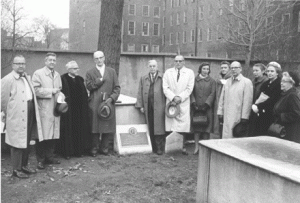
Benjamin Rush is often referred to as “the father of American psychiatry,” and indeed his portrait still adorns the seal of the American Psychiatric Association. In 1965, the APA placed a bronze plaque by his grave at Christ Church Cemetery in Philadelphia, affirming and consecrating his paternity.

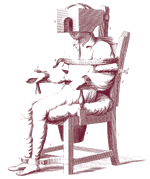
Rush’s seminal opus, Medical Inquiries and Observations, Upon the Diseases of the Mind now reads like a primer for psychological torture. Suggested punishments for the misbehavior of mentally ill patients include tranquilization through the imposition of physical restraints; food modification or deprivation; cold water treatments; and prolonged shower baths.

“If all these modes of punishment should fail of their intended effects, it will be proper to resort to fear of death.”

Other fears also come in handy, as well as an acute sense of shame, though Rush asserts that because of some neurological process he fails to specify, the patient will have erased all memory of such fears, once returned to mental health. Also, we should note Rush’s deft distancing from the brutal exercise of the whip; clearly he prefers other more refined techniques.

FROM CHAPTER VI, TREATMENTS

In many cases, the line between punishments and treatments is quite flexible within the medical philosophy of Dr. Rush. Thus the tranquilizer performs a highly useful secondary role in facilitating the application of other treatments:

“The tranquilizer [chair] has several advantages over the strait waistcoat or madshirt. It opposes the impetus of the blood towards the brain, it lessens muscular action every where, it reduces the force and frequency of the pulse, it favours the application of cold water and ice to the head, and warm water to the feet, both of which I shall say are excellent remedies in this disease; it enables the physician to feel the pulse and to bleed without any trouble, or altering the erect position of the patient’s body; and lastly, it relieves him, by means of a close stool, half filled with water, over which he constantly sits, from the foetor and filth of his alvine evacuations.”

On the website of the Pennsylvania Hospital, the tranquilizer is described as “doing neither harm nor good.”  The statement is made without reference to any supporting documentation or testimonials from patients or doctors:

Though Rush mentions in his book that a fully functioning tranquilizer was used by the hospital at the time of publication (1812), I have been unable to confirm its present existence as a physical object; a copy of an engraving endorsed by Rush as accurate appears on the website for the U.S. National Library of Medicine:

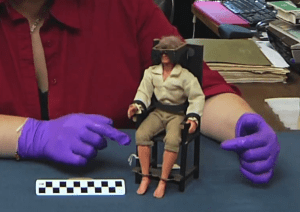
A small scale model of the chair on display at the Mütter Medical Museum, also in Philadelphia, shows a rather different device (purple gloves belong to Mütter curator Anna Dhody):

DISPLAY MODIFICATION

Of particular note is the absence of the “close stool”; and the innovation, apparently devised by the model maker, of the blinders. With this modification in place, the patient can neither move his head nor bear visual witness to anything happening within his environs.

It is possible that the design change was introduced by the model maker simply to make the head structure more durable, yet whatever the explanation, the modification is remarkably prescient in anticipating a key attribute of contemporary psychological torture as developed by the CIA since the 1950s: the merging of corporeal restraint with sensory deprivation and/or perceptual disorientation.

NO TOUCH TORTURE

Interestingly, the two most recent recipients of the APA’s Benjamin Rush award, together with the titles of their lectures, are:

2008 Mark S. Micale, Ph.D., Associate Professor, History of Science and Medicine at the University of Illinois, Urbana-Champaign.Psychological Trauma and the Lessons of History.
2011 Andrea Tone, Ph.D., Professor and Canada Research Chair in the Social History of Medicine, McGill University. Spies and Lies: Cold War Psychiatry and the CIA.

Woundscapes

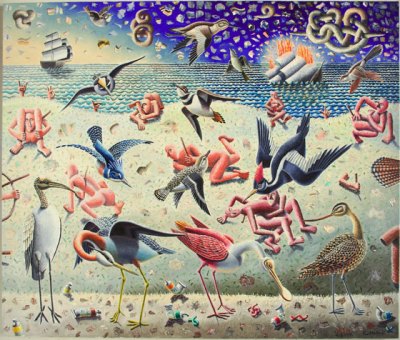
A remarkable selection of Morgan Bulkeley’s paintings is presently on view at The Berkshire Museum in Pittsfield, MA. At the show’s opening earlier in February, Bulkeley referred to Henri Rousseau’s painting “La Guerre” in relation to two of his own woundscapes, “Love and Death” and “War Wounds”. We later engaged in the following email dialogue:

HENRI ROUSSEAU, LA GUERRE

DP   Can you describe your response to Henri Rousseau’s “La Guerre”, on first viewing?

MB   Insane horse and rider– eyeless horse extended over ground composed of corpses – the rider not really seated on the horse – almost floating in front of the steed defying gravity and sanity – putrid blood pink clouds. The whole image eerily without hope or humanity, a world dedicated to death. Who is this tattered imbecile leering with her sword and smoking stick reveling in the apocalypse? Horror.

DP   Yes, and the wounded, scorched landscape. What do you make of the tree in the foreground, the snapped limb and the gashed bark? It almost seems as if the berserker, having run out of bodies to cut down, is now on the rampage against the trees. And the use of color, for the bodies, the “greening” of the dead, the blurring of the line between landscape and woundscape. The corpses seem to be sinking into the ground; or maybe the earth is sucking them in?

MB   It seems all life is being snuffed out; the leaves – what few there are – look wilted, and the crows are feasting on death. In the background, there are trunks and stumps. Cut or maybe just giving up, the limb seems to be overcome by the assault. Why should the crows be alive; death is their food. I was always fascinated by the horse’s tongue and the silver slivers of horseshoes, maybe the only remnants of technology along with the sword, and that weird splintered dress.

MORGAN BULKELEY, WAR WOUNDS

DP   Was Rousseau’s “War” on your mind when you began working on your own painting, “War Wounds”?

MB   “War Wounds” was a partner piece to “Love and Death”, the first painting of the second line on my website. Both were a response to the horror stories coming from Iraq and Afghanistan.  When I started these paintings I was thinking of Rousseau’s horror story, but also of the small paintings (the size of playing cards) that nuns did in the 16th century to meditate on the pain and suffering of Christ and the Saints, to try to enter the state of mind and share the terror and passion with them.

DP   The birds in the painting are not carrion eaters. They seem to inhabit an entirely different dimension, maybe even a different time. Yet at the same time, they are a haunting presence.

MB   The birds in my pieces are an assortment of passers-by or watchers (the wood stork and godwit) ; I think Nature is more of a constant, a mix of beauty and death, that is just the matrix of human actions, not a cause or contributor to the story.

DP   Unlike the passive blue sky background in Rousseau, your sky is highly charged with all sorts of objects and figures. For example, what are those wormlike tangles?

MB   I found the sky in my paintings felt flat and empty next to the turmoil in the land. Suddenly, I realized that the clouds could be anything, knots, abstracted hats, barbells, even people writhing in the sky. They gradually became more complex. The flecks and daubs of paint added a physical energy (almost like molecules, atoms, strings) and I was amazed to find that they seemed to add up to “Sky”.

DP   In contrast to how the bodies seem to bleed directly into the earth with Rousseau, the way the wounded and destroyed bodies are placed in your landscape, it almost has the sense of a sculpture garden, almost as if they have been found, possibly washed up on the beach, and then carefully arranged, put on display. And also, while they are broken and contorted, they are not yet dead.

MB   Yes, most of my figures are still alive. I’ve always wanted to walk a tightrope between hope and despair, or horror and beauty as it seems that is our lot in life.  In “Love and Death” two adversaries have just cut each others heads off– one head staring at it’s former neck, the other staring at the head it has just severed. Much of this came out of the news at the time of beheadings, and I suppose it’s a theater of the absurd choked chuckle. My Mom used to trudge up to my studio, and after staring for a while, she would say ” It’s beautiful…. Do you feel alright?”

DP   I am very struck by the hands rising from the wounds, indicating some obscure semiotic. I have always loved the Brothers Grimm tale about the young girl who is very stubborn and willful, so much so that when she is dead and buried, her arm keeps pushing through the dirt, as if to say “I am still here”, and of course this is one quality that is both admirable and dangerous about humans. What are those willful hands telling us, signing from the dunes?

MB   I think “I am still here” is a fairly accurate translation of the wounds and severings. One person lovingly cradles his/her hands with bloody stumps. Hands appear over the hill in a V-victory sign, or pointing like a kid’s play gun, or with a raised index figure “I’m no. 1”, absurd gestures in an absurd world.

MORGAN BULKELEY, LOVE AND DEATH

DP   You have spoken about your desire to find a way of figuring the human body that is drained of specificity, abstracted, yet also quite identifiably human. Can you tell a bit more about how you arrived at your aesthetic of figurative abstraction?

MB   As I mentioned, I used to paint portraits and anatomically accurate (or somewhat more accurate) figures, but I found that people would look to see who the person was and what their emotions were. I wanted to tell less specific stories, ones of ideas not personalities. It took some fumbling and messes to arrive at these fleshy, generic approximations of people, but they seemed to represent life, and I could bend them in any way I wanted.

DP   Finally, I am struck by the paint tubes in the foreground, part of the flotsam and jetsam of the battle, or whatever it was. I immediately thought: yes, art is part of this woundscape, too. Where is the artist in our larger landscape of everyday atrocities, the endless tales of cruelty and violence?

MB   The paint tubes, I feel, are an optimistic statement of creation; this landscape can be changed by a little paint, in fact the whole vision is only paint, but it can tell any story. The landscape is a matrix: we exist in it, but it also exists without us. It may go back to an empty Eden without us. I believe in “humanity” and I hope for a rational wrestling with our “problems”. I think of my paintings as prods and lures, meaning to push toward an alternative way of thinking.  I think we are still in Eden with a last chance; think that we can find beauty and meaning in Nature; think that there are alternative ways of doing things.

DP   Yes, and there is also the sense not of complicity but of entanglement. The same human hands that create paintings might also create corpses. You refer to nature as the matrix of human actions. Could you mention your father‘s influence in all of this, his keen naturalist eye for detail, and how you pay homage to that tradition?

MB   My Dad understood that Nature is a foundation, that it is a spiritual ground, a way to meditate and escape instant gratification and the speed that our culture foists on us. Of course in his day all the crushing realities hadn’t completely formed yet.


Wrestling with Modernity

AESTHETICS OF MODERNITY

History is not like chess; it is more like wrestling. History takes place as flesh moves inside space; it is thus, among other things, about the biology of flesh – as well as about the topology of space. If history is about flesh-and-blood individuals interacting in material space, it also follows that history is not confined to humanity alone.

We tend to concentrate on humans because we consider humans as actors in history – they have desires, they move about, and thus they shape reality. But all living beings have desires and move about, and so they shape reality as well; and in another way, the same is true even of material reality itself. And because all these actors occupy the same stage, they cannot fail to interact; no species is an island.

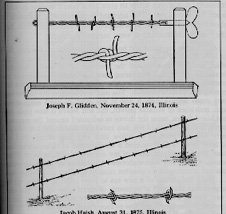
Thus history is embodied – and not only inside human bodies but in the bodies of all species. One of the main features of history is the prevention of motion. Biologically, animals just move around: history arrives when they are confined to a place. In a formula, this is history: humans change the terrain to prevent the motion of animals as well as other humans.

HISTORY ARRIVES

To have our motion prevented is unpleasant, at the basic biological level. We want to move around, and to be denied that is itself painful. Even more directly, prevention of motion is usually painful for a simple reason: usually the way to prevent us from doing what we wish is to cause us pain.

There is thus a direct relationship between the prevention of motion and violence. Modernity made possible a total asymmetry between the powerful and the powerless. With this asymmetry of power, everything about an organism’s life could be controlled, and as a result, a new kind of living being was created.

Both cows and humans suffered the same modern equation of iron over flesh, and so both were transformed into what may be considered an altogether new species: the victim of extreme control. This victim – animal or human – is the hero of the twentieth century.

EARLY AMERICAN HERO

{Excerpts from Netz Epilogue as compressed by DP}