Tag Archives: rights of nature

Deep In Our Tissues

Now comes the resounding voice of Barry Lopez, with a passage from within the conversational riffles of his  Syntax of the River: The Pattern Which Connects.


Our trouble seems to be that, you know, our primate heritage, which is apparent in watching the behavior of chimpanzees and bonobos, is that we’re keenly interested in ourselves and opposed to others. That’s deep in our tissues. And with the kind of world we’ve built, that’s not going to work. So, those human beings who have the very strongest residue of the kind of patrolling behavior and violence that troops of chimpanzees have, those people would like the world to be, I think, arranged in a way that suits their habits and their desires. But a lot of people die that way. And we have created a chemical environment that is killing people left and right, quickly or slowly, through cancer, for example.

It just doesn’t make sense anymore to have these ideas about “me” and “mine” and the terrible burden that has been created by so-called advanced nations about the primacy of ownership, the ownership of food. Or, you know, the terrifying thing in the United States, this idea that nothing is exempt from the application of a kind of economics that’s meant for profit. I mean, how can you make the care of another, the professional care of another person’s body, be informed by a profit motive? Even a fifth-grade kid can see there is something that doesn’t really add up here.

So, for me as a writer, I live here and I’m informed by this [river]. And the way it informs me helps me understand a lot of the things my species does that are suicidal. It’s not up to me to say that they are suicidal, but I would feel like a traitor to my teachers here if I never said a thing, never mentioned it.


˜˜˜˜˜˜˜


Along the Highway of Tears

Scientific evidence across a wide range of phenomena confirms acceleration of climate/ecocidal breakdown at a rate beyond even the most grim predictive models. For example, temperatures in Antarctica recently reached a record 65 degrees Fahrenheit while data elsewhere suggests that bumblebees are disappearing at a rate “consistent with mass extinction”.

What can be done? Given the abject failure of so-called global “elites” to develop emergency mitigation policies, alternative leadership has emerged, rooted in the wisdom, courage and sovereignty of indigenous peoples.

Witness the ongoing struggle against TransCanada’s four hundred mile Coastal GasLink pipeline through the words of Wet’suwet’en hereditary chief Molly Wickham, spoken during a recent interview on Democracy Now. We take particular note of the convergence of violence against nature with the murder/disappearance of indigenous women.


WHY IS A RCMP SNIPER RIFLE BEING AIMED AT UNARMED AND COMPLETELY PEACEFUL LAND DEFENDERS ON THEIR OWN SOVEREIGN TERRITORY?


˜˜˜˜˜


Wild Law

Two highly significant environmental justice victories over the past year flow from courts extending legal rights to two rivers: the Whanganui in New Zealand, a living ancestor to the Maori people; and the Ganges, together with its main tributary the Yamuna, sacred to all Hindus. The decision in favor of the Maori emerged from one hundred and forty years of negotiation, and was cited as a critical precedent by the court in the northern Indian state of Uttarakhand.

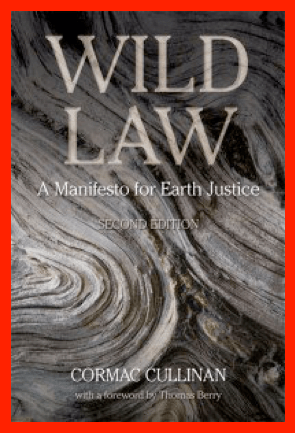
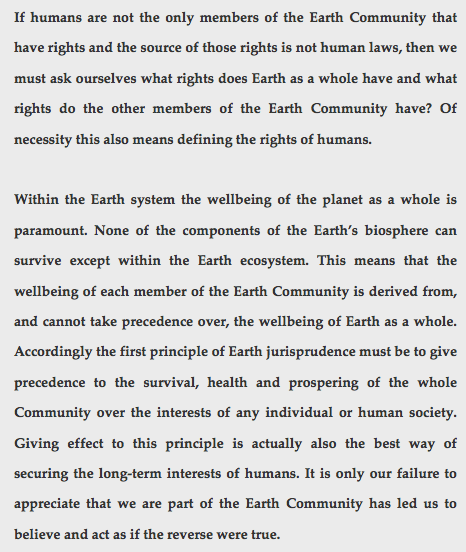
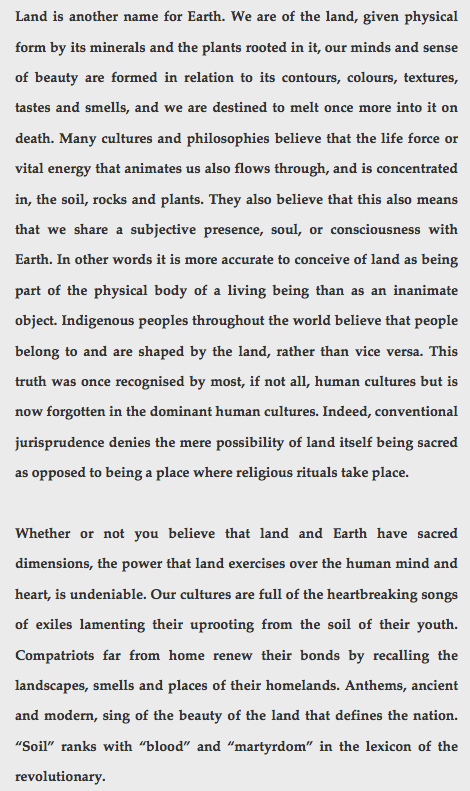
Extending from Thomas Berry’s ideas of nature-based jusrisprudence, we excerpt the 2011 manifesto for earth justice, Wild Law, by Cormac Cullinan:

˜˜˜˜˜

In a related story, we take note of a clueless tourist and former Playboy model named Jaylene Cook, photographed in her birthday suit in front of Mount Taranaki, considered a sacred burial ground and ancestor by the local Maori. We will not compound Ms. Cook’s naked ignorance by reproducing the image here; it has gone toxic-bacterial in the meme-swamp formerly known as the world wide web.