Author Archives: DP

Such is the Depth

SOULSCAPE FOR PRISONER NUMBER FIVE

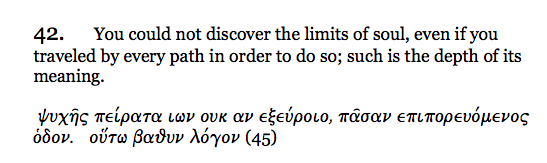
HERACLITUS FRAGMENT 42

Having finished building his wild garden, Albert Speer circled Spandau Prison on daily walks, moving peas from one pocket to the other to record his laps, from which he could then calculate total kilometers. By his own account, he soon became bored and restless with the same old familiar itinerary. To enliven his imagination, he conjured a more richly varied landscape to traverse: Heidelberg, the Alps, and then onwards across distant and exotic lands.

Yet we cannot help but question whether boredom was the true motivation. Perhaps he stumbled across some unwelcome thought buried deep in the mysterious core of his essential being; glimpsed some charred corpse or ruined city; or heard the footfalls of unquiet spirits, battalions of the dead, marching past the dark speleothems of his memory. Then he decided — time to go.

Could it be that his imagination was not becoming too dulled, but rather too lively, turning up uncomfortable truths with which he was not prepared to reckon? Possibly the same mechanism that prevented him from seeing the truth about Hitler became active here again. Or maybe he did break through to some deeper insight, and then could not tolerate the implications.

In a subtle treatise on walking his home landscape to the rhythms of personal memory, William deBuys writes:

On my twenty-seven-year circuit up and down arroyos and back by the river and the field, the layering of repetition and memory has so twined my sense of the land with my sense of my own past that one leads to the other and back again without the least interruption.  (…)

It is as though one’s awareness of place and awareness of self had grown together like two plants in the same pot, so that their enmeshed roots formed a single web of memory.   (…)

In such a way, a homely well-worn path becomes a route into and through the self, leading to destinations unimagined. This is the paradox of the familiar: the more you know a place, or think you know it, the more it can take you where you do not expect.

For prisoner number five, that was exactly the problem. The walk around the prison threatened to become a spiral down into unexpected and unwelcome depths, where the tangled roots of memory threatened to choke him. On such a circuit, he was far too present to himself, and thus set off for safer territories, distant, and full of of the sorts of aesthetic abstractions that made him feel most at home.


Even in the Sleeper

HISTORY OF A CIPHER

We know a good deal about Albert Speer during his years at Spandau, both through his own voluminous accounts, and through forensic cross-examinations performed by the incomparable Gitta Sereny. Her book, Albert Speer: His Battle With Truth offers the patient reader a model of careful excavation, the sort that yields tiny fragments of bone that suddenly disrupt everything we thought we knew.

Shortly after arriving at Spandau, Speer realized that sitting in his cell with his scraps of text would not be enough to sustain himself; he soon began a different sort of labor, in the garden. As he wrote to his wife Margret:

MEMORY GARDEN

It is about 6,000 square meters of wilderness full of nut trees and huge lilac bushes. Now we are all spending hours every day weeding; it is good for us. I already feel much better. I have big ideas for the garden, have designed a promenade I will lay, and plans for all kinds of flowers, a rock garden and, above all, fruit trees and vegetable plots for which I hope I will be allowed to have seeds sent me. (…) There is a lot to do, and I think the soil is healthy.

For this reader, the words promenade and plots summon other images into this upbeat and arcadian scene: images of the death camp Himmelweg, shaped by its dense tangle of barbed wire and pine trees, an improvised fusion of steel and nature that captures the essence of Nazi aesthetics. Though Speer did not participate in the construction of the camps (Hitler would not permit such crude soiling of his muse’s “purity”), he would likely have approved of the idea of a barbed bough. He would also have approved of the fluid linkage between a straight passageway leading to a well defined terminus, a signature feature of his vision for Berlin.

Eventually, having completed both the garden and his memoirs, Speer needed another way to stay in motion:

I had worked it out – if I did thirty circuits of the path I had laid out in the garden, that would be seven kilometers a day. I asked Hess, who sat and watched me, if he would mark down each time I passed him, so that I wouldn’t lose count. He had a marvelous idea. He gave me thirty peas and said, “Put these in one pocket and move one to the other pocket each time around. That will do it.”

In 1954, Speer decided that he would walk from Berlin to his home in Heidelberg:

It was a more imaginative goal than just completing the circuit thirty times, as I had been doing. That was successful, so I kept on going, across the mountains to Italy, and finally decided to see how far I could get. After preparing for the walks by studying maps, travelogues and art history books, I focused imaginatively on the differences in the landscapes, the rivers, flowers, plants, trees and rocks. In the cities I came through, I thought of churches, museums, great buildings and works of art.”

Often, he would receive specific advice from his friend and rather unrepentant Nazi Rudi Wolters, who would also faithfully supply him with source books and maps:

For the trek through the huge uninhabited wastes of Siberia, I would strongly advise you be kind to yourself and take a train. Saves time, too as you can do it at night! But don’t sleep too much. It would be a crime to miss seeing those unending snowy mountain chains and prairies and the sea of stars above. If you open the top slat in your compartment window, you can smell the purity of the air even in your sleeper. Only careful – if you expose your face too long, your mouth and nose will freeze. 

Speer took his last walk on September 29, 1966. He had covered 31,936 kilometers; “I suppose it too became an obsession. But what’s wrong with that, if it makes one happy?” He was released from Spandau the next day, having served his complete sentence.

In the end, the internal life of Albert Speer remains stubbornly inaccessible, with an unbroken cipher at the heart of all those thousands upon thousands of well-crafted sentences. For all his weeding and lateral perambulations, Speer never ventured to descend into the darkest soils of his self. Past a certain depth (Speer’s ability to experience love and empathy only through art and abstraction), even the formidable soul-seeker Sereny comes up blank. She grants him the benefit of the doubt regarding his moral recuperation, yet her conclusion is tentative.

In 1981, while in London for a BBC interview and in the company of a much younger woman, Speer suffered a stroke that would end his life a few hours later. Was this the autumnal love that might have finally released the meaning of the cipher, or yet another happy obsession for prisoner number five?

SCHLAFWAGEN SPANDAU


The Mysterious Core

Gitta Sereny, 1921-2012

Gitta Sereny, 1921-2012

With much sadness, we note the death of Gitta Sereny at the age of 91. Possessing an abundance of analytical intelligence and moral acuity, Sereny’s writings explore the interplay of history and human psychology with peerless subtlety and skill, conveyed for the reader in a style that is graceful, complex and lucid.

Her virtuoso “examination of conscience” in the case of Franz Stangl, Kommandant of Sobibor and Treblinka, sets a very high standard for the forensic examination of human behavior in extreme circumstances. Rejecting the simplistic classification of Stangl as either a Nazi Monster or as a banal civil servant, Sereny reconstructs his social and private Lebenswelt with meticulous care, her spirit of empathy – even though she found him personally repellent – matched by an unsparing drive to excavate his deeply buried guilt.

In dialogue with Sereny, Stangl becomes human again for the reader, only for Sereny then to lay bare the fundamental corruption within his personality that permitted him to perform his role within the death machine with such cold efficiency. By cross-checking Stangl’s recollections with interviews of his wife, children and other key people in his life, she uncovers the emotional black hole at the core of his being, an emptiness which eventually expresses itself as a grotesquely distorted conception of “self-will”, an identity distortion that is absolutely critical to comprehending his obedience within the genocidal chain of command.

Sereny’s examination of Stangl is so cathartic for her subject that, at its conclusion, he at last acquires an understanding of his complicity and guilt: “My guilt is that I am still here. That is my guilt.”  Nineteen hours later, he is found dead of heart failure. By the end of her account, the reader (or certainly this reader) also experiences a sort of collapse, a collapse that creates the conditions for fresh insight, well beyond the history of the death camps.

Her portrait of Albert Speer reaches the same depth, complicated by the eventuality of Sereny’s feelings of friendship and even admiration for Speer’s remarkable talents and personal qualities. Speer is certainly in a different category from the brutish provincial policeman Stangl. Speer is painfully aware of his profound guilt from an early stage, and devotes the rest of his life to an examination of his own conscience; hence Sereny’s title, Albert Speer: His Battle with Truth.

While Speer’s moral resolve wins respect from his interlocutor, she does not abandon her hunger for deeper questions, as she constantly pushes him on critical weaknesses in his personal accounting, above all regarding his complicity in the Final Solution. As readers, we witness their friendship strengthening in the exact same rhythm as Speer’s last defenses regarding the depths of his guilt weaken and then crumble. It is an astonishing tension to experience, rendered with literary skill equal to any writer of her time.

Though Mr. Rose is not even remotely in her class as an interviewer (we wince at his clumsy interruption in mid-sentence, when she is on the verge of making her most important point), the below video at least conveys some slight sense of her exceptional self-awareness and deep humanity.

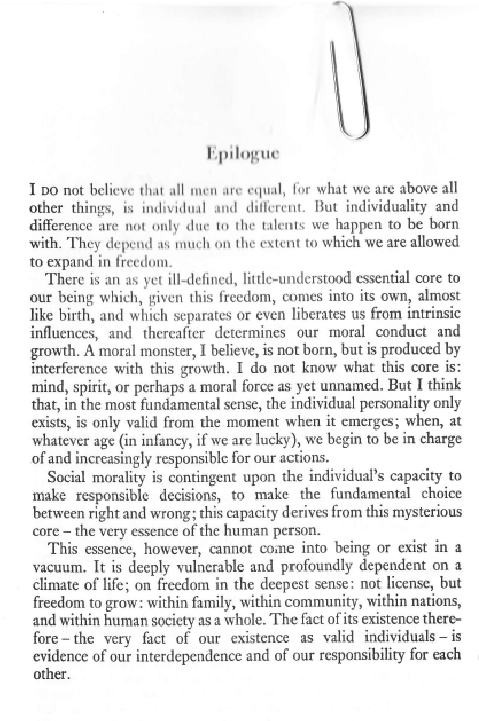
In closing, we submit the epilogue from our DP office copy of Into That Darkness, in which she neatly summarizes her perspective on the social conditions for an active moral consciousness. Her fearless grappling with the mysterious core of human identity remains more relevant than ever, as the species spins off into yet another crazed Tarantella of corruption, cruelty and slaughter. The incomparable Gitta Sereny: the world will be very fortunate indeed to see her kind again.


Predator Nation

The designation “Predator Nation” captures both the fraudulent dynamics of the global financial system and the strategic machinations of American foreign and military policy. Charles Ferguson, director of the excellent documentary about the global financial crisis Inside Job, uses the title for his new book:

“Over the last thirty years, the United States has been taken over by an amoral financial oligarchy, and the American dream of opportunity, education, and upward mobility is now largely confined to the top few percent of the population. Federal policy is increasingly dictated by the wealthy, by the financial sector, and by powerful (though sometimes badly mismanaged) industries such as telecommunications, health care, automobiles, and energy. These policies are implemented and praised by these groups’ willing servants, namely the increasingly bought-and-paid-for leadership of America’s political parties, academia, and lobbying industry.

If allowed to continue, this process will turn the United States into a declining, unfair society with an impoverished, angry, uneducated population under the control of a small, ultrawealthy elite. Such a society would be not only immoral but also eventually unstable, dangerously ripe for religious and political extremism.

Thus far, both political parties have been remarkably clever and effective in concealing this new reality. In fact, the two parties have formed an innovative kind of cartel—an arrangement I have termed America’s political duopoly, which I analyze in detail below. Both parties lie about the fact that they have each sold out to the financial sector and the wealthy. So far both have largely gotten away with the lie, helped in part by the enormous amount of money now spent on deceptive, manipulative political advertising. But that can’t last indefinitely; Americans are getting angry, and even when they’re misguided or poorly informed, people have a deep, visceral sense that they’re being screwed…”
SIGNATURE FOR A KILL LIST

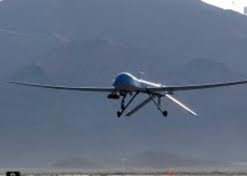
“Predator Nation” also has a second meaning, namely the emergence of drone aircraft as the signature “tools” for the implementation of American foreign policy and military strategic objectives. The estimable Tom Engelhardt recently wrote a critique of an astonishing article in the New York Times by Jo Becker and Scott Shane, “Secret ‘Kill List’ Proves a Test of Obama’s Principles and Will,”; astonishing not just for what it describes, but for its breathlessly obsequious tone. We find the Engelhardt critique worthy of lengthy citation:

“If the Times article — which largely reflects how the Obama administration cares to see itself and its actions — is to be believed, the drone program is also in the process of being sanctified and sacralized.

You get a sense of this from the language of the piece itself.  (“A parallel, more cloistered selection process at the C.I.A. focuses largely on Pakistan…”)  The president is presented as a particularly moral man, who devotes himself to the “just war” writings of religious figures like Thomas Aquinas and St. Augustine, and takes every death as his own moral burden.  His leading counterterrorism advisor Brennan, a man who, while still in the CIA, was knee-deep in torture controversy, is presented, quite literally, as a priest of death, not once but twice in the piece.  He is described by the Times reporters as “a priest whose blessing has become indispensable to Mr. Obama.”  They then quote the State Department’s top lawyer, Harold H. Koh, saying, “It’s as though you had a priest with extremely strong moral values who was suddenly charged with leading a war.”

In the Times telling, the organization of robotic killing had become the administration’s idée fixe, a kind of cult of death within the Oval Office, with those involved in it being so many religious devotees.  We may be, that is, at the edge of a new state-directed, national-security-based religion of killing grounded in the fact that we are in a “dangerous” world and the “safety” of Americans is our preeminent value.  In other words, the president, his apostles, and his campaign acolytes are all, it seems, praying at the Church of St. Drone.”

PRAYING IN THE CHURCH OF ST. DRONE

“What should astound Americans — but seldom seems to be noticed — is just how into the shadows, how thoroughly military-centric, and how unproductive has become Washington’s thinking at the altar of St. Drone and its equivalents (including special operations forces, increasingly the president’s secret military within the military). Yes, the world is always a dangerous place, even if far less so now than when, in the Cold War era, two superpowers were a heartbeat away from nuclear war.  But — though it’s increasingly heretical to say this — the perils facing Americans, including relatively modest dangers from terrorism, aren’t the worst things on our planet.

Electing an assassin-in-chief, no matter who you vote for, is worse.  Pretending that the Church of St. Drone offers any kind of reasonable or even practical solutions on this planet of ours, is worse yet.  And even worse, once such a process begins, it’s bound to be downhill all the way.  As we learned last week, again in the Times, we not only have an assassin-in-chief in the Oval Office, but a cyberwarrior, perfectly willing to release a new form of weaponry, the most sophisticated computer “worm” ever developed, against another country with which we are not at war.

This represents a breathtaking kind of rashness, especially from the leader of a country that, perhaps more than any other, is dependent on computer systems, opening the U.S. to potentially debilitating kinds of future blowback.  Once again, as with drones, the White House is setting the global rules of the road for every country (and group) able to get its hands on such weaponry and it’s hit the highway at 140 miles per hour without a cop in sight.

James Madison, Thomas Jefferson, George Washington, and the rest of them knew war, and yet were not acolytes of the eighteenth century equivalents of St. Drone, nor of presidents who might be left free to choose to turn the world into a killing zone.  They knew at least as well as anyone in our national security state today that the world is always a dangerous place — and that that’s no excuse for investing war powers in a single individual.  They didn’t think that a state of permanent war, a state of permanent killing, or a president free to plunge Americans into such states was a reasonable way for their new republic to go.  To them, it was by far the more dangerous way to exist in our world.

The founding fathers would surely have chosen republican democracy over safety.  They would never have believed that a man surrounded by advisors and lawyers, left to his own devices, could protect them from what truly mattered.  They tried to guard against it.  Now, we have a government and a presidency dedicated to it, no matter who is elected in November.”

Fraudulent derivatives and drone assassinations both promise spectacular rewards with zero negative consequences. Such promises are delusional. In time, the consequences of both the most rapacious plundering of global wealth ever conceived and the imperial delivery of remote controlled death to groups and individuals through a decision making process that is entirely extralegal will express themselves with a vengeance. The term “blowback” will not be equal to the task of describing the chaos unleashed by both ugly faces of our Predator Nation.


The Little School

INCARNATION AND SOLITUDE

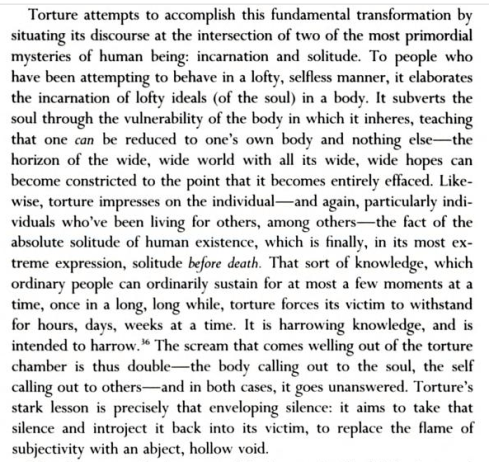
In the lucid Afterword to his most important (and too soon forgotten) book A Miracle, A Universe, Lawrence Weschler develops a conception of history as a battle over who gets to say “I”, that is, who gets to embody and enact their subjectivity. In this conception, torture is cast as essentially a form of teaching, with the core curriculum focused on destroying any semblance of existential autonomy; crushing any aspiration or expression that exceeds “abject objecthood”. Going deeper, Weschler writes:

OUR BEST GRADUATES ARE HOLLOW VOIDS

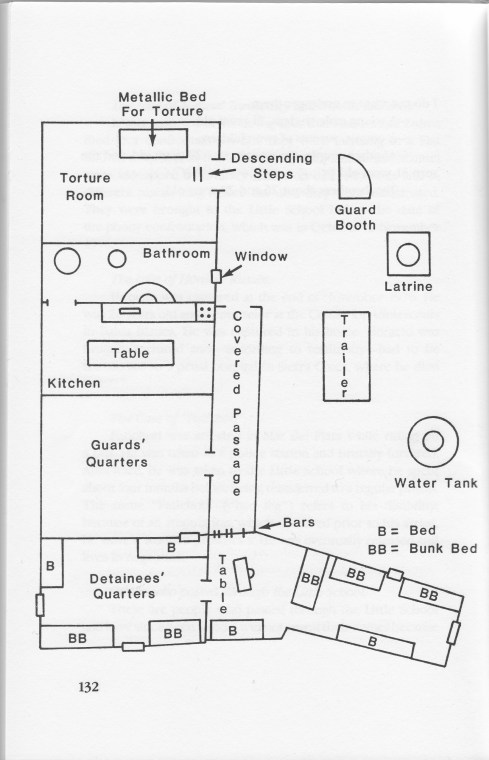
Any moment of rupture inside this enveloping silence becomes a triumph of the subject against the brutal pedagogy of the Torture Room. Consider in this light the extraordinary “tales of disappearance and survival” recounted by Alicia Partnoy in The Little School. In this memoir of her experience as a prisoner during the Argentine Dirty War, Partnoy refuses to grant her torturers primacy within the narrative of her time as a victim of their teaching. Instead, her focus is on her fellow prisoners (their refusal to be stripped down into despondent solitude) and on their persistently expansive sensoria ( their refusal to be defined by or reduced to their pain).

Returning to Weschler in the final page of his last chapter, just prior to the Afterword, he quotes from a poem by Stanislaw Baranczak, “Those Men, So Powerful”:

From our perspective up here in the crow’s nest of Desperado Philosophy, the battle over who gets to say “I” has never been more vivid; and the ones who stand above have never been more afraid.

The Human Snake

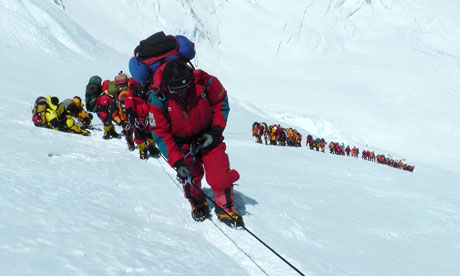
Sometimes an image so thoroughly captures the spirit of the times that even the hyperventilated blogosphere must pause for a deep breath. Such is the grotesque image snapped by the honorable Ralf Dujmovits, depicting what he describes as a “human snake” ascending Qomolangma, or Holy Mother.

The mountain is known to western climbers as Mount Everest, named after a surveyor for the British Empire. {DP note: Sir George Everest actually opposed the name, on the grounds that it could not be written in Hindi nor pronounced by locals.} Once considered an expedition reserved only for the most skilled mountaineers, luxury adventure travel companies now offer Everest as a trophy destination available to anyone who can pay the piper.

Dujmovits had himself reached the South Col where, after assessing the deteriorating weather conditions, he made the correct decision to turn back. Among the most experienced and respected mountaineers in the world, Dujmovits was then astonished to see a lengthy human snake slithering up the Lhotse face.

HUMAN SNAKE

Dujmovits described the scene in an interview with a reporter from the Guardian:

 I was at around 7,900m and saw in the distance on the Lhotse face a human snake, people cheek by jowl making their way up. There were 39 expeditions on the mountain at the same time, amounting to more than 600 people. I had never seen Everest that crowded before.

I was thinking how absurd the scene was. Watching them, I had a strong feeling that not all of them would come back, and I wrote as much in my internet diary.

That leaves you with a really oppressive feeling that some of the people in the picture would soon be dead. I was also filled with sadness [for] this mountain, for which I have immense respect together with the experienced sherpas, that a great deal of that has been lost. People nowadays treat the mountain as if it was a piece of sporting apparatus, not a force of nature. It really makes my soul ache.

[Hobby climbers climb] just so that they can boast to their friends when they get back ‘I’ve climbed Everest’, like people who flash the Mercedes symbol around boasting that they’re rich enough to have one.

FACE OF THE SNAKE

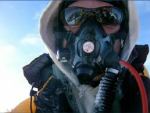
In fact it takes no skill to do what most of the tourists to Everest do. The growing trend in the last 10 years has been to use oxygen almost from base camp onwards, whereas for decades it was only considered to be normal to use it from 8,000m onwards. Now they drink it like it was water.

[I saw] one overweight French journalist – a small woman weighing around 80kg, who had used her entire supply of oxygen before she’d reached any height at all, and an American of Turkish origin who was carrying his bicycle with him because it had always been his dream to take it to the summit and insisted on fulfilling that dream at whatever cost.

Nepalese organizations are picking their customers from the internet without any concern as to whether they are capable of the journey. I am anti-regulation, but I think the Nepalese government has little choice but to ask tougher questions of would-be climbers in future.

They should be asked to state which mountains they have climbed, to provide details of their fitness and to prove in general that they’re mountaineers.

Everest has been pushed to its limits, and a complete change of mind needs to take place otherwise we’ll see many more tragedies taking place. We need to debunk the myth of Everest.

It’s spoiled for me now. And it’s too dangerous. There are simply too many people on there who should not be there.

DEATH ZONE

Elsewhere, in a press release from Boston Consulting Group we find:

The purchase of such experiences does not come without a price, such as the transformation of the noble Qomolangma into a high altitude garbage dump and deep freeze morgue.

Ralf Dujmovits has long been an advocate of climbing without the use of supplementary oxygen. In his view, oxygen-assisted climbs should not be counted as legitimate summits. In a prescient statement from 2006, he stated:

Personally as a climber, I’m convinced that we shouldn’t count climbs with supplementary oxygen as a real summit climb. That’s why I will return to Everest – my climb in 1992 was with O2. I had reached close to the South Summit without O2 a few days before; but had to turn back due to cold feet. I deeply respect everyone who climbs this big mountain – with or without O2. But I also see that an increasing number of people are trying to climb Everest with almost no climbing experience, or not fit enough to perform correctly in difficult circumstances. Both are essential conditions in mountain climbing.

Six years later, he returned to the South Col (without oxygen) and witnessed the perverse spectacle of the human snake: clueless tourists sucking on their O2 canisters, greedily consuming the Holy Mother, wholly oblivious to her nature.

HUMAN SNAKE EXCREMENT


Venus in Sole Visa

 “Doubts of all things earthly, and intuitions of some things heavenly; this combination makes neither believer nor infidel, but makes a man who regards them both with equal eye.”         – Ishmael, in Moby Dick

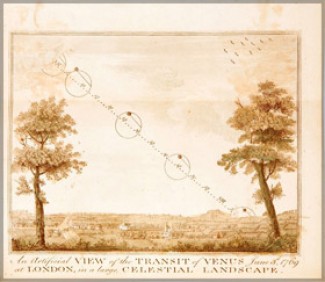
SKETCH OF TRANSIT OF VENUS 1769

NO PUERILE VANITIES HERE

With eyes to the sky, we note the last Transit of Venus for this century. The first documented observation of the transit is usually credited to the Cambridge sizar Jeremiah Horrocks from his home in Much Hoole, yet it is entirely plausible that the phenomenon had previously been observed by Babylonian and Chinese astronomers, and even by the Aztec king Montezuma, who derived authority from his affiliation with Huitzilopochtli, god of the sun, the hunt, and war.

In 1636, Horrocks (Latinate “Horrox”) recorded his observations thusly:

STAINED GLASS AT MUCH HOOLE

Since the transit occurs in the portentous year 2012, we would be remiss not to make note of the Mayan understanding of the planet Venus:

(Lamat Glyph, Venus), Chak Ek’ was the astronomical object of greatest interest, the Maya knew it better than any civilization outside Mesoamerica. In Maya myth, Venus is the companion of the sun. This no doubt reflects the fact that Venus is always close to the sun in the sky, rising not long before sunrise as morning star (Ah-Chicum-Ek’) or after sunset as evening star (Lamat). They thought it was more important than the Sun. They watched it carefully as it moved through its stations, it takes 584 days for Venus and the Earth to line up in their previous position as compared to the Sun. It takes about 2922 days for the Earth, Venus, the Sun, and the stars to agree.

VENUS GLYPH

The Maya made daytime observations of Venus. Venus had a psychological effect upon the Maya, it has been shown in the Dos Pilas staircase, that the Maya were timing some of their wars based on the stationary points of Venus and Jupiter, (The famous Star War between Tikal and Dos Pilas, Naranjo and allies). Humans were sacrificed on first appearance after Superior Conjunction when Venus was at its dimmest magnitude but they most feared the first Heliacal Rising after Inferior Conjunction.

In the Dresden Codex, the Maya had an almanac that displayed the full cycle of Venus. Venus cycles were the mean synodic Venus year of 584 days and a “great cycle” of 37960 days (the lowest common multiple of the Tzolkin, and the Venus year, equal to 104 calendar years or 2 calendar rounds). In Rio Azul’s tomb 19 the Lamat or Venus Glyph is beautifully painted. A “star war” is a full-scale war planned in accordance with specific astronomical events, usually the first appearance in the morning sky of the planet Venus. The heliacal rising of the brilliant “star” in the pre-dawn sky was considered by the Maya as a highly evil portent. As such it was an appropriate herald of warfare, at least on the part of the attacker.

These would appear to be among the intuitions of “some things heavenly” worthy of our attention.


Come, Thick Night

Collaboration between the research arms of Google and the CIA inside the vast data mine of the internet has received ample attention from Danger Room and elsewhere. Below, we assemble a brief montage of excerpts from the birth-document for their most far reaching venture: Recorded Future – A White Paper on Temporal Analytics.

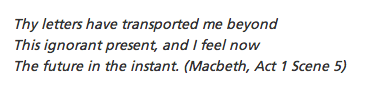
We note that the White Paper exposition begins with high minded bravado expressed through a quote from Macbeth, and terminates in a citation from Sun Szu’s Art of War, a favorite source of inspiration for the authors of Shock & Awe, a document which provides the strategic context for the machinations of Recorded Future.

The full context for the quote from Macbeth reveals more than literary conceit, and surely more than intended by the marketeers for temporal analytics, for here we find Lady Macbeth delivering one of Shakespeare’s most bone-chilling speeches:

How long before the engine of temporal analytics generates behavioral scientific justification for preëmptive detention, together with subsequent corrective measures? And why stop there? If the future is recorded accurately enough, would that not provide adequate legal and moral basis for preëmptive obliteration, beyond the ignorant present?

It is certainly not difficult to divine the future for this keen knife; a future full of “direst cruelty”. Come thick night, indeed.

THE FUTURE IN THE INSTANT


The London Whale

It appears that a large mass of blubber has created a cephalopodic clot in the soul sucking sinkhole named JPM.  Star trader Bruno Iksil aka The London Whale “owned the spread” in a highly leveraged sovereign bond bet that failed to follow his gut, which soon became tripe tossed into the sea as shark chum. In these sorts of hedge fund feeding frenzies, the chum usually loses, and so it was for the London Whale.

FUTURE CHUM

Last weekend, The New York Times published an investigation into the chain of command that would lead to this sort of wild gambling inside a bank that once upon a time was widely admired for its rigorous risk management. As if we needed further proof that reality will eventually humble all attempts at satire, the chain includes an Achilles (the Whale’s nominal supervisor) and a tick who bit the hand (or more likely the armpit) that fed all of them: chief investment office Ina Drew. We note that Ms. Drew has since announced her resignation, a departure that will be softened by a severance payment of $14.7 million.

The NYT report makes for entertaining reading, but begs the essential question: why was there ever such a creature as the London Whale swimming around inside a publicly subsidized commercial bank? James Rickards is the author of an extremely important book titled Currency Wars: The Making of the Next Global Crisis, and a highly respected analyst of high finance sewage and those who produce it. In a recent commentary in U.S. News, Rickards writes:

As of this writing, Mr. Dimon has not resigned. Also as of this writing, his “known associate” Mr. Jon Corzine remains at large, floating like a jellyfish among the seaweed. PBS recently released an excellent report on what appears to be fraudulent malfeasance at the black hole formerly known as MF Global, under Corzine’s spectacularly inept and potentially criminal leadership:

We note a statistically significant overlay between the residential preferences of financial titans and the epidemiological hot zone for Lyme disease. Perhaps we shall see a variation on the “junk food” defense in future criminal investigations wherein those under indictment for the most outrageous financial fraud in history will contend that their judgement was severely impaired by Lyme disease, thus they cannot be held accountable for their actions. Ladies and gentlemen of the jury: the tick did it.

WHERE’S MY BONUS?

These scandals are not isolated events, no more than the perverse scenarios that unfolded inside Abu Ghraib were the handiwork of a few “bad apples”. As Charles Ferguson puts it in this excerpt from his book Predator Nation:

LONDON WHALE EATS BOAT FULL OF MUPPETS


The Crying of Lot 160

An item identified as a Ronald Reagan Blood Vial is presently on offer:

The seller helpfully includes a detailed narrative describing the item’s provenance:

“These articles have actually been in my family’s possession since 03/30/1981, the day that President Reagan was shot in Washington D.C. Back in the 70’s and 80’s, my mother worked for Bio Science Laboratories in Columbia, Maryland. Her laboratory was the laboratory contracted by Walter Reed Army Medical Center as well as the George Washington University Hospital to handle blood testing as well as other types of testing. Her lab did the blood work and testing for President Reagan. The test tube and the lab slip that I have are for his blood work to be tested for lead on [Monday] 03/30/1981. The testing was completed and the test tube was sitting on my mother’s desk. At the end of the week, she asked the director of her laboratory if she could keep the paper work and the test tube. The director of the lab told her no problem and really never gave it a second thought. It has been in my family ever since. My mother passed away back in November last year [2010] and my father passed away in January 2009. Prior to their passing, they knew that it was the only thing that I wanted with regards to their personal property or money that they accumulated over the years.”

Executive director of the Ronald Reagan Presidential Foundation John Heubusch said, “If indeed this story is true, it’s a craven act and we will use every legal means to stop its sale or purchase.”

Seeking context for this little smear of Americana, we contacted our old friend Walter Sculley, the well known dealer in corporeal memorabilia. Speaking from his warehouse located somewhere in the Bahamas, he told us that while he did not have specific information about this particular item,  “there is enough Reagan assassination blood on the market to fill a bath tub”. He then commented that the stiff price being offered for a single vial was “hair-raisingly naive not to say bone stupid.” When pressed for an analysis as to who was likely doing the bidding, he said “DNA speculators, hedge funds, private equity, same old same old.”

Fragments of the bullets removed from the President are also “abundant”, according to the bone trader. “If you tried to reconstruct that bullet from the fragments that are floating around the marketplace, you’d have a projectile the size of a watermelon.” He also mentioned that “slivers of the Gipper’s polyp” dating from the 1980s were “more plentiful than splinters from the Old Cross”, while confessing that he has “never understood the Reagan end of the market.”

When asked to respond to the use of the word “craven” to describe such an auction, Sculley delivered the following riposte:

“Craven? What century is that guy living in? What’s ridiculous to me about this whole shebang, I mean Reagan was the great communicator about the unimpeachable virtues of the free market, right? So why not let the market decide what’s craven, and in any event, in case the guy at the foundation hasn’t noticed, craven sells, and sometimes craven sells in a super large way. Just ask what’s his name, that Facebook guy, he knows all about craven. I learned a thousand years ago, you can’t get all hot and bothered or queasy about what’s out there. Listen to the market, it will tell you who we are, not the other way around. With all due respect, Reagan would be spinning in his grave at the idea of lawyers getting involved in the sale of one measly little vial of dried blood.”

GOING ONCE GOING TWICE….