Author Archives: DP

Made Out of Meat

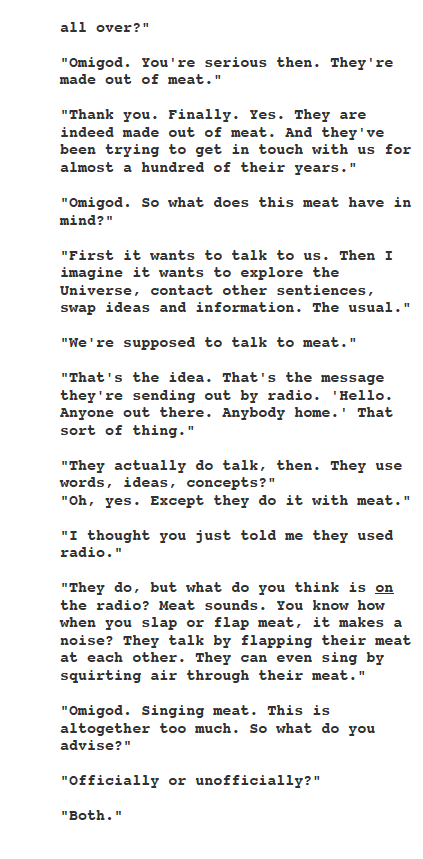
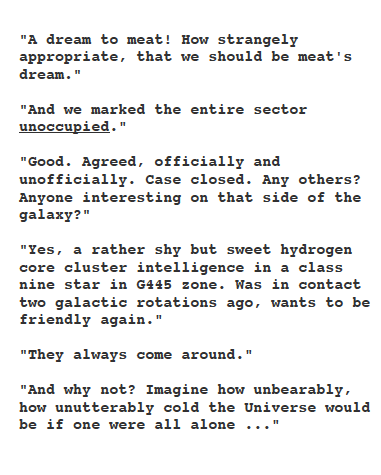
The first chapter of Colin McGinn’s book The Mysterious Flame includes an excerpt from a science fiction story by Terry Bisson. A bit of simple tracking uncovered the mother ship of the entire text, which Mr. Bisson has graciously offered to the Creative Commons.

During these dog days of August, we find his brief dialogue between two alien intelligences both entertaining and perceptive, regarding the strange human paradox of sentient meat:


Bones to Philosophy


In the above scene from a 1965 television documentary, J. Robert Oppenheimer describes his reaction to the Trinity test explosion, while brushing away the threat of a tear:

 
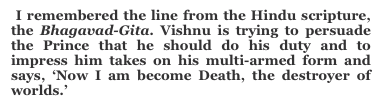
Some translators have preferred Vishnu the shatterer, rather than destroyer. A recent essay by Allen S. Weiss notes that while the English word “pottery” refers to the shape of the object as a vessel, the Japanese “yakimono” means “fired thing”; surely Hiroshima was shattered by the fire-blast of August 6, 1945.
 
In the same year as he delivered these oft-quoted lines, frequently interpreted as evidence of a deep remorse for his role in the slaughter of a civilian population, Oppenheimer told a reporter from the New York Times Magazine that he had simply performed his duty:  “I never regretted, and do not regret now, having done my part of the job.”  He also told Newsweek, “At Los Alamos, there was uncertainty of achievement but not of duty,” and on the day before Hiroshima Day 1965, he said that “when you play a meaningful part in bringing about the death of over 100,000 people and the injury of a comparable number, you naturally don’t think of that as—with ease.”
 

HIROSHIMA: ILL AT EASE?

In 1954, while being interviewed for a security clearance related to work on the hydrogen bomb, Oppenheimer was asked if he felt any moral revulsion regarding such work. He countered that the word “revulsion” was too strong, while also rejecting the word “moral”. The use of the bomb by politicians and warriors was not his province nor his responsibility; as a scientist, he must simply do his duty, in the lab and on the testing ground.
   
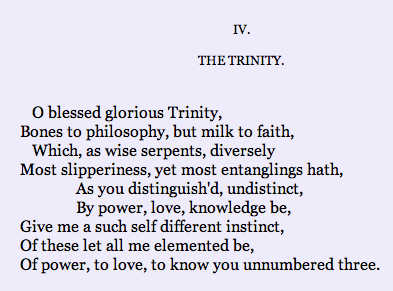
A fascinating essay by James Hijiya (who guided us through the above citations) suggests that Oppenheimer used philosophy (above all the Gita) as an anodyne for occasional sharp pangs of conscience. It is certainly evident that matters of conscience bothered him at an abstract level, and that he was in need of frequent intellectual balm, whether from Hindu philosophy or from the pages of Shakespeare. Indeed, Hijiya notes that Oppenheimer’s fondness for John Donne’s poetry may have yielded the name for the historic Trinity test blast in the Jornada del Muerto:
 
  
Impossible to summarize here, Hijiya’s comprehensive forensic examination of Oppenheimer’s complex yet ultimately vacant conscience ranks in the same class as Gitta Sereny’s examination of Albert Speer upon his release from Spandau. Prompted and prodded by his dialogue with Sereny, Speer is ultimately the more honest and forthcoming of the two in confronting his moral limitations, though one wonders what might have emerged had Hijiya been able to directly engage Oppenheimer in a similar way.
 
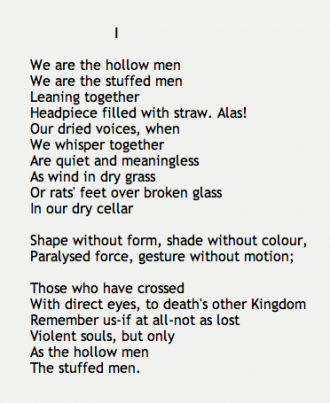
Influenced by Hijiya’s close genealogical analysis of Oppenehimer’s citation from the Bhagavad Gita, we revisit the above documentary clip. In place of harrowing self-scrutiny, we now hear an empty seed pod rattling around inside this brilliant man, as if the worm of conscience had left behind not rich black soil, but an empty echo chamber, resounding with false Dharma and self-serving fatalism. T.S. Eliot, another of his favorite poets, knew this condition well: for all his abundant intellectual power, Oppenheimer became a “paralyzed force, gesture without motion.”
 

Moral Predators

THE CATEGORICAL IMPERATIVE

In 2010, philosopher Bradley Jay Strawser published an essay titled “Moral Predators: The Duty to Employ Uninhabited Aerial Vehicles” in the Journal of Military Ethics. The key passage, slightly reformatted below for clarity, reads as follows:

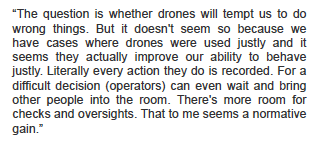
During a recent interview with a correspondent from the Guardian newspaper, Professor Strawser, who now teaches at the elite Naval Postgraduate School, summarized his position as follows:

He also asserts that drone warfare permits greater transparency and accountability, since each deployment is recorded for later analysis:

Yet if such normative gain is achieved outside juridical oversight, then Strawser’s PUV does not meet its own obligation to “the demands of justice”. Where there is no law, there can be no accountability, and evidence for the extralegal murder of non-combatants through the use of UAVS is compelling and well documented. While UAVs project the illusion of greater precision and accuracy, recent historical experience on the ground has presented us with more “downside” than even the upbeat Professor Strawser would wish to accommodate, by his own ethical and philosophical standards.

UAVs are only as accurate as the intelligence gathered regarding human targets, intelligence that is inherently ambiguous, above all in highly complicated regions such as Waziristan. Accuracy and precision of delivery for the lethal force becomes morally repugnant when the target turns out to have been innocent, misidentified as a result of tribal or family feuds, or by in-fighting among various intelligence agencies.

Further, Strawser’s PUV appears to imply that the single driving motivation for the development and increased use of UAVS has been reduction of risk for pilots. Yet the actual motivations shaping drone use have been more complex, including their psy-ops value as exemplary instruments for the strategic doctrine of Shock & Awe.

Finally, physical, visceral confrontation with battlefield carnage remains among the few reliable deterrents to armed conflict, as each generation learns, over and over again, that War Is Hell; with only the “moral predators” of remote controlled UAVs to bear witness to the chaos, we can be sure that the war will go on and on … forever. Maybe that is the deeper play?

We note the following quote on the home page of Professor Strawser’s website:

“Two things fill the mind with ever increasing wonder and awe, the more often and the more intensely the mind of thought is drawn to them: the starry heavens above me and the moral law within me. Morality is not properly the doctrine of how we may make ourselves happy, but how we make ourselves worthy of happiness.”

– Immanuel Kant

Shocked & Awed


Sans Soleil

CM SANS SOLEIL

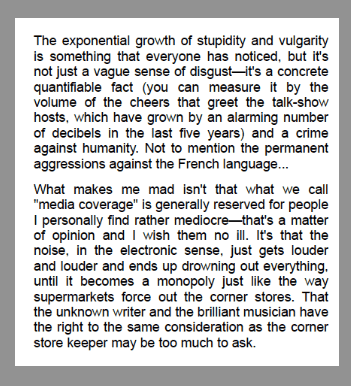
We note with sadness the death of Chris Marker at the age of 91. Marker wrote very little about his films, and shunned publicity. Below, edited excerpts from a rare interview published in the newspaper Libération, March 5, 2003, and translated into English by Film Comment:

And finally, a brief passage from his brilliant masterwork Sans Soleil, in the voice of the narrator:

Onwards into the unknown, dear CM.


The Core Account

We have been keeping a wary eye on affairs in Old Europe, wondering how so many cultures with many hundreds of years of divergent history can possibly be reconciled. Thus you can imagine our excitement when we stumbled across an online white paper written by a distinguished political philosopher of our own invention who presently teaches at the University of Bielefeld: Professor Wolfgang Keinengels.

Keinengels has been scratching his head over various thorny issues of European history for two decades, and now believes he may have found a solution to the problem of profoundly unbalanced accounts throughout the Eurozone. We spoke in German with Professor Keinengels last week, and offer the below edited and abbreviated transcript {reviewed and approved by WK} to our loyal readers, hoping to convey the gist of his radical and far from modest proposal:

HEAVY DIRT-DENKEN AT BIELEFELD

DP      You write that Europe has an intractable problem of history, that in your view history and its residues in daily consciousness within the life-world {Lebenswelt} constitutes the critical ontological problem in Europe; the “core account” that must be reconciled before the crisis can be resolved.

WK     Yes, and of course it seems so obvious when you say it just like that in one sentence, but I wanted to see what would happen if we really pursued the idea, dug into it if you like: French dirt, German dirt, Greek dirt and so forth. It began as a kind of thought experiment, but sometimes you begin something like this, dirt digging, and then you finally hit something solid, I mean, not just the bones of some ancient conflict, but solid gold so to say, an idea whose time in the sun might finally have arrived.

DP      And that is what you mean by the “rebalancing of variable dirt”?

WK     Exactly. You see, the core problem of Europe is that our dirt — not our soil but our dirt — is so profoundly different, that is to say, the lived experience among bodies in relation to the demands of nature and landscape have taken quite markedly distinct forms and shapes and rhythms depending on where you performed the entire range of bodily functions; in that sense, there is no Europe, there has never been a Europe; there are instead these different “residues of life-world experience” that derive from dramatically distinct experiences, and these residues yield different qualities of dirt and become, if you will, part of the national treasure or inheritance, that is, not what comes out of the dirt, but the dirt itself {Schmutz-an-sich}, which is the symbol of the shared experience of the collective corporeal identity that always must take grounded earth as its essential existential property.

DP      We were particularly struck by your thoughts on how consciousness relates to these different existential dirt balances {existentielle Schmutzguthabens}, as your call them.

WK      Yes, based on contemporary advances in neurobiology, some of them happening right here at the University of Bielefeld, we propose that the ground upon which we walk does significantly shape and impact our moment to moment consciousness of self, above all self in relation to the social-political group, and thus it is not realistic to expect that consensual decision making will emerge from such radically unreconciled dreck accounts, or Schmutzguthabens.

DP      We suppose that what some may have found controversial in your analysis is your idea of a trans-European market for these Schmutzguthabens.

WK     Yes, at first we simply wanted to see where the thought process would lead, but as we got deeper, we realized that we may have uncovered a fresh approach with massive policy implications. It is true that different dirts have different values, and that in part depends on the depth of the smut, and the deepness of the history, but in theory we can imagine a certain “charge” or “value injection” that is stored in these different dirt balances, charges that will have an impact on day to day consciousness in the Lebenswelt.

DP      How does that work?
HIS DIRT HAS VALUE

WK     For example, we Germans sometimes look at the average Greek citizen and wonder how he can still be so happy, with all the problems in Greece; he is still happy and smiling. That happy consciousness is based in the very particular granularity of the Greek storehouse of Schmutzguthaben, and the residual effect of that charge on everyday life, in private consciousness.

DP      Emotions grounded in historical experience, stored in the core account …

WK     Yes, exactly, I mean the happy Greek is deeply happy, irregardless of the present temporary despair; and it all comes through the feet, through which the Greek person knows, at a subliminal prelinguistic level, that in ancient times this was a well functioning and enlightened society, indeed the birthplace of so much culture, art; the polis and philosophy. Meanwhile at the same time in ancient Germania, we were basically animals, rutting and squatting in the dark wood.

DP      So in essence, you’re talking about cutting a deal, dreck for dreck, so as to secure a piece of the Greek core account, and thus incorporate the happy Greek Lebenswelt?

WK     No, I doubt there would be any takers for a straight trade, given the heaviness of German dreck, not just in ancient times, but also very conspicuously in more recent history – the really nasty Geschichtliche Scheisse that feeds what you might call the great German Kopfschmertz. But what we do have is something missing in the Greek situation, and that is economic prosperity; so the idea is that Germany would agree to assume the economic debts of Greece in exchange for Greece assuming part of the headache stored inside the German Schmutzguthaben.

A FEW SORE POINTS

DP      So you mean to turn historical guilt for the Nazizeit into a sort of toxic waste, dumped on the Greeks?

WK     No, I reject that sort of characterization, though you are not the first to use it. Our belief is that this core account rebalancing would lead to a certain evening out of the respective situations, as Greece would receive a nice welcome injection of German prosperity, and Germany would receive a nice injection of the Greek happy consciousness. We fully understand that while German dirt would go to Greece, there is negative exchange value there – a net liability – and so the deal needs to be sweetened with other benefits, in the form of debt forgiveness and other economic compensations such as home appliances and luxury automobiles.

DP      So in effect, Greece would be voluntarily accepting this dirt as the physical repository of historical guilt, in exchange for Bosch dishwashers?

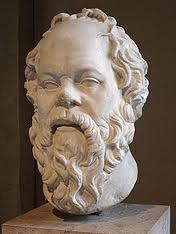
WK     Yes, but try to see the bright side. We doubt that Europe will find any way forward into the future unless we start sharing everything. Like in a marriage, you take the good with the bad. It is pointless to speak of a banking union, or a fiscal union, unless you have a union in consciousness, and this means also a dispersion of historical implications and consequences, if you will, such that we all walk on the same earth, and smell the same mud. Why should Germany not be able to have some small stake in the origins of western philosophy? This way,  Nietzsche residues can intermingle in a very material way with particulates from Socrates and Plato; does this not have a certain ring of truth to it?

DP       No comment on that one, for now; so how has all this been received?

WK      Well, first there was shock. We anticipated that. First comes shock, and then comes reality. The hard fact is that there is not much else of value in Greece for Germany to receive from them in trade, beyond their valorized consciousness, as expressed and stored and sustained through Greek Schmutzguthabens, and we see this reality slowly but surely sinking in, with more and more people coming around to our way of thinking.

DP       How so?

WK      We have had plenty of offers to broker private placements at a family or community level; offers to receive a few tons of German dirt here and there. At a national level, it will likely take more time, but we’ll get there. The fundamental point is that there really can be no European future until these historical inequalities have been reconciled properly, through the marketplace.

DP      What about the logistics of this plan? Is this not a massive undertaking, moving so much dirt from north to south and from south to north, across such challenging terrain?

WK     Yes, and that is where the secondary benefits come in. As you know, there are very high unemployment levels in places like Spain and Italy. So those populations now receive immediate benefits of good jobs and new mechanical skills. Then maybe down the road we can arrange similar reconciliations with each of those countries, too. We have no illusions about the size and depth of the German Schmutz-Probleme. We are all too conscious of that — indeed we have a surplus of such heavy consciousness, which we now wish to trade for a happier, sunnier state of mind.

DP      In other words, there is plenty of Kopfschmertz and Geschichtliche Scheisse to go around?

WK     You might say that, yes, though putting it more positively you could also say there is plenty of good German prosperity to go around too. Let’s be fair about it and share everything, the good with the bad. Then we can start talking about a true European union.

HEADACHE TABLETS


Three Sheets

I

WORRISOME?

The Greenland ice sheet has apparently melted this month at a rate considerably in excess of any other thaw in recorded history. This follows the calving of an iceberg from the Petermann glacier the size of Manhattan. Goddard Space Flight Center glaciologist Lora Koenig said, “If we continue to observe melting events like this in upcoming years, it will be worrisome.”

Last year, a University of Washington study led by Twila Moon used satellite data to track the progress of two hundred Greenland glaciers between 2000 and 2010: “Previous studies only had a couple of observations from big glaciers. We found we are certainly not on the worst-case scenario, but the glaciers are speeding up and we see no sign of that stopping. We found, contrary to conventional wisdom, that glaciers have rapid and large changes in speed.” Regarding the resulting inevitable rise in sea levels, Ms. Moon noted:  “If you raise the floor of a basketball court by just a few inches, you will see many more slam dunks.”

Leaving the curiously unsupportable logic of grounded bodies dunking a floating net aside, if the rate of melt increases any further, even to the point of Moon’s “worst-case scenario”, will we then get to spike the football?

II

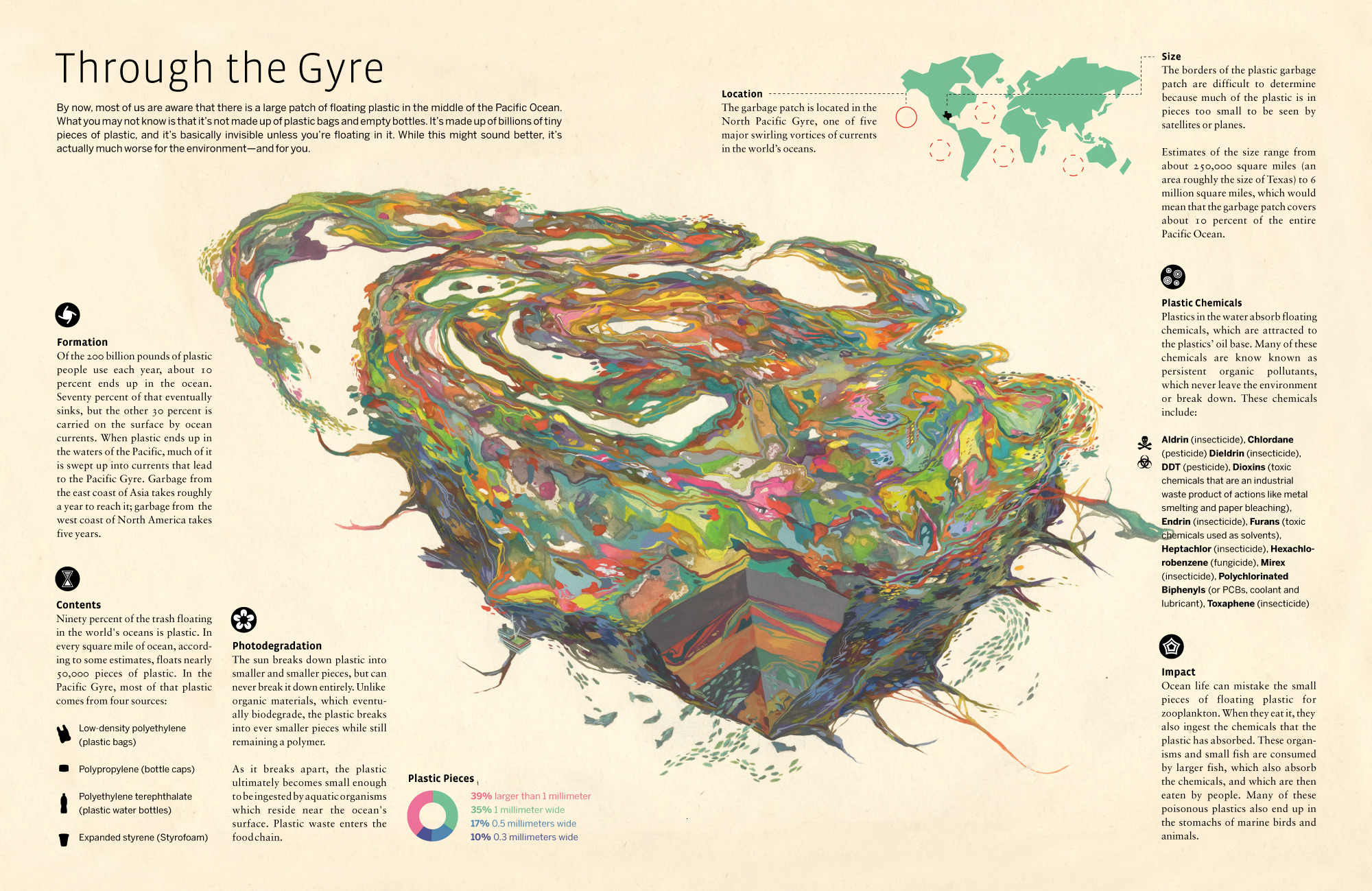
As one sheet melts into the sea, another takes shape as an immense gyre created from tiny pieces of pelagic plastic and other industrial debris floating beneath the surface; water within the gyre contains at least six times more plastic molecules than phytoplankton, the organisms that occupy the bottom (and most essential) rung of the marine food chain. A 2008 study found a ratio of forty six to one, suggesting that the rate of concentration is accelerating through time. Estimates of size vary widely, reflecting the difficulty of defining boundaries; where does it begin and where does it end?

In 2009, photographer Chris Jordan travelled to Midway Island to document the death of baby albatrosses. Mothers scoop the plastic from the gyre and feed it to their babies. The bodies of the baby albatrosses decompose, yet the previously ingested plastic remains intact. These dramatic photographs caused a momentary global crise de conscience, and then they too disappeared into the opaque plastic soup.

DECOMPOSED INDIGESTION

III

We recently attended a poetry reading at a nearby gallery, and in the thematic environs of Birds, Bats & Riddles. The riddler-poet was Jon Swan, whose poems celebrate resilience and grieve degradation, sometimes within the very same line. Among the many excellent poems voiced by Swan on this occasion:

ANGELS OF GRACE, FORGIVE US


Fortress of Seclusion

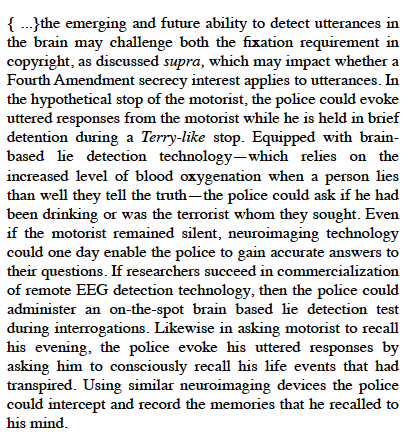
While researching the dense tangle of legal issues raised by Thomas Metzinger’s  neuroethical speculations in The Ego Tunnel, we came across a lucid article by Nita Farahany, whose most recent work explores the difficult philosophical tensions between neurobiology and constitutional law. The entire article is worth careful reading; the passage below has specific relevance for Metzinger’s issues of autonomy, self-models, privacy and state intrusion:

LASS MICH ALLEIN


Your Worst Enemy

AN OPEN BOOK?

In one of the more troubling passages in his book The Ego Tunnel, philosopher Thomas Metzinger contemplates a range of ethical issues deriving from the what he expects to be the inevitable emergence of forensic neurotechnologies such as infallible lie detection; how would such a technology change and disrupt our “self-models”?

We find this rather breezy discussion of the “ethics”  governing the will of any despot – to lay bare the ‘secret selves’ of the body politic – all somewhat bewildering, given that two pages before this, Metzinger had submitted the bold and apparently non-negotiable axiom:

If we take this latter statement to be valid, then does not such political autonomy include “the enjoyment of intellectual autonomy”? If so, then is there any ethical question whatsoever, in this consideration? Is not the boundary line abundantly clear, a line that must be vigorously defended, without compromise?

Or let us put the question another way: if “the paradigm of privacy” is not part of the aspirational political autonomy of “free societies”, then what, pray tell Professor Metzinger, is such autonomy?

NEW SELF-MODEL

Of course, we need look no farther than the first chapter of 1984 to find pioneer neuroethicist George Orwell unfolding his vision for what happens when the ego tunnel is fully illuminated by a totalitarian state hungry for neuromniscience:

Or in Chapter 5:

And then in Chapter 6, ever more concisely:

The objection that forensic neurotechnologies transform our own nervous systems into our own worst enemies would likely elicit this sort of reply:

Look, these technologies are coming, whether we want them or not. The commercial possibilities for niche applications are staggering (just think about the field day for divorce lawyers!), and once the technologies have a foothold in these relatively benign niches, a more generalized use, mediated by state authorities, will almost certainly become a reality. To resist such a tidal wave is futile: focus on how certain protections might be introduced, such as my idea of a ‘mental sphere of privacy’ which would be considered sacrosanct. And just think; there will no longer be any need for “no touch torture”, because the prisoner will have absolutely nothing to hide

We recall a similar sort of fatalism at play within Jeffery Rosen’s otherwise excellent (and thus largely ignored) The Naked Crowd. Passive submission to body scans is one thing; routine examination of neural “fingerprints” quite another. Yet the two are connected, and indeed in years to come we may find that the one leads to the other like the spine leads to the brain.

SEDITION, SCANNED


Storms of Thought

EGON’S THOUGHT STORM

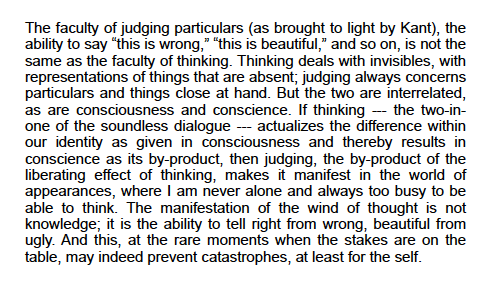
In her discussion of conscience as the inevitable by-product of thinking (Life of the Mind ), Hannah Arendt quotes Heidegger’s Was Heisst Denken:

For Arendt, the figure of Socrates offers a crucial model:

Socrates himself describes this quality of movement with reference to the metaphor of the wind: “The winds themselves are invisible, yet what they do is manifest to us and we somehow feel their approach.”

While tracking this philosophical mistral from Socrates through to Arendt and back again to Socrates, we received an email from a friend who was completely oblivious to our ethereal tell-taling, yet who must have sensed something loose in the air, for the poem was from Rilke, in the Bly translation:

Rilkean  “growth” – the growth enabled by such recurrent decisive defeats – represents an expansion both of the quality of conscience, with regards to the silent dialogue with the self and of the quality of the judgement, which is the manifestation of the wind of thought within the world of appearances.
When Arendt meditates upon Eichmann, she zeros in on  “… the only specific characteristic one could detect in his past as well as in his behavior during the trial and the preceding police examination was something entirely negative: it was not stupidity but a curious, quite authentic inability to think.” Absent the winds of thought, conscience remains inert; absent conscience, the thoughtless subject knows no evil, and thereby becomes capable of any action, and any thing.

A DECISIVE DEFEAT


Live in Hiding

In a recent essay titled “How to Think”, Chris Hedges writes:

Arendt’s comments (including her own allusion to the Epicurean lathe biosas), were made within the context of her acceptance speech for the Danish Sonning Prize, given every two years for significant contributions to European civilization, and whose recipients include many writers and artists with whom we have (happily) wrestled: Pamuk, Enzensberger, Barba, Kieslowski and Habermas. Arendt received the prize in 1975, and used the occasion to offer a brilliant , subtle and quite humorous discursive resistance to the entire idea of recognition-in-philosophy:

Hedge’s reference to Arendt’s comments on the inability to think comes from an entirely different source, her book The Life of the Mind, where further along she also writes:

Hedges closes his own essay with another echo from Arendt:

UNCOMMON POIGNANCY