Author Archives: DP

None Else By

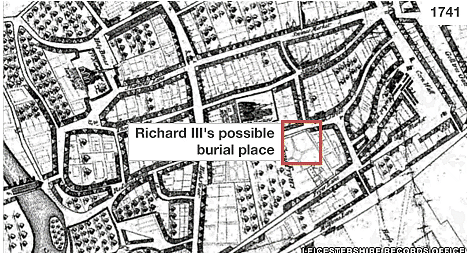
We note with great interest the possible discovery of the bones of Richard III at the site of the fifteenth century friary of Greyfriars, in the choir of the old church, excavated from beneath a Leicester car park.

As described in the first-hand account provided by archaeologist Mathew Morris:
AND THUS I CLOTHE MY NAKED VILLAINY

Shakespeare, whose characterization of Richard III drew heavily from a tendentious bit of propaganda scribed by Sir Thomas More, nonetheless provides us with an exceptionally vivid examples of interior disharmony:

Shakespeare had a keen ear for such acrimony between the “me” and the “myself”, which he understood as the essence of consciousness, Plato’s “soundless dialogue”. The worm of conscience chews away invisibly at the public ego, capable of anything; for the duration of the play Richard tries to dig the worm from his brain because:

Shakespeare also knew a thing or two about bones, and their ambiguous and often discordant tales. In Julius Caesar, Marc Anthony delivers the famous line:

“The evil that men do lives after them, the good is oft interred with their bones.”

As the bones of Richard III may now be disinterred, we wonder: what good will come from them?

O COWARD CONSCIENCE


Like a River Flows

CAN’T HELP FALLING

Last week, a bible given to Elvis Presley by his Uncle Vester and Aunt Clettes on the occasion of his first Christmas at Graceland in 1957 sold at auction for £59,000. The volume was heavily underlined; sparsely annotated.

INKED BY THE KING

At the same auction, a pair of underpants worn during Presley’s final tour — and possibly during his final performance — failed to meet the reserve price of £7,000. The last song Elvis performed at his last concert on June 26, 1977: Can’t Help Falling in Love. Elvis died on August 16, in a bathroom at Graceland.

SOILED TO THE HIGHEST BIDDER

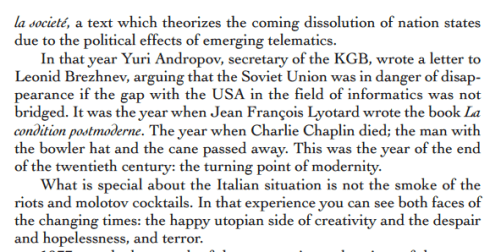
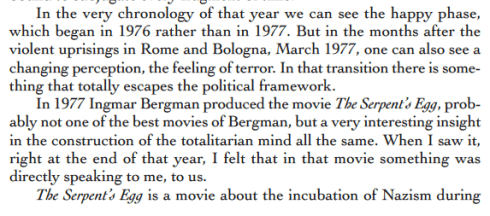
The Italian media philosopher Franco “Bifo” Berardi sees the year 1977 as pivotal, as described in this brief montage of excerpts from his Precarious Rhapsody:

GERMANY IN AUTUMN: CRACKED EGG

PRECARIOUS RHAPSODY


Expertise and Emptiness

THE CARNAL CONTEXT FOR MORAL PHILOSOPHY

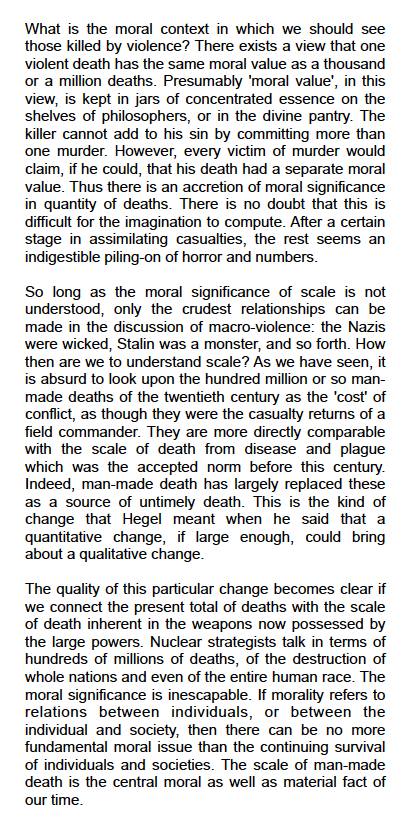
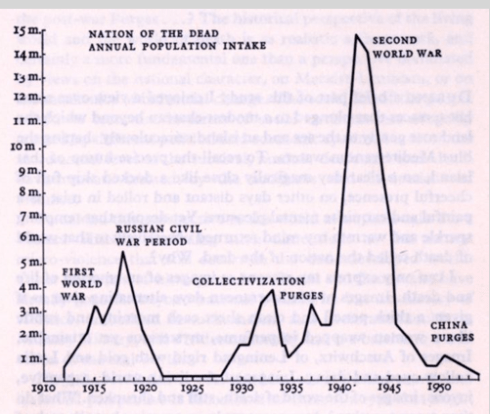
In Straw Dogs, while discussing the dark tango between scientific progress and mass murder, John Gray makes reference to the remarkable yet neglected study of human violence: The Twentieth Century Book of the Dead. Written by Gil Elliot, the book was published in 1972, with twenty eight years of violence still left in the century, including the vast killing fields of the Khmer Rouge. In the passage below, Elliot tries to digest the indigestible:

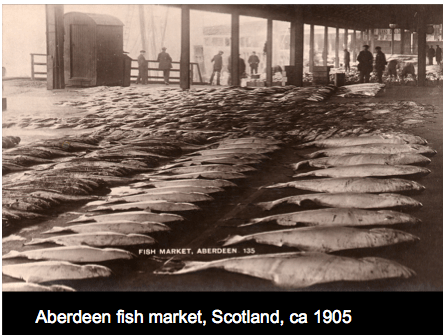
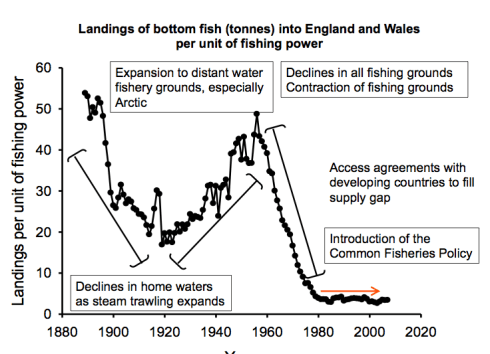
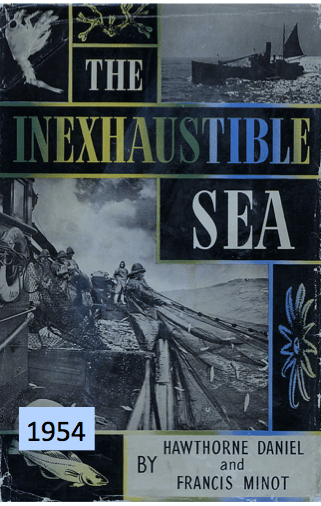
Let us now return for a moment to Reviel Netz and his “ecology of modernity”; his thesis that history is embodied not only in the bodies of human beings but in the bodies of all living things. Next, let us contemplate the staggering violence inflicted upon global fisheries, as documented (among others) by Callum Roberts.

Consider the following slides from Roberts’ report on the past and future of European fisheries:

THE MORAL SIGNIFICANCE OF SCALE

HEGELIAN QUANTITY ON THE HOOK

RHYTHMS OF SLAUGHTER

Returning to The Twentieth Century Book of the Dead,we find a strikingly similar graph, and (elsewhere in the text) an astonishing passage regarding the “universal body of death”:

THE NATION OF THE DEAD

We close for the day with one final duet from Roberts, on the theme of our apparently limitless appetite for disappearance:


Don’t Look Back

LOOK FORWARD

Last week, Attorney General Eric Holder closed the door on any accountability whatsoever for past war crimes and acts of torture. In truth, the door had by then only been open a few centimeters, but now it is slammed shut, locked and chained.

_____________

The key sentence:

Based on the fully developed factual record concerning the two deaths, the Department has declined prosecution because the admissible evidence would not be sufficient to obtain and sustain a conviction beyond a reasonable doubt.

This decision to “decline prosecution”  is consistent with the Orwellian Obama Doctrine of “Don’t Look Back”, as articulated on the below clip from the January 11, 2009 edition of This Week:

Transcribed, Mr. Obama’s remarks read as follows:

More than any other, this statement belies the undercurrent of lawlessness that courses through Mr. Obama’s entire tenure as President. As any first year law student knows, the rule of law is inherently backward looking, whether by careful review of facts for events which have (always) transpired in the past, or through reference to legal precedent – that vast repository of past wisdom and consideration that is stored within hundreds of years of prior adjudication.

A constitutional republic, such as the one that used to exist here in North America, cannot function without constantly looking backward; without justice regarding past crimes, the future has no standing. Most shockingly, Mr. Obama suggests that the ever-expanding domain of “national security” (which now includes everything from commercial air transport to the banking system) shall be placed outside the “backward looking” law, and be permitted to unfold without any constraint whatsoever. Such views, from a man who once taught constitutional law?

By stark contrast, let us recall lucid preface contributed by Major General Antonio Taguba to an extensively documented analysis of medical evidence released by Physicians for Human Rights in June 2008:

SOMEWHERE OVER THE SHOULDER

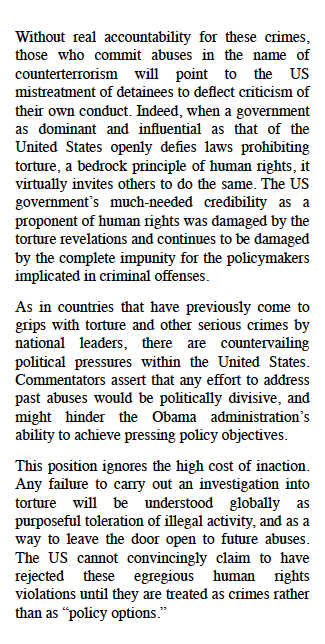
As for the long term price of impunity for the perpetrators of these abhorrent crimes, we turn to a second well documented report, submitted by Human Rights Watch in July, 2011:

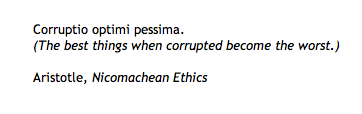
Those who defend our gradual slide into a bifurcated legal system – with one standard applied to “commoners” and another to the wealthy and powerful – with the claim that our system functions well on a relative basis (relative, say to Afghanistan or Russia) would do well to meditate upon the words of Aristotle:


Double Ice Axe

THIS IS NOT A PADDLE

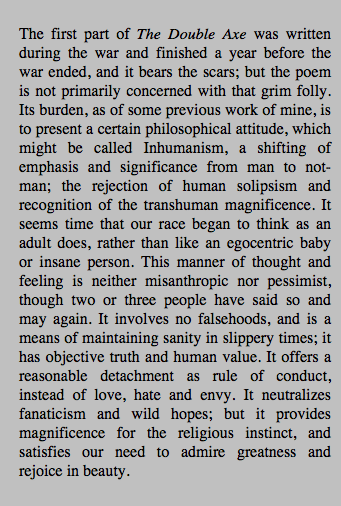
In recent days, we have been rediscovering the poetry and philosophy of Robinson Jeffers. In his remarkable preface to The Double Axe (1948), Jeffers writes:

By “inhumanism”, Jeffers is not proposing a standard of interpersonal conduct but rather a way of experiencing the world that breaks loose from the solipsistic assumption that the human species alone embodies meaning in the universe.

Meanwhile a DP associate, knowing of our interest in the arctic ice sheet and its potential chilling impact on the solipsistic worldview, alerted us to updated data regarding the arctic ice melt, as monitored by the National Snow & Ice Data Center. On the graph below, the left hand unit of measurement is millions of square kilometers. The blue line for 2012 is on track for a dramatically new record low, which appears to be in excess of six standard deviations from the norm. Statisticians will comprehend the implications of such extreme data:A second graphic provides a bird’s eye view, with the orange outline representing the median melt; keep in mind that as of this posting, we are still three weeks away from the normal September data point for the minimum extent.
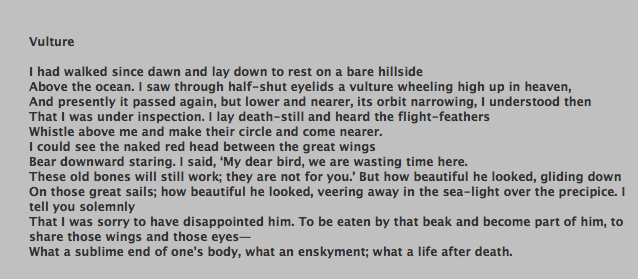
A perspective of “inhumanism” may not be one that we freely choose, but rather one that is forced upon us, as mother earth harshly reminds us of our pathetic insignificance. It may be timely to meditate upon Jeffers’ poem, Vulture:

CLICK TO ENLARGE

FOOD FOR THOUGHT


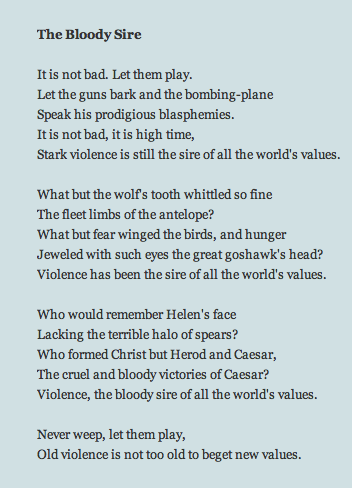
The Bloody Sire

SWIMMING HOLE FOR STRAW DOGS

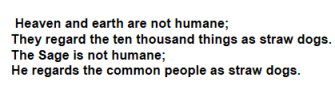
John Gray’s aphoristic compendium of thoughts on humans and other animals derives its title Straw Dogs from an oft-quoted passage in Lao Tzu’s Dao De Jing:

The passage in Chinese, with a translation courtesy of Richard Garner, reads as follows:

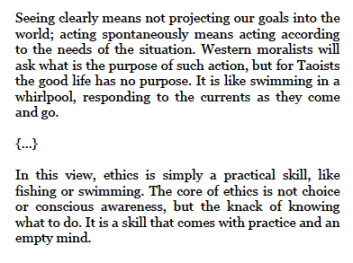
As Garner points out in his helpful commentary, the meaning of the passage depends very much on the philosophical baggage one brings to the sacrificial altar. With the turn of a new millennium (Straw Dogs dates from 2002) Gray – who had once carried rather heavy baggage – appears anxious to travel light. In his chapter The Vices of Morality, passage fourteen, he writes:

From Gray’s anti-humanist perspective, purpose suggests delusions of progress, delusions that are always destructive and often lethal. Happy to go with the flow no matter how vicious the maelstrom, Gray takes any notion of homo rapiens  “salvation” as a desperate form of solipsism.

The full context for the citation from the epic poem by Robinson Jeffers crafts a vision of the opposite coast rather more subtle and complicated than that of the soggy Taoist swimmer Mr. Gray, and the entire stanza is worth a careful reading:

John Gray owes a good deal more than a footnote to Jeffers’ philosophy of poetic “Inhumanism”; Jeffers, long the poet laureate of Deep Ecology. It has been fifty years since Jeffers’ death; meanwhile, the Bloody Sire {Jeffers, 1940} begets fresh carnage, and from the carnage flows fresh value, of a sort.
___
___

LET THEM PLAY


Free Pussy Riot

With a deep elective affinity for the young women of Pussy Riot, we add our voice to those demanding their immediate freedom. We understand that the suppression of their voices signifies only the tip of a very large iceberg, yet some tips are more revealing than others. Here is the August 16 Letter to Supporters from band member Nadia Tolokonnikova,  followed by a a translation courtesy of EngPussyRiot:

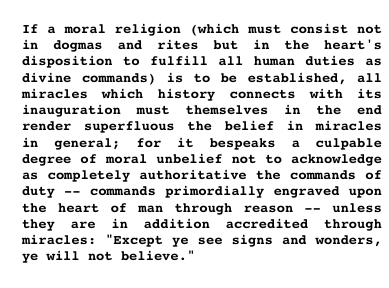
The relevant passage from Kant’s Religion Within the Limits of Reason Alone:

PUTIN OBEDIENCE BOX

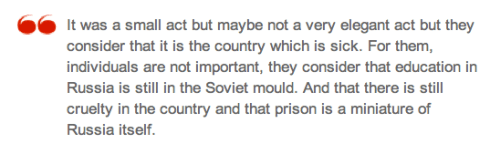
On the other side of the dialectic, we offer a brief quote from the lengthy disquisition by the presiding judge in this most conspicuous show trial, as provided by the Guardian’s live blog:

CLICK FOR VIDEO

Here is the full text for the punk-prayer that led to Pussy Riot “incrimination”, with thanks again to the Guardian’s live blog feed:

Why is Vladimir Putin so terrified of Pussy Riot? Because they have him, nailed. For such astute and truthful analysis, they must be punished. Russian history is full of brutal kleptocrats pretending to have authority conferred directly by God; in a previous epoch, such individuals were called “czars”.


We Are the Dark Side

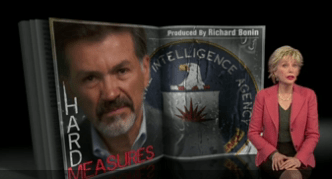
Alfred McCoy has released his new study of coercive interrogation and “no touch” torture: Torture and Impunity: the US Doctrine of Coercive Interrogation. McCoy provides a concise summary of his investigation in an essay on the indispensable TomDispatch in which he outlines the nasty pincer of impunity at home and rendition abroad. This led us to review the extraordinary 60 minutes interview between Lesley Stahl and José Rodriguez, the former head of the CIA Clandestine Service, and the chief executor for the regime of “enhanced” interrogation imposed during the years following 9/11.

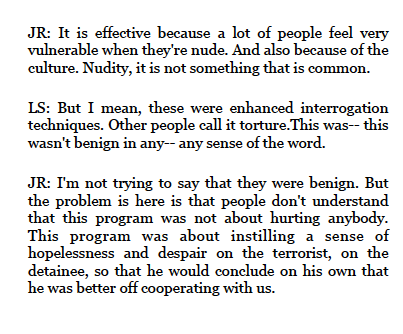
The interview received scant attention at the time, and quickly disappeared into the media whirlwind of scandals and crisis, or was dismissed as nada de nuevo. The transcript makes for sobering reading, and reveals what Gitta Sereny would call a “corrupt personality”; corrupt as in broken, together. Even Lesley Stahl, well seasoned after decades of exposure to venality and corruption in every shape and measure, appears perplexed by the moral vacuity and lack of self-reflective conscience exhibited by Mr. Rodriguez. We have slightly edited and compressed excerpts from the transcript below:

The use of the word “qualm” in interesting in this context, as it descends from the Old English quealm, referring to disaster and plague. The conscience of the dark side qualmeth not. The dialogue goes on…

One might insist that “big boy pants” would rather mean adhering against all pressures to inalienable human rights, and insisting also on protocols of thorough verification for the “flood of intelligence”, most of which turned out to be waste water. Difficult to quibble, though, with a Man With No Qualms. And so the dialogue goes on…

We marvel at the ease with which Mr. Rodriguez articulates the distinction between “not hurting” and in the next breath “instilling a sense of hopelessness and despair”. We also note the instant and effortless elision of terrorist into detainee, as if the designation “terrorist” had been established as legitimate in each and every detention, a claim that we have since learned to be false.

Alfred McCoy (among others) has amply documented the severe damage done to victims of no touch torture; wounds to fundamental identity and to the invisible yet essential sense of self are in many ways far more cruel and damaging than wounds to the body. We read this interview and feel many qualms indeed: U pisciu puzza era capu.


Ruin Value

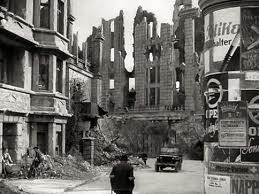
Fairly early on in his memoir Inside the Third Reich, Speer reconstructs the dialogical genesis of his Theory of Ruin Value:

We note that it is the conscience of a future Germany that would be the subject of such monumental messages. But let us not get stuck in mnemonic mud, for Speer trudges ever onwards to the Zeppelin Field:

For the purposes of imperial memory, above all an empire which dreams of virtual eternity, present buildings have diminished utility if they fail to project heroic decadence for posterity. Shortly after these invigorating discussions, Hitler would appoint Speer as a department chief on the staff of his Deputy Rudolf Hess, who would later provide Speer with moral support for his imaginary “walk around the world”.

THE LAW OF RUINS

In a recent post delivered from inside his well-crafted Charnel-House (with a nod to Corbu),  Ross Wolfe invites our rumination thusly:

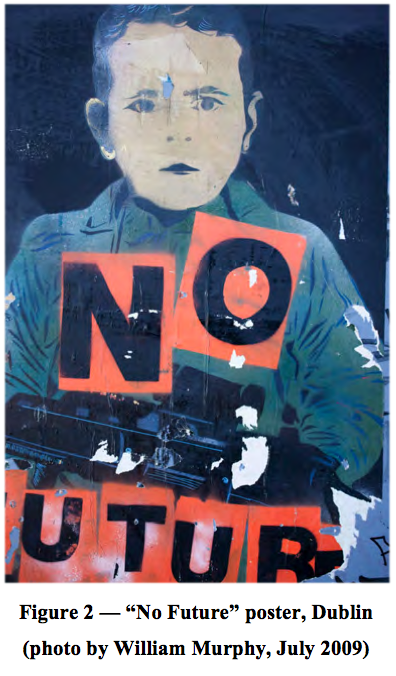
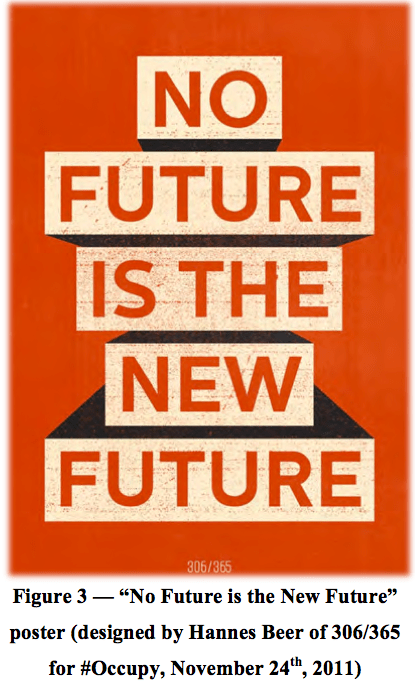
Wolfe then goes on to discuss the “futureless present” theorized inter alia by the Italian Autonomist and desperado philosopher Franco (Bifo) Berardi, whose analysis might best be conveyed graphically by these two Occupy posters {as documented in the Charnel-House} :


Towards the end of his lengthy post (downloadable as a PDF), Wolfe quotes Owen Hatherley from his book-manifesto Militant Modernism:

With this in mind, we turn to the webiquitous images of a No Future ou topos; the abandoned Chinese theme park known as Wonderland. Typically discounted as a folly of central planning, or as fetish-evidence of the perverse malinvestment that runs riot during global credit bubbles, perhaps Wonderland offers a hint of things to come for those who wish to contemplate the interior architecture of some future conscientia.

And for those intemperate pilgrims who hunger for the ultimate “no place”, take heart, for we are getting there at a speed which guarantees a truly spectacular final act.

MODEL FOR AN EVISCERATED HISTORY


Made Out of Meat

The first chapter of Colin McGinn’s book The Mysterious Flame includes an excerpt from a science fiction story by Terry Bisson. A bit of simple tracking uncovered the mother ship of the entire text, which Mr. Bisson has graciously offered to the Creative Commons.

During these dog days of August, we find his brief dialogue between two alien intelligences both entertaining and perceptive, regarding the strange human paradox of sentient meat: