Author Archives: DP

Severe Harmony

HEAD MOLE FOR SOULFUL SOIL

We sing today our praises for the extraordinary work of Karinne Keithley Syers, an artist-philosopher in the very best of senses; one who uses all her senses.

While doing a bit of ruminative slogging through the dense sediments of the web several years ago, during a time when we thought creative brain activity on planet earth had ceased, we chanced upon Keithley Syer’s Basement Tapes of the Mole Cabal, and they cheered us up considerably and left us wanting: more.

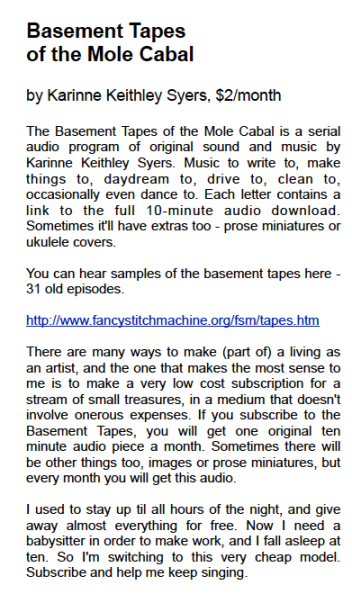
Perhaps a wired bird reached her ear with our request, for it seems Ms. Keithley Syers has recently renewed her basement excavations, available for a very modest fee:
__________________________________________
The announcement of a resurfacing of the Mole Cabal prompted us to ask all those questions we had wanted to ask upon first hearing the gentle excavations of this delightfully curious creature:

DP     First, can you venture a brief description of the basement tapes, in terms of the different categories of material, and the process you follow for assembling such hauntingly beautiful bits of thinking/singing/tunneling?

KKS     I think of them as ten minutes of audio floating, like being let into a walled landscape for a balloon tour. There is always a kind of ground made of a combination of sampled sound and sampled instrumentation (I play instruments but then plunder the recordings and manipulate the sound), and then some ghost voices captured from public archives. You will always move into and then pass out of the vicinity of a song. So the process begins with collecting, and then sifting and separating, and then turning that into a drone that can either be manipulated into a skeletal bass line through simple pitch shifting, or just looping, at which point I catch the nearest word or image I can find, and start improvising a song. I usually build a line, and then build its harmony, before making the next line. When the thing is around ten minutes, I end it.

LIVE WITH THE LIVING

I should say too that the way the sound functions as a landscape is directly in relation to my own work as a choreographer making my own sound, and as a sound designer for other choreographers. Sometimes I plunder my own dance scores and reassemble them into basement tapes, other times I plunder my basement tapes and reassemble them into dance scores. If I was to choose any model to point to, it would be Bill Holt’s Dreamies, which I stumbled across during a period of my life when I went to Other Music regularly just hoping to find some music to make dances to. The guy making work on his four track in his garage is definitely a hero of the mole cabal.

DP     So, Hamlet hears the ghost, and says. “Well said, old mole! canst work i’ the earth so fast? / A worthy pioneer!”  The basement tapes have a sense of speedy digging, yet also deep digging. Can you describe your first thoughts for the series; what led you into this particular ghosted basement?

KKS     Most of the tapes were made over the course of one or two evenings, as this week’s episode (not that they ever came out weekly, but they always had a sense of being an installment). So it’s slow because it becomes a practice; the appetites for combination evolve slowly. I think the first thing I wanted to do was just find a venue for making things that wasn’t burdened by the problems of live performance — I was going through a period of disappointment with the professional performance life and looking for ways to keep shuffling along in the space of my own home (also the materialization of the mole totem, this private shuffling and digging).

The subscriber serial (I know it’s called podcasting but… ) has a weird kind of tenderness. You make it on headphones, you imagine it being listened to on headphones; it’s very intimate. Yet at the same time it’s a message in a bottle and you can expect that message both to travel and to survive in a way that live performance can’t. Emotionally I wanted a place to keep working, and at that time it had to be underground. My first episode was called “Music you can dance to,” which one of my first subscribers thought was a joke. It wasn’t actually; it was taken from the music I had made for the end of my show ASTRS (about a rabbit revolution in eternal return), built by plundering a Faust track.

Around the same time, for the work on another dance score, David Neumann gave me a copy of a cd of short wave radio calls, which show up in many of the episodes. I’d say the first ten tapes are pretty accidental, and then the form began to emerge. By this time I’d discovered the Library of Congress American Memory collections, where I found a lot of my early sources. More recent tapes have had specific events that I’ve trawled – the Columbia explosion, the Iran hostage crisis.

The tapes then went through a shift in a second period of digging, after a personal crisis. This was the point at which all the things I already knew about creative practice as a form of life and health was really disentangled from creative practice as a profession, because at that time I took a kind of sabbatical from my professional performance life, even as I started making more and more things at home – the tapes, my stop motions, and cutup series like the Ghost Host Pigeon Post. The tapes and the paper cutups became both a means of digging into the sound of other catastrophes, and a way of setting those sounds into little lotus ponds, even as they remained a kind of cryptic messaging system, at first to the agent of that crisis, and then I guess to anyone.

EVERYTHING WORTHY

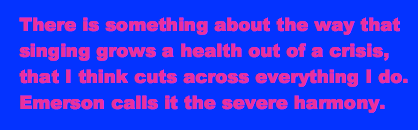
Years later I am working on this corner of my dissertation on the riddle of Ralph Waldo Emerson’s concept of impersonality, which has to do with this same knot where private digging is the scene of an experience of drastic commonality. This scene is both relieving and obliterating. There is something about the way that singing grows a health out of a crisis, that I think cuts across everything I do. Emerson calls it the severe harmony.

DP     Going back to the “worthy pioneer”, which Hegel later takes up as spirit and Marx puts back on terra firma with revolution: the first pioneers were foot soldiers meant to clear the way for the main army. Among their activities – mining. Yet one of the many layers of poetic reflection in the basement tapes conducts something of a mine sweeping. You have  a rare gift for defusing certain histories by bringing them into your soundscape, though not erasing them. Remembering and recuperating certain “loaded” spaces in a way that also drains their corrosive power, a quality that caught my ear from the very first episode. 

KKS     I think that has to do with the grain of the voice as it survives recording, compression, preservation, and historical distance. When I hear political speech in the present, I can’t separate out its entanglement with forces that I am somehow agitated by, whether for or against. But somehow the phenomenon of the person returns with the distance, and I think that I cannot not empathize with any person. I felt heartbroken at the Nixon Library, for example. And then pairing those returned persons with music takes a kind of atomic mass measurement of their failures.

I don’t mean to suggest that we should drop all of our skepticism about political violence, or that we should forget the way that historical violence structures present violence, but there is something to just measuring the atmospheric pressure in the lungs of our own or anyone else’s failure, that I think if we can’t hear it and ingest it and to at least some extent take it personally (I mean incorporate it, not take it as an offense), then we’re just reenacting a lazy form of venomous blame. Wallace Stevens has this line, “man’s intelligence is his soil.” I seem to be making a rationale for an alternative form of history based on eating our own soil. We get, at least, the song as a reward for our humility.

DP     Then there is the aspect of the “cabal”; your “mystical interpretation” has such poetic lucidity, even when the lights are dim. At times, you seem to be meditating on the rhythms of thought and feelings themselves, and we are permitted to hear your self thinking/sparking the mine. This sense is then underscored by the presence of the songs and by your own voice, which has a special quality all its own. Is there some metaphysical map for all these “mines” or are you moving through the murk by dead reckoning? 

KKS     One way I have described my creative work is as philosophy in various media. I’m particularly drawn to what falls under the rubric of process philosophy (versus philosophy as a set of definitions or proofs). I try to stay as dumb as possible when I’m making things, by which I mean I try to quiet all the forms of projection and the counsel of expertise. I have a cellular level of patience as I wait for things to emerge and take pleasure in their recession — this is grown in a person by among other things the very gentle and exploratory work done on the fringes of dance. So there is no map, but I recognize the emergence of paths and patterns as they’re happening, and that gives me a lot of happiness.

I make almost everything I do improvisationally; it’s the only way I could make as much stuff as I do. But that also has to do with a belief that things belong to their season of making. (The worst thing about writing a dissertation is that it’s not too amenable to improvisation. So I’m cultivating these forms of slow, recursive improvisation to get through it.)

DP     Cabal suggests collaboration or co-conspiracy, though in your case, the collaboration is more across your different materials and using all your varied talents and voices in a way that has the energy of an ensemble yet the delicacy of a private journey. This quality is something I have noted throughout  your work. How do the basement tapes resonate, for example, with your literary and theater poetics?

KKS     Originally the mole cabal was supposed to be a group of people working on performance projects, but schedule is a beast. I suppose I liked the fiction of being part of a posse of moles, so I never dropped the cabal. And I’m suspicious of the proprietary or expressive frame around creative work. In my mind, the mole cabal is not the proletariat or anything, but does expand beyond just me, connecting I’m sure to other cabals. We’re not plotting, just trying to survive (like the Wombles of Wimbledon). Or maybe plotting in the older sense of plot, as a garden plot, a patch of worked earth.

I was trained as a choreographer and I still think of myself as a choreographer, but one working in other media. (If the brain exists so we can move, as Andy Clark says, then this is an unproblematic restatement of the assertion that I’m a philosopher working in other media.) Sound was the first region I strayed into — I could never find the right music, so I had to start making my own. Then text, then images, then video, now forms of installation.

I love to be a beginner and to go through a learning curve, and I also like to trust my instincts and appetites for combination that grew up in dancing, as I take them into other media. It keeps me free of the new rules while still having a kind of structural intuition.  What I mean to say is that I’ve been able to tap into a vein of true amateurism by staying on the move, and so it has a choral effect. In any project, whether I’m writing or making sound or making theater, I do the same thing: start somewhere and then putter along until it feels like it’s singing. In fact the one medium it’s really hard for me to work in is dance, because my training still circumscribes my sense of freedom. My most recent project is to return to dancing and do battle with that restricting mind.

DP     In the meantime, we are delighted that the mole cabal of KKS will be digging and dancing and singing through the soul-soil, and may you be buried in fresh subscriptions!
THIS BIRD

Aliens at the Gate

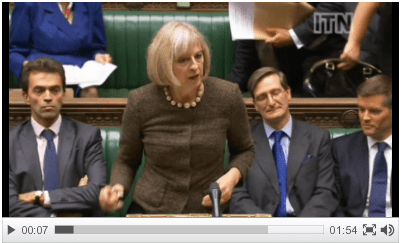
We note with relief that Gary McKinnon will not be extradited to the US, on human rights grounds, as stipulated by the Human Rights Act. The full statement by UK Home Secretary Theresa May can be accessed through the Guardian video link, with a (slightly abbreviated) transcript provided below:

Much of the reaction following Ms. May’s announcement has focussed either on the legal implications regarding other past and future extraditions or on her mistaken reference to Asperger’s Syndrome as an “illness”, which of course it is not.

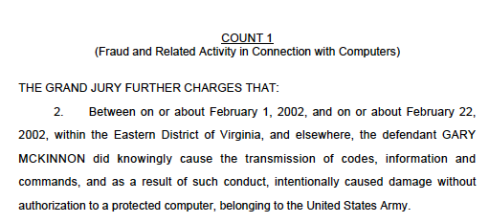
Though we have followed the McKinnon story from the beginning, we had never read the original indictment in its entirety until today. The document presents the UFO researcher as a highly dangerous enemy of the state, one whose eyes (and keystrokes) had penetrated firewalls considered by government prosecutors as critical for the protection of national security.

CLICK FOR COMPLETE PDF

While the legal charges center around alleged transmission of codes and destruction of data (hacker mischief and vandalism), the deeper threat is not hard to decrypt: That little nerd saw stuff — and knows stuff. 

In an interview with Wired News back at the time of the indictment, Mr. McKinnon elaborated in some detail about what he saw, and what he knows:

Of course, any mention of “Roswell” in polite intellectual circles, and the eyes glaze over, and whoever might have dared to utter the word is instantly consigned to the discursive looney bin.
Here at DP, we take no fixed position on whether or not there is intelligent life elsewhere in the universe; we are baffled enough by the human mysteries of our immediate neighborhood. Nonetheless, we do like to follow twisting paths, connect obscure dots, and stumble around in the fog. Thus we chanced upon a fascinating video that may help explain how the intense curiosity of a harmless young man should lead to his designation as a dangerous enemy of the state.

Try to screen out the annoying Twilight Zone voiceover (how do these narrative tropes become so entrenched?) and focus on the interviews with the various researchers, including those who are skeptical:

NON-TERRESTRIAL OFFICERS IN ACTION?

In any event, following the statement by Ms. May, a former counsel to the White House named David Rivkin made statements of his own, which we can relay courtesy of the excellent Guardian live blog:

And then this …..

Forgive me, Mr. Rivkin, but apparently you are unaware of the “precise situation” of our criminal justice system. Your comments are laughable. Mr. McKinnon himself displayed a finer understanding of the brutal reality in a rare interview with the Guardian in 2005:


One for the Thumb

FOREIGN POLICY THINK TANK

The Twittersphere typically passes us by. Every now and then, however, someone emits tweets so foul that we cannot screen them out. It’s as if we are sitting next to a man at a raw bar who suddenly burps up a couple of punky oysters – and they land on our napkin.

So it goes with recent tweets from a hashtag named Blake Hounsend, who lists himself as the managing editor of Foreign Policy, a publication that those who fancy themselves part of the global ruling elite like to leave on their desks to feign gravitas.

The context? A discussion of the devastating effects of economic sanctions on the civilian population of Iran. In the perverted logic of imperial DC, the death of a “couple thousand” Iranians becomes a “humanitarian” alternative.

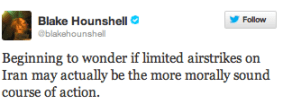
Burped up oyster number 1:

Burped up oyster number 2:

The notion that we should rather follow a policy that refrains from harming innocent civilians, most of whom are living barely above subsistence, appears to have been edited off the page by Mr. Hounshell and his ilk.

On the Foreign Policy website, we find the following bio:

We suggest that Mr. Hounshell’s capacity for moral discernment is as mangled as his Arabic. In place of a functioning conscience, we find a hollow shell; in place of thought, we find a thumb. Lamentably, such qualities make him a man for our times. Chalk one up for the thumb!

As Glenn Greenwald points out in his forensic analysis of the same two burped oysters:

Greenwald closes with a question that Foreign Policy is unlikely to contemplate in its next, or any, issue —


The Iceberg Waits

FLY ME TO THE MOON

Now comes iron ore magnate Clive Palmer, and his plans to construct an exact replica of the RMS Titanic. The name rang a faint bell for us here at DP; then we remembered that this very same Clive Palmer suggested not long ago that Greenpeace had been funded by the CIA to destroy the Australian mining industry.

About his Titanic plans, a buoyant Mr. Palmer says:

Not a fairground ride, yet:

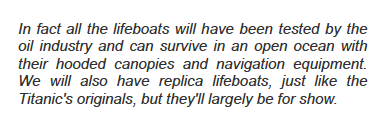
And what about the lifeboats?

SHOW BOAT IN COLD WATER

Though designed in Europe, the boat will be built in China, presumably using iron from Mr. Palmer’s mines. So why has the unsinkable billionaire chosen this particular vehicle into which to sink his fortune?

And finally:

___

In The Eighteenth Brumaire of Louis Napoleon, Karl Marx wrote:

We suggest that when tragedy strikes the first time, history is then able, upon repetition or replication, to proceed directly to farce. Enter Mr. Clive Palmer, for his character-defining dialogue with an iceberg.

SHOW STOPPER


Marfa Lights

Among the very few artists/writers addressing issues of security architecture, surveillance and the weaponization of communications airspace, we find Charles Stankievech of particular interest. His new installation “cleanses the air” in the vicinity of Marfa, Texas – with its own complex art historical resonance.

Below, a description of the installation taken directly from the press release, followed by a dialogue with the artist; a lengthy post for DP readers, justified by the importance of this brilliant and timely work.

DP:     Can you give a brief exposition of your work north of the US border with Canada, and how that leads in both logical and unexpected ways to Marfa?

CS:     I’m interested in extremes—mainly because exceptions to the rule usually tell us what is paradoxically at the heart of an ideology.  People love to tout the “American Dream”, but exceptions/prohibitions/extremes often tell us more what a culture shares and is defined by.  As a result, I’ve spent a lot of time over the years looking at outpost architecture and military infrastructure.  It might not tell us much directly about the everyday citizen but it sure reveals a lot about the values maintained to protect the culture—or at least those in control of the culture.

The first window into this mechanics I discovered doing site visits, researching archives and producing work about the Cold War’s DISTANT EARLY WARNING (DEW) Line in the Arctic which was created as a bilateral defense infrastructure to protect continental USA from Soviet attacks.  As a result, I looked into the history of the electromagnetic in the arctic from early Marconi experiments with the US military to current experiments at HAARP.

Marfa is on the other NORAD border one could say, and I was invited to do a residency on the border with Mexico because of my research in issues of fluid boundaries.  Judd’s Chinati Foundation is also interesting because it is housed in an old military base that was operational from around 1910-WWII—so even Marfa’s existence is premised on military outpost architecture.

DP:    What sort of field research have you conducted along the southern border?

CS:     A lot of travelling and photographing things throughout the landscape for sure:  from swimming in the Rio Grande to lots of driving and hiking. Just existing in Marfa for a while you get a pretty heavy does of Homeland Security.  You drive a couple miles out of town and you go through a border checkpoint even though you aren’t crossing a border.  While officially the border is the Rio Grande, the entire area is more like a border zone and quite different than the 49º parallel.  The most common vehicle you see here is one of the many from the fleet of Border Patrol. There are also military installations that use Surveillance Aerostats (zeppelins) in the area.

With a little bad luck turned good, in the first week driving around in West Texas I had some car trouble and the Border Patrol stopped to check on what was transpiring.  It took about an hour for civilian help to come and in the meantime they hung around.  I was able to talk about their work the entire time and learned quite a bit such as the gap between official mandates of Homeland Security (prevention of terrorism as their prime directive) and the reality of the daily job (picking up 15 illegal Mexican immigrants the day before).

DP:     Your use of bug zappers resonates very well with the language of dehumanization used by the CIA and other agencies to describe drone strikes as “bug splats”. 

CS:     I actually wasn’t aware of this terminology until you mentioned it to me.  It’s one of those latent meanings that surprised me when I was trying to make a poetic connection between the ideology of security and a citizen’s everyday object—only to find out it is not a poetic piece of satire but sadly the entrenched mentality already made manifest in official cynical language.  The stranger part is that the term “bug splat” connects two projects I did in the last month: HOMELAND SECURITY in Marfa, Texas and my recent performance at dOCUMENTA(13) in Kassel, Germany, which I titled Drone Strike.

DP:     We are also struck by the metrical use of grids in the installation, grids that are also present in the geometry of surveillance and death, in the skies above Waziristan and other target populations. Indeed, the rhythms and metrical order of the grid appear central to the aesthetics of global information dominance. 

CS:     Do you know that eerie short story by J.G. Ballard “The Watch-Towers”– A wonderful panopticon story of a grid of watchers hung above the city 25ft above the roofs and in a grid spaced out 300ft in each direction?

I don’t want to give the Grid a bad name as it’s an ancient and remarkable system that’s allowed a considerable improvement of life , but I did first come to understanding the colonial implications of math and the metrical by studying clocks on exploration ships and their need to keep precise time to map out the grid work of latitude and longitude as delineated from the colonial center: Greenwich.  In this way, traditional indigenous navigation based on landmarks and narrative were replaced by the “objective” mathematical grid only making sense from the perspective of the colonial capital.

There is nothing inherently violent about the grid—it’s simply the universalizing of space, which can be good or bad.  Since it’s the cheapest and most efficient parsing of space based on universal application vs. specific sensitivity, the grid ends up being utilized by systems ranging from the military to minimalism; it’s no surprise then that the scale and layout of HOMELAND SECURITY was partly based on Donald Judd’s aluminum box sculptures installed here in Marfa at the Chinati Foundation.

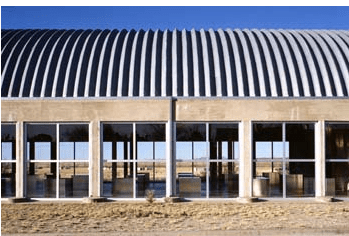
ARTILLERY SHEDS

Today however, I think we are witnessing the decline of the grid in a lot of ways—or at least the outdated style of the grid (as we will never leave it totally behind).  I feel my installation appears dated because of its grid structure, probably because I studied a little bit at the Architectural Association in London which is one of the hotbeds for parametric design—basically curvy architecture made famous by F. Gehry, G. Lynn and Z. Hadid.   The Grid is so Modern according to architectural aesthetics. Today the vogue is organic patterns or complex modeling, using computers.

As far as global information dominance, the grid stands in for static structure, while dynamic theories of topology are gaining more and more prevalence.  I’m thinking here of such people as Deleuze+Guattari, Paul Virilio, Alexander Galloway, Eyal Weizmann and Ben Fry who are aware of the shift from controlling a square plot of land to controlling the protocol of connections in a network. All of this said, I do understand what you mean by the “geometry of surveillance and death.”  The zappers installed this way suggest a sense of “instrumental reason”.

DP:     The acoustics of your installation summon the buzzing sound of the ubiquitous drone zone; a recent Stanford/NYU report identifies sound (particularly the ominous buzzing) as a key aspect of the psy-ops trauma experienced by non-comabatant civilians on the ground. You have long been concerned with vibrational and acoustic space as key aspects of securing boundaries and controlling bodies. 

CS:     “A SCREAMING COMES ACROSS THE SKY. It has happened before, but there is nothing to compare it to now. It is too late. The Evacuation still proceeds, but it’s all theatre. There are no lights inside the cars. No light anywhere. Above him lift girders old as an iron queen, and glass somewhere far above that would let the light of day through. But it’s night. He’s afraid of the way the glass will fall—soon—it will be a spectacle: the fall of a crystal palace. But coming down in total blackout, without one glint of light, only great invisible crashing.”

THE SOUND COMES LATER

These are the first lines of Gravity’s Rainbow, by Thomas Pynchon.  He brilliantly compared the difference in Psychological Warfare in the civilian terror bombing of London during WWII as part of the Vengeance strategy of the NAZI Wehrmacht.  The V-1 “buzz bombs” used in the first attacks were insanely loud and caused panic when they were heard—heralding an imminent attack.  The V-2 “vengeance rocket” ,  being supersonic, travelled faster than the victims could hear it—it arrived before the sound of itself did so.  In effect, the psychological terror switched.  Basically, one lived in fear continually knowing an early warning was impossible and if you heard an explosion, it meant it missed you and you were a survivor — sometimes not always better than being a victim.

However, with the ubiquity of drones since 1982 and their implementation of surveillance equipment, not just weapons, again we return to a buzz in the sky as not only a by-product of a Vengeance weapon— but used with full knowledge of its sonic terror.  It’s a well-known strategy that in breaking a prisoner in an interrogation the threat of pain can be as effective as conducting pain — some say more so.  Sound has always been an important part of psy-ops: from the repetitive looping of the Sesame Street’s theme song as an interrogation method to drone buzzing.

We can’t forget of course of Virilio’s analysis of drones used in the Vietnam War (1960s) and the Israeli war “Peace in Galilee” (1982) in his book War and Cinema: The Logistics of Perception that was written before smart bomb videos became pop culture in the 1991 Gulf War: “This toy craft, worthy of Ernst Jünger’s Glass Bees”.

DP:    How does your analysis of outpost architecture relate to Virilio’s bunker archeology, and his ideas about orbital space?

CS:     Virilio’s Bunker Archeology is a paragon of research for me in so many ways: his existential fieldwork, aesthetic engagement and vast research in military strategy shine with his cutting insights.  I’ve tried to extend or repurpose his methodology as applied to WW2 Bunkers to my analysis of Cold War Geodesics Radomes.  Essentially my thesis is: ‘the Geodesic Radome is the synecdoche of post-WWII warfare—an architecture that distributes its structural forces through a framework formally related to the communication network connecting the architecture.’

This comes out of Virilio’s analysis in Bunker Archeology“While most buildings are embanked in the terrain by their foundations, the casemate [bunker] is devoid of any, aside from its centre of gravity, which explains its possibility for limited movement when the surrounding ground undergoes the impact of projectiles.  …the bunker is the last theatrical gesture in the endgame of Occidental military History.”

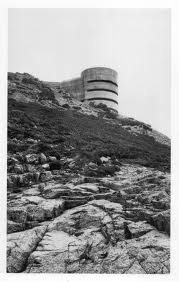
THE LAST THEATRICAL GESTURE

I find it interesting that Virilio doesn’t engage with the geodesic radome in his theories of “orbital space” even though he uses in Speed and Politics the phrase “geodesic war”, but maybe that is his extreme point — his movement away from real architecture to the dematerialisation of space.   Any building at all is too slow; he prefers the image of the parabolic missile echoed in the parabolic trajectory of Albert Speer: from director of New German Architecture to Minister of Munitions.  But I have the existential experience with radomes that he had with bunkers, and being more an artist than a philosopher these days, I’m aware of the materiality of the digital, and hence the reality of terrestrial surveillance outposts like CFS ALERT which I worked at this past year while under contract with the Dept. of Defense to make artistic depictions of their signals intelligence station located at the most northern settlement in the world: 82ºN.

DP:     Finally, also with reference to the locus of Marfa: Donald Judd had an uneasy relationship with the establishment art world, an uneasiness or skepticism which you seem to share?

CS:     Probably most artists have an uneasy relationship to the established art world. Judd’s personality included loud opinions and he had the ambition and eventually the funds to attempt some sort of relative autonomy, so we are more aware than normal of his uneasiness.  While we both moved to remote regions to “start” unique institutions (Chinati in Marfa by Judd, Yukon School of Visual Arts in Dawson City by myself and a crew of other people), the motivation for both us is a little more complicated and probably quite different — especially since we did it at different points in our lives.

I do know from anecdotes told by people here in Marfa who knew Judd that when he was alive he didn’t like the border patrol, and that he even wrote a letter to the Mexican authorities after being harassed one time near his ranch.  The irony today is that the JUDD Foundation and Chinati Foundation are firmly part of the art world establishment.  Thus the cycle continues.

CYCLE IN BLUE


The Fire Pit

ISLAMOPHOBIC SMOKE

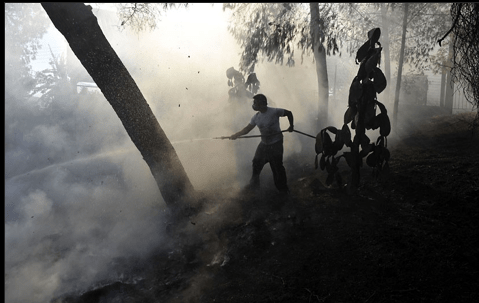
A trusted foreign correspondent has brought to our attention a Moscow Times report on a novel explanation for the dramatic increase in forest fires throughout southern Europe. Former KGB henchman Alexander Bortnikov, presently a key member of the Putin crony capitalist consortium, blames Al-Qaida terrorists for the wildfires. At a recent “security services conference” Bortnikov said:

Nicolai Schmatkov, the forest policy director for the World Wildlife Fund, dismissed the notion out of hand:

Other factors might include climate change; the reduction of rural fire-fighting teams; and a dramatic reduction in grazing animals in Spain and Portugal, the latter a trend that may soon reverse, as workers formerly sucked into the whirlwind of speculative construction return to working the land.

FORESTRY EXPERT: NOT

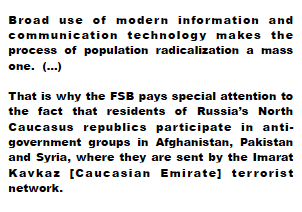
Mr. Bortnikov’s long service in the KGB supports a preference for projecting the most sinister conspiracies from a few discarded cigarette butts. Indeed, his concern about fire in southern Europe appears to be nothing more than cover smoke for his eagerness to suppress hot spots closer to home, as indicated elsewhere in the same speech:

Population radicalization comes in many flavors, and the suggestion of a “forest jihad”, unhindered by the lack of credible evidence, has certainly spread like wildfire within the Islamophobic tinderboxes of the internet:

EXHIBIT A

And even from within our moderate northern neighbor (left unedited, for your consideration):

EXHIBIT B

As the economic crisis in Europe and North America deepens in years to come, with the subsequent currency wars and currency debasement, we urge contemplation of a graph that charts the relationship between inflation and demonization during the “Witch Craze” of the 17th century in England.

EVERY PRICE ‘REVOLUTION’ HAS ITS PRICE

The experience of the Weimar hyperflation, skillfully reconstructed and analyzed in Adam Fergusson’s classic study, When Money Dies, reveals the same dynamic relationship between inflation and the “enemy within”, with even more deadly results.

How many will be rounded up and thrown into the vast fire pit, this time around?


A Secret Violence

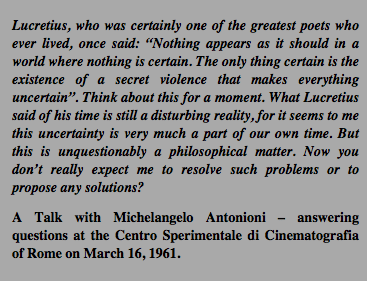
Michelangelo Antonioni entered the world one hundred years ago, today. We mark the occasion by meditating upon what we have long considered to be his masterwork: The Passenger. In a quiet, restrained and unresolved way (which some critics at the time dismissed as boring and pretentious) Antonioni explores difficult and complex themes of identity, fate, illusion, perception and violence.

As the narrative unfolds, perception becomes ever more difficult, no matter how bright the sun. Violence both defines and collapses identity, though not entirely; love and death converge on the same site, to a rhythm nobody can follow, in shapes obscured by layers of dust. Below, the final dialogue between Locke and “Girl”:

BEAUTY AND THE DUST

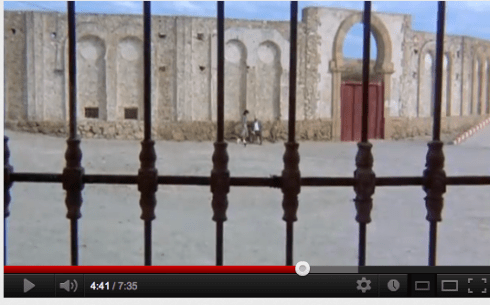
We have long nurtured the pet theory that “Girl” is actually the elusive Daisy; or perhaps even pretending to be Daisy? De todos, we move on to the film’s famous penultimate tracking shot, a virtuoso bit of inside-out filmmaking created by Antonioni and his cinematographer, the great Luciano Tavoli.

MICHELANGELO ANTONIONI, IN “ENCOUNTERING DIRECTORS”


Everyone is Ill

___

LIVING UNDER DRONES

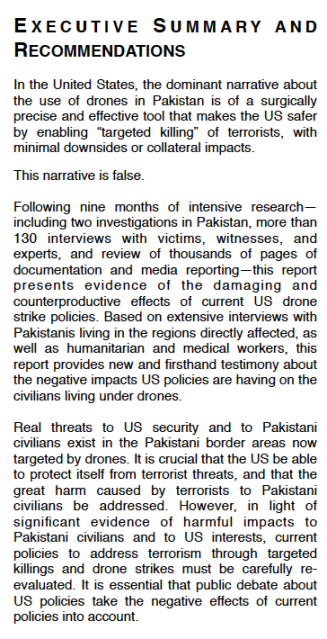
An important new report has been published by the Conflict Resolution Clinic of Stanford Law School in conjunction with the Global Justice Clinic at the NYU School of Law: Living Under Drones: Death Injury, and Trauma to Civilians From US Drone Practices in Pakistan.

In an earlier DP entry, we suggested that the tactic of drone strikes has become a critical feature of the technologically updated strategic doctrine of Shock & Awe. As such, the “decapitation” of militants supports the more general objective of subjugating the entire regional population through the traumatic disintegration of collective spirit, group will and tribal autonomy. Basic community rituals such as the provision of proper burials consistent with religious beliefs are shattered,  thereby weakening resiliency and resolve.

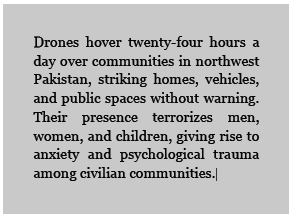
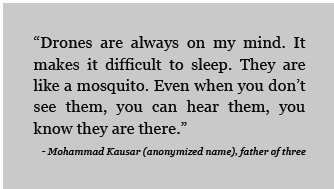
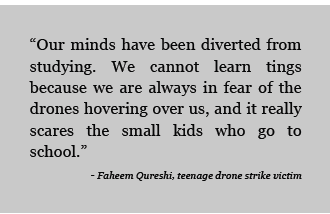
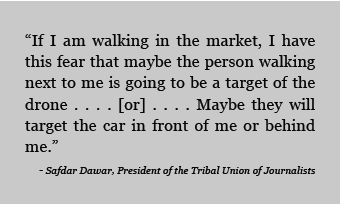
Living Under Drones extensively documents the success of this savage tactic in achieving a condition of generalized trauma throughout Waziristan. In numerous interviews with survivors of attacks and with family members of non-combatant victims, the study details the horrific “psy ops” terror inflicted upon communities through the constant presence of armed drones buzzing through the skies above. Further, the study examines how such actions have occurred outside any legal oversight or framework, essentially implemented by executive fiat in the name of “keeping the American people safe”.

Below follows the authors’ executive summary and a brief montage of excerpts, some of which have been incorporated into frames for the (excellent) film, linked above in its entirety.

_
_
_

Not One Bone

In August 1676, a Wampanoag sachem named Metacom, son of Massasoit – King Philip to the English colonists – was hunted down and killed in the swamplands of coastal Rhode Island. To the English colonists, King Philip had become a dangerous threat, not only because of his considerable talent in conducting asymmetrical warfare, but also for his diplomatic skills. If Philip succeeded in uniting a critical mass of tribes against them, the fragile colonies might well be erased from the map.

Cornered by a combined force of English soldiers and Sakonnet/Pokasset Indians under the experienced command of Captain Benjamin Church, Metacom was shot through the heart by a Pocasset known by the English name Alderman. Metacom’s wife and son were subsequently sold into slavery in Bermuda.

LONG LIVE THE KING?

Towards the end of his masterful narrative Mayflower, Nathaniel Philbrick reconstructs the scene immediately following the death of the great sachem:

So what happened to the head?

Cotton Mather is rumored to have taken the lower jaw from the bleached skull; the fate of this bone is not known, though it likely remains unburied if not undigested.

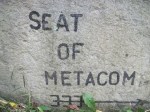
A small stone marker commemorates the death of Metacom in the Miery Swamp near Mount Hope, though the site is difficult to access and the stone hard to locate. Similarly, the rock formation known as the Seat of Metacom has been obscured by years of neglect. The site is now owned by Brown University, whose curriculum once included a highly regarded (though much lampooned) semiotics program.

SEMIOTICS OF OBLITERATION

Kenneth Foote’s remarkable study of America’s landscapes of violence identifies four distinct dispositions towards such sites: sanctification, designation, rectification and obliteration. The landscape of Metacomet slowly but surely recedes into the fourth mode.

WIKIPEDIC PROJECTED ILLUSION

OVERGROWN REALITY

The signifier Metacom/Metacomet, detached from actual lived history as embedded in specific landscapes, survives through other semiotic systems, such as roadways, condominiums and golf courses. There is a small rock island in the Connecticut River called “King Philip’s Nose” as well as various recreational hiking trails named after the vanquished sachem. We once asked a hiker on one such trail if he knew the meaning of “Metocomet”; he told us with great conviction that it had “something to do with geology.”

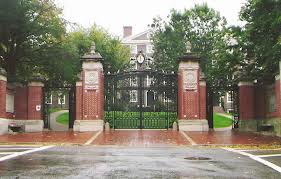
Close by Mount Hope, within easy walking distance from Metacom’s Seat, we find the former residence and gardens built during a previous Gilded Age by coal magnate Augustus Van Wickle and his wife Bessie, who was a keen arborist. In 1901, Mr. Van Wickle donated ornamental gates to the semiotic configuration of his alma mater, Brown University; in 1906, he was killed while shooting skeet with his brother-in-law. The death was ruled an accident.

VICTORY GATES

The Van Wickle estate is well signed; according to the leaflet provided for self-guided tours, thousands are inspired each year by the legacy of the Van Wickles.

METACOM MEMORY THEATER


With a Brain Confounded

EVEN THINKING MINDS FORGOT

While contemplating the violence inflicted upon the polis in the name of securing “safety for the people”, we turn to a passage (Book Tenth) from William Wordsworth’s lengthy narrative poem The Prelude, or Growth of a Poet’s Mind. The poem was originally intended to serve as an auto-biographical prologue to an epic triptych titled The Recluse. Outlined while Wordsworth was still in his twenties, the epic had still not been committed to paper at the time of his death, at the age of 80.

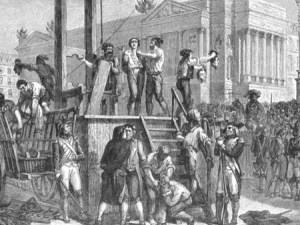
The notion of “thought crime”, put into play whenever fanatics seize political power, was very much in the air during those heady revolutionary days of Robespierre’s Terror; the Committee of Public Safety required that virtue be present in every glance and every utterance. Such times are fast upon us once again, when in the name of “public safety” and patriotic virtue, all hell will break loose.

What sort of refuge is the soul, at last reckoning? Epicurus tells us that if we are to think and thus grow the mind, we must live in hiding; so where exactly might we hide? Is withdrawal, for all its poetic elegance, inevitably solipsistic? In September 1799, Coleridge wrote to Wordsworth:

 “I am anxiously eager to have you steadily employed on `The Recluse’ . . . . I wish you would write a poem, in blank verse, addressed to those, who, in consequence of the complete failure of the the French Revolution, have thrown up all hopes of the amelioration of mankind, and are sinking into an almost epicurean selfishness, disguising the same under the soft titles of domestic attachment and contempt for visionary philosophes. It would do great good, and might form a Part of `The Recluse'”

We include a link to a PDF; print out the text, take it to the public square or to the parking lot at Walmart; or to the balcony inside the mall; or to some distant hilltop or dark wood; and declaim con molto gusto.

VIRTUE HARVESTED