

We strongly recommend close consideration of Rebecca Gordon’s recently published book, Mainstreaming Torture, Ethical Approaches in the Post-9/11 United States. In examining the question of whether torture is ever morally permissible, Gordon critiques narrow utilitarian and deontological justifications, and proposes that a virtue ethics approach (descending from Alasdair MacIntyre) permits a deeper understanding of the ways in which the socially and politically embedded practice of torture twists and distorts our national character. She also suggests an alternative path; collaborative practices oriented towards the rebuilding of our presently dismantled habits of courage and wisdom.
Below, a brief dialogue between Rebecca Gordon and DP, intended to inspire large numbers of readers to purchase this absolutely essential book:
DP We know that torture is designed to shatter and break the identity of the victim, to make it impossible for the victim to experience the world through a coherent subjectivity, as only the torturer gets to say “I”. Less well understood is the corrupting effect torture has on the torturer, and on a society such as our own that does not merely permit torture, but often seems to celebrate and reward it. Torture deforms us all, at a deep moral level, eradicating any semblance of human virtue. Throughout your writing, I am struck by your profound understanding of the devastating moral and ethical implications that institutionalized, habituated torture carries for us all. Can you describe the genesis of such understanding, certainly within your philosophy, yet also in your political engagement?
RG My understanding of torture as an ongoing, socially embedded practice really began with the time I spent working in the war zones of Nicaragua in the 1980’s. There I met people who had been tortured, some earlier under the Somoza dictatorship, and some later by the remnants of the Somoza’s National Guard, who formed the nucleus of the U.S.-backed contras. I began to understand how torture works – and it does work – not by gathering “intelligence,” but as a means of destroying social bodies that threaten a regime. By attacking the minds and bodies of some of the members of a union, a church community, a political party, a beekeeping cooperative, the agents of a state can dismember those organizations.
I first started writing about U.S. torture in the fall of 2001. Less than two months after the terrible attacks of 9/11, people in the mainstream press were beginning to suggest that 9/11 meant someone needed to be tortured. Quite suddenly something most people thought was a settled consensus – that torture is wrong – was once again an open question. Both the mainstream press and academic ethicists began musing about whether things hadn’t changed after 9/11. Jonathan Alter wrote in Newsweek called “Time to Think About Torture,” in which he suggested that something extra was needed to “jump-start the stalled investigation of the greatest crime in American history.” Anyone who had qualms about it was “hopelessly ‘Sept. 10’—living in a country that no longer exists.” Ethicists, too, began to question their positions on torture. Jean Bethke Elshtain, for example, wrote in an essay in Torture: A Collection (ed. Sanford Levinson; New York: Oxford University Press, 2004) that before “the watershed event of September 11, 2001,” she was one of the many people who listed torture in the “category of ‘never,’” Afterwards, she changed her mind.

As the conversation about torture began to develop, it became clear to me that both mainstream press and academics were making a basic mistake about what institutionalized state torture is. They were treating is as an isolated activity, something that people do in moments of extremity. Both the press and academics were marshaling arguments for or against “torture” largely on deontological or consequentialist grounds. Deontological arguments against torture referred to the Kantian prohibition on treating humanity as a means to some end. Those in favor cited the duty of government officials to protect their population. Consequentialist arguments for torture most often cited the choice to torture one person to save a million from a ticking time bomb. Those against torture focused either on the danger it might present to U.S. reputation in the world, or to U.S. soldiers if they were captured. But all these arguments treated torture as if it were something that happened once, or once in a while.
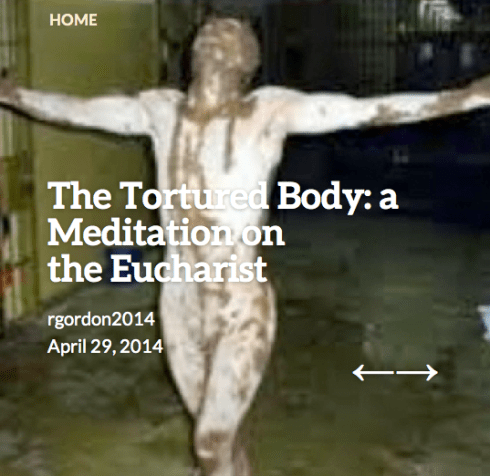
My experience in various solidarity movements had taught me something different. Institutionalized state torture is a practice. It has its own histories, traditions, and even rituals of initiation. It has its own internal values, and it forms its practitioners in a specific set of moral habits – call them virtues or vices as you will. And I believe that when torture becomes quasi-public especially in a democratic society, as it has in this country in the so-called “war on terror,” it can engender vicious moral habits in all of us. One of these is cowardice – the willingness to accept any necessary evil in the (ultimately false) belief that it can guarantee one’s personal survival. Another is a distortion of practical wisdom that I call culpable ignorance, the voluntary refusal to use one’s capacity for thought and judgment, for example to be able to see torture when it is being called something else, like “enhanced interrogation techniques.” Or, indeed, to see that practices we might decry in Abu Ghraib or Guantánamo are part of the daily routine in U.S. jails and prisons.
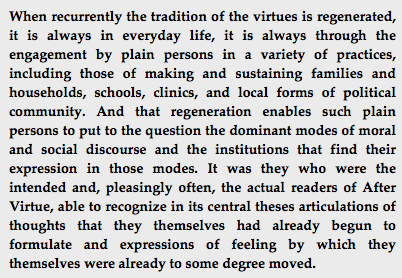
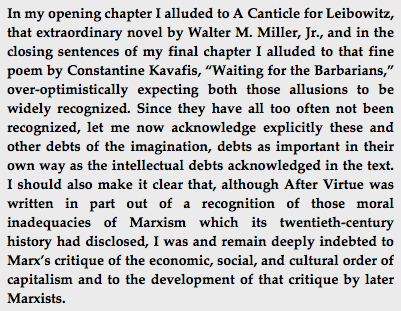
Thinking about torture as a practice led me to look at Alasdair MacIntyre’s contemporary revival of virtue ethics, starting with After Virtue. I found his categories of telos, virtue, practice, and tradition very useful for understanding how institutionalized state torture works.

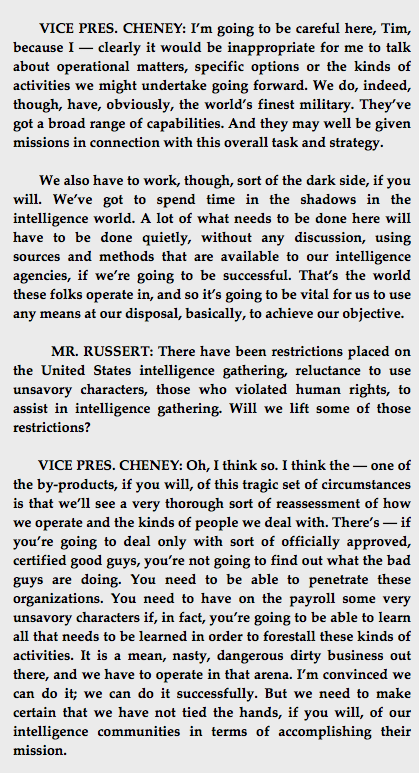
DP Colin Powell’s former chief of staff, retired Colonel Lawrence Wilkerson, recently offered an interesting comment regarding the character of one of our most stridently unrepentant torture advocates, Dick Cheney: “”Immorality is something that can be ferreted out, checked and balanced. Amorality is an altogether different affair, especially when you’re exploiting the politics of fear in order to carry out state purposes, which is what Dick Cheney’s forte is.” Can you expand on your reading of MacIntyre’s After Virtue, with reference to state torture, once it becomes such a fully articulated and even legally codified practice? Is there any sense in voicing a moral critique once the state embraces a fundamentally amoral universe centered on the breaking of those bodies and spirits who dare to resist?
RG You ask, “Is there any sense in voicing a moral critique once the state embraces a fundamentally amoral universe centered on the breaking of those bodies and spirits who dare to resist?” I think that my answer is a sort of “Yes, but…” or perhaps better, “Yes, and…”
In voicing any critique, one immediate question is, “Who’s the audience for the critique?” Is there any sense, for example, in arguing ethics with Dick Cheney himself? Probably not. If Wilkerson’s characterization is accurate, it seems unlikely that Cheney would engage in good faith argument, willingly disclosing his fundamental assumptions. If he were willing to disclose the foundation of his moral approach to governing as something along the lines of, “It is right to use whatever instrument is effective in advancing the power of the state,” I am hard pressed to imagine where I would begin to seek a shared assumption from which to begin an argument. One route might be to inquire about why it is important to maintain or expand the power of the state – what value lies behind this imperative, but I’m not convinced we’d get anywhere.
If the audience is the larger public, then I think it is not only sensible, but vital, to advance a moral critique. The challenge we face here, however, is profound. Public moral discourse in this country is almost always framed in instrumentalist terms. Arguments appealing to values other than cost/benefit calculations are generally dismissed as idealist, unrealistic, or adolescent and soft-headed. This is a very difficult frame to break. It’s easier to try to think up an argument against torture within this frame (“It doesn’t work. You don’t get good information.” “Torturing the enemy puts our own soldiers at risk if they are captured.”) than it is to challenge instrumentalism as a moral approach. It may look as if we can win the argument within the terms set by the opponents, but we can’t.

This is where MacIntyre’s approach comes in. There is another way to understand the moral life than as a series of cost/benefit analyses (even if the costs and benefits we are weighing are not our own, but those of the “greatest number.”) MacIntyre encourages us to not to understand our lives as a series of isolated choices (What in this will bring about the greatest happiness for the greatest number in this situation? Shall I kill one person to save five? Will my maxim, if universalized, lead to a logical contradiction?) Rather, he would have us think of human life as a particular kind of story, a quest to discover what makes for a good human life. This is a quest he believes (with Aristotle) can only be undertaken in the company of other human beings. In its course we enter into particular practices – complex, collaborative activities that enable us to develop certain intellectual and often physical skills; activities that have their own internal goods, and which allow us to develop certain moral habits — virtues — that sustain us in our quest.
What does any of this have to do with the problem of torture? I’m arguing that torture itself is the kind of complex, collaborative activity that engenders certain moral habits – twisted versions of the four “cardinal” virtues embraced by Greek and Roman philosophers (along with Thomas Aquinas). These four are justice, courage, moderation, and wisdom. In Mainstreaming Torture, I describe this process more fully, and I suggest that especially in a democratic society, it affects not only those directly involved, but the other members of the society.
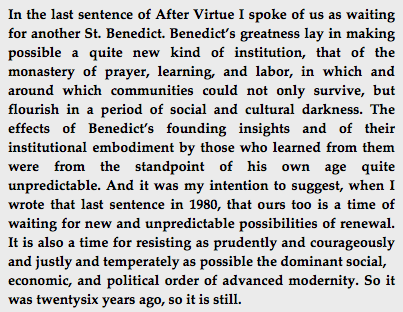
And here’s where I come to my “Yes, but…” Unlike Enlightenment moral philosophies such as utilitarianism or Kantian deontology, virtue ethics can’t be demonstrated through argument. It is a way of living. The virtue ethics argument against torture isn’t just a verbal argument; it is a life in which people rebuild our habits of courage and wisdom. Perhaps we might begin with the complex, collaborative, long-term activity of dismantling state power built on Cheney’s politics of fear.



































 Desperado Philosophy