Author Archives: DP

Agency of the Nonhuman

Staying within the pages of the Los Angeles Review of Books, and within the theme of how art responds to the Sixth Extinction, consider the following thoughts from novelist Amitav Ghosh. Images are from the studio of Nathalie Miebach, with a project titled The Floods.


BUILD ME A PLATFORM, HIGH IN THE TREES, SO I MAY SEE THE WATERS


DETAIL, BUILD ME A PLATFORM


DETAIL, BUILD ME A PLATFORM


˜˜˜˜˜

Nathalie Miebach writes:

My work focuses on the intersection of art and science and the visual articulation of scientific observations.  Using the methodologies and processes of both disciplines, I translate scientific data related to astronomy, ecology and meteorology woven sculptures. My method of translation is principally that of weaving – in particular basket weaving – as it provides me with a simple yet highly effective grid through which to interpret data in three-dimensional space. 

By staying true to the numbers, these woven pieces tread an uneasy divide between functioning both as sculptures in space as well as instruments that could be used in the actual environment from which the data originates.

˜˜˜˜˜


Hold Still and See

Every now and then, we come across web-embedded voices that elicit audible shouts of affirmation throughout DP’s vast editorial complex. Such was our reaction upon reading a recent dialogue in the Los Angeles Review of Books between Everett Hamner and Richard Powers, roaming deep forests of ideas in the vicinity of Powers’ recently published novel, The Overstory.

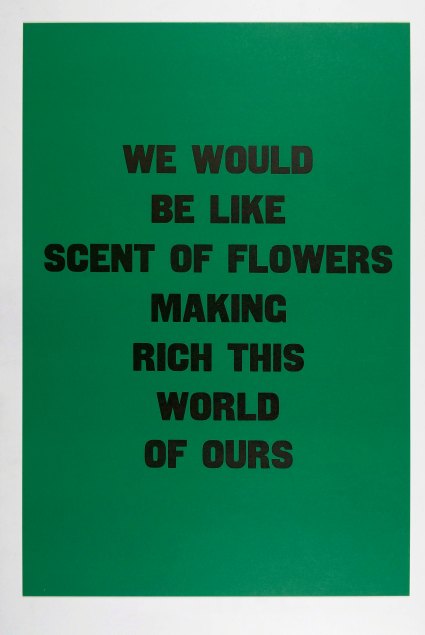
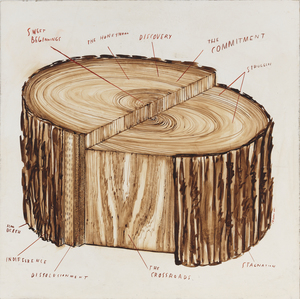
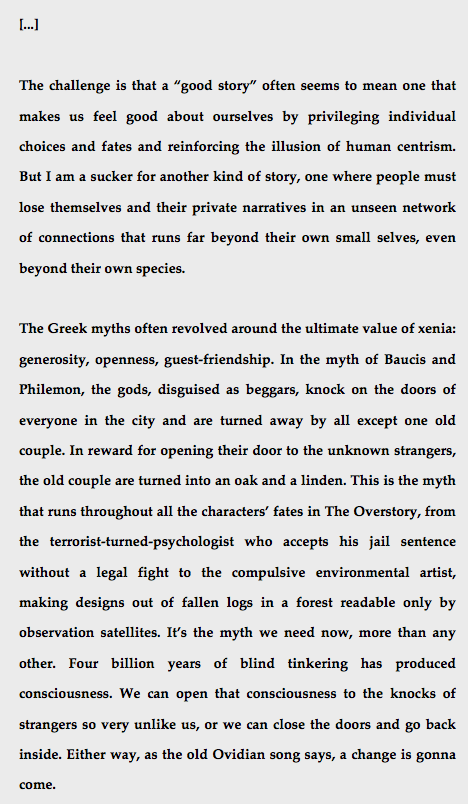
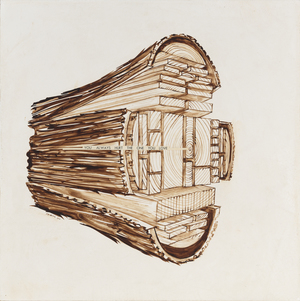
We highly recommend consideration of the entire exchange; a few brief excerpts below. Images are from the studio of Lora Fosberg, whose work we also highly recommend.

Now comes Richard Powers, on the role of literature (and the moral responsibility of fiction writers) in the time of the Sixth Extinction:


HEARTACHES


SWEET BEGINNINGS


YOU ALWAYS HURT THE ONE YOU LOVE


On the actions of a “proudly suicidal” (!) administration:


EVERYTHING MEANS EVERYTHING


YES


˜˜˜˜˜


Sanctity and Revenge

Slightly over a week ago, the White House press secretary Sarah Huckabee Sanders, asked to justify the unconscionable separation of immigrant children from their mothers, stated that “it is Biblical to enforce the law.” With her words fresh in mind, we turn this week to philosopher Catherine Malabou, with excerpts from a recent essay titled Repetition, Revenge, Plasticity.

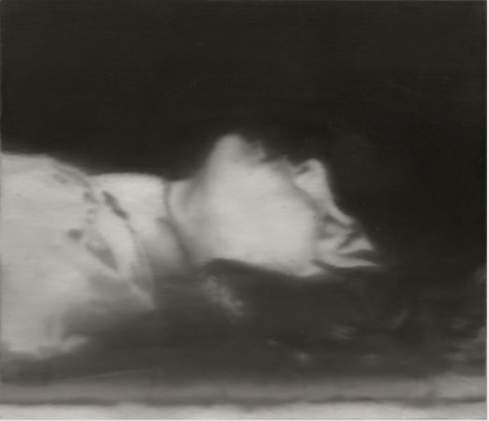
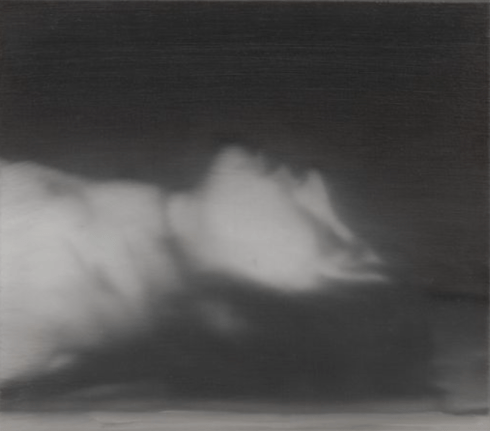
Images are from Gerhard Richter, three paintings completed in 1988, each one titled Tote (Dead).


TOTE


TOTE


TOTE


˜˜˜˜˜

Regarding the three Totes, we find the following explication on the Richter website:

The three paintings are based on photographs depicting the terrorist Ulrike Meinhof, a founding member of the Red Army Faction, that were taken after her suicide in prison in Stuttgart-Stammheim on 9th May 1976. The images were published in the magazine stern on 16th June 1976 and show close-ups of the head and upper body of a lying woman, whose eyes and mouth are partially open. Her dark hair is almost undistinguishable against the dark background whereas the bright clothes and pale skin of her face brightly stand out. Her somewhat overstretched neck reveals a dark deep line left by the noose.  

The three works show an almost identical image segment with only the angle and the proportions varied slightly in each painting. Besides their format, the three images also vary in their painterly execution. While the facial features of Ulrike Meinhof are relatively clear in the first version of Dead, they are blurred almost unrecognizably in the last painting, with bright and dark shades merging, contrasts paling and the overall black background fading to a uniform dark grey. Moreover, the position of the head seems to be slightly altered in each version. While the first painting is guided clearly by the original photograph, the second version shows the head with a slightly raised chin and the eyes almost completely closed which is carried forward even further in the third work. Because of the increasing blurring and the changing position of the head, Ulrike Meinhof seems to be removed further and further from reality with every painting, her mouth and eyes seem to close slowly. In death, she is withdrawn from the gaze of the public, the terrorist is given back a part of her human dignity that was taken from her by exhibiting her dead body in mass media. At the same time the dramatic effect is increased by the multiplication of the subject and the increasing blurring of details that seem like a cinematic fading out. The dead body seems to sink into the surrounding, impenetrable grey.

The three likenesses appear like a search for an appropriate way of representation, carefully and gradually approaching death. The distinct close-ups set the paintings apart from other depictions of dead RAF members in the cycle and create a certain intimacy that affiliates the work with Youth Portrait [CR: 672-1][7]. Furthermore, Meinhof’s apparent isolation and loneliness are underlined by focusing solely on her face and upper body. In regard to iconography, the body lying parallel to the image plane is evocative of representations on predellas and hence creates a connection to a traditional European iconography of death. This prevents the paintings from being seen as ideological images or to turn into icons of martyrs. Instead, the works pose the question as to the why of the events. As no other painting in the cycle the painting speaks of sadness, and “[…] sorrow, […] sorrow for the people who died so young and so crazy, for nothing.”

˜˜˜˜˜


America Embodied

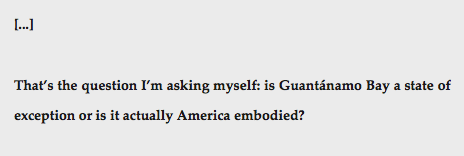
An article in The Intercept directed our attention to an extraordinary series of documentary photographs by artist-attorney Debi Cornwall, published in a book titled Welcome To Camp America. Among her images, we visit the “stage sets” of Guantanamo Bay within the vast security theatre of the surveillance state.

The images are freely viewable here, documenting a lounge chair in a room wired for visual media, rewards for compliant detainees; a prayer rug, with an arrow on the floor indicating the direction of Mecca; a sales display stocked with cigarettes, titled “Military Privileges (Kools)”; and a plastic toy floating in an empty swimming pool.

The projected play of normal life obfuscates the severely damaged or destroyed biographies at the heart of the state of exception, a fictionalized distortion that psychologist Robert Jay Lifton has characterized as “malignant normality”.

Towards the end of an interview published elsewhere, Ms. Cornwall  poses the question:

For the six and one half years of DP, we have proposed the latter.

˜˜˜˜˜

Elsewhere in the semiotic swamp of malignant normality, for those who have not yet viewed the bizarre “trailer” for the Trump/Kim “Summit Movie”, we urge consideration here:


˜˜˜˜˜


Carbon Ideologies

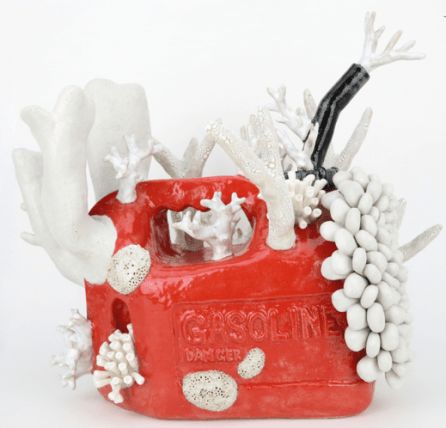
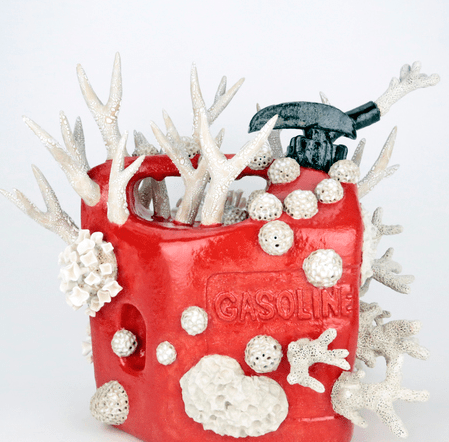
Now comes the remarkable writer William T. Vollman with an excerpt from No Immediate Danger, the first volume in a series that will explore the many delusional stories we conjure to justify our unwillingness to change behavior — except in the most trivial ways — while in the midst of the sixth extinction. His title refers to the narrative superimposed by Japanese government and corporate reality spinners in the aftermath of Fukishima.

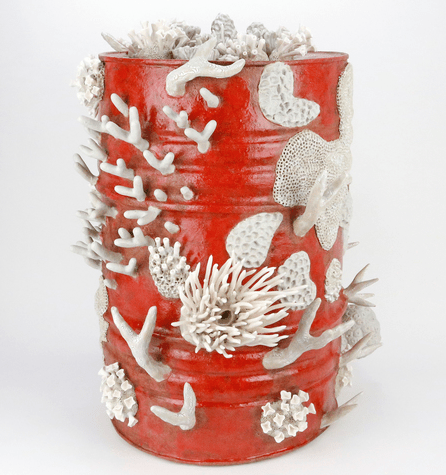
Images are from the studio of artist and ocean advocate Courtney Mattison.


OIL DRUM

OIL CAN

GASOLINE: DANGER

GAS CAN

˜˜˜˜˜


Sometimes Lies Are Prettier

A few weeks ago, a report by the Pelagos Cetacean Research Institute in Athens was released, with the conclusion that most of the endangered sperm whales that have been found dead in the eastern Mediterranean since 2001 have experienced slow and painful deaths as a result of their stomachs becoming clotted by indigestible globs of plastic, often in the shape of bags.

Yesterday, the Guardian reported that a pilot whale died in southern Thailand after ingesting eighty plastic bags. A marine biologist who assisted in the autopsy commented: “If you have 80 plastic bags in your stomach, you die.” The sentence would also be true with the pronoun “we”.

Now comes Timothy Morton, with a few paragraphs from his Being Ecological. Images are from Tavares Strachan, whose work is included in an exhibition at Storm King, and from whom we also borrow our title.


WHO DESERVES AQUAMARINE, BLACK AND GOLD (FLAG)


STANDING ALONE


˜˜˜˜˜

Longtime DP readers are familiar with the name Gunther Anders, and his concept of inverted utopia, where we are able to imagine endless technologies that, in the end, suggest a world without us. We offer our slight amendment: the world will be without an abundance of other sentient creatures as well, those that we will have erased along the path of ecocidal utopian inversion.


Symbolic In Their Afflictions

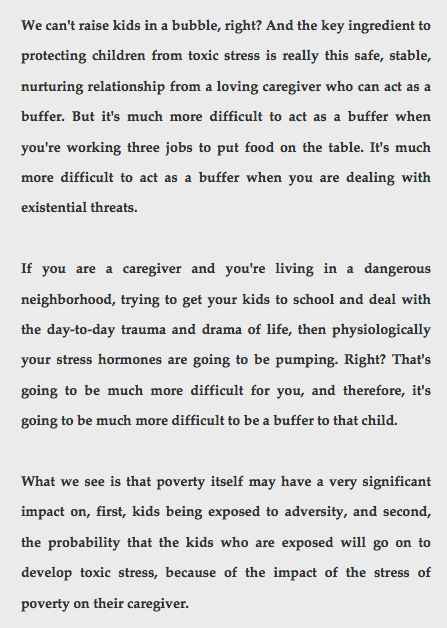
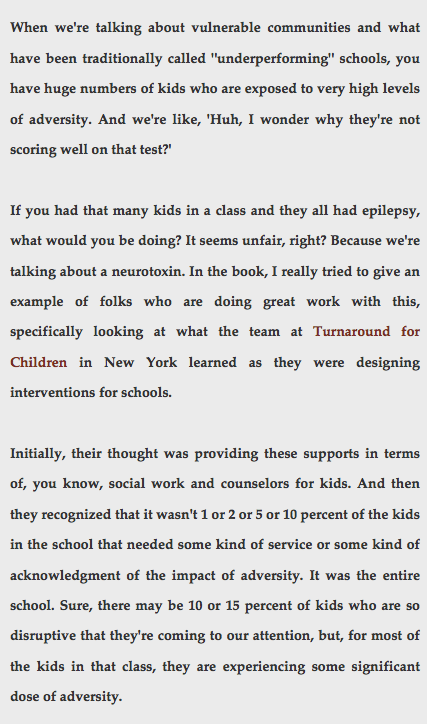
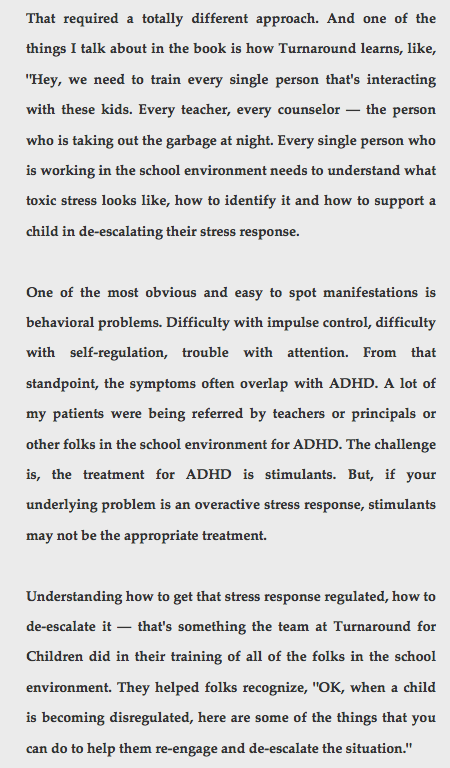
During a time when American children are increasingly subjected to toxic psychological and physical traumas, including clinically suspect behavioral drug regimes, we turn to pediatrician Nadine Brooke Harris with excerpts from a recent interview following the release of her book, The Deepest Well.

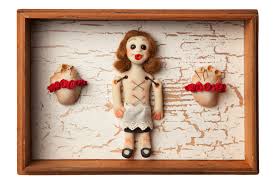
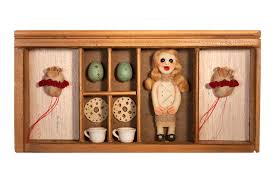
Dolls are from the studio of Amber Groome, where safety pins signify the opposite of safety.

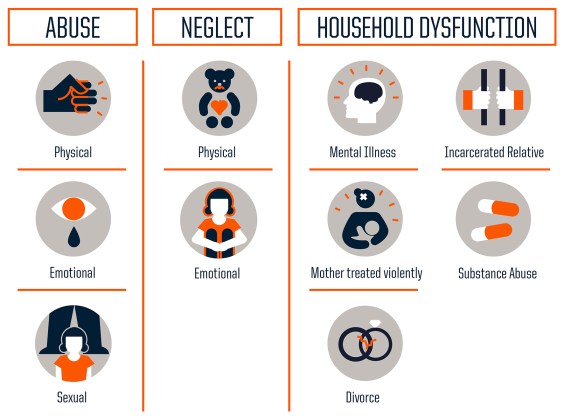
On the added risk of ACEs rooted in the experience of poverty:


ADVERSE CHILDHOOD EXPERIENCES


˜˜˜˜˜

About her dolls, Amber Groome writes:

“Each doll that I make is one of a kind as well as handcrafted. They are symbolic in their afflictions. For me, my dolls are a testimony to the trauma and sorrow of being female and living with mental illness. When I create the dolls, I become absorbed and preoccupied with internal conflict as well the private depths of my childhood and psyche. The dolls are adored and loathed by me at the same time. I prefer to have them viewed in large quantities so they appear to be even more obsessive and detailed in nature.”


Key for symbols:

Hearts exposed-vulnerability
Hearts with glass shards-religious, devotion
Pins and Needles-affliction, self-mutilation
Eggs-birth/rebirth
Safety Pins-opposite of safety, inflicts pain
Doilies and Lace-femininity
Pines Cones-Nature
Pills-being dependent on medication
Antlers-dreams/supernatural

˜˜˜˜˜

It Don’t Mean A Thing


If it ain’t got that swing……


DOO WAH DOO WAH DOO WAH DOO WAH


Wait……. what???


On the Brink

Having been within twenty feet of a North Atlantic right whale while sea kayaking, we can attest to the magnificence of this severely stressed and endangered creature. From the website of Whale and Dolphin Conservation:


North American WDC executive director Regina Aasmutis-Silvia expanded on the crisis in a recent Living On Earth interview, excerpted below:


˜˜˜˜˜

The Woods Hole Oceanographic Institute has developed an “on call” buoy that would at least mitigate the problem of fixed-line entanglements:


Partan and Ball call their new device an “on-call” buoy. It looks like a giant spool of bright orange thread. On land, the 3.5-foot-high spool with 2,000 feet of line wound around it weighs 340 pounds, but in water, it’s buoyant and floats near the bottom attached to the lobster traps. With a timer or an acoustic signal, the device can be activated to unspool its line and float up to the surface for retrieval.

“Our system is to try to store the vertical line on the seafloor—keeping the lines out of the way of large swimming animals—until the fishing vessel crew releases it and is on site and ready to haul it in,” Partan said.


The technology is listed as “patent pending”. Will it be too little, too late? Unfortunately, we will know the answer to that question within the next few years.


Life After Nature

Now comes Jedediah Purdy, with excerpts from a 2015 interview that appeared in The Atlantic Monthly following the publication of After Nature, in which Purdy traces the history of the American environmental imagination, and the ways in which projected meanings and “lessons” of nature have been used to justify its exploitation. Purdy suggests that if we are to change our relationship to the living world during this time of the Sixth Extinction, we will need to radically change our understanding of what it means to be human.

Images are from a 2011 Walton Ford exhibition, I Don’t Like To Look At Him Jack. It Makes Me Think of That Awful Day On The Island.


wf4


jp5

˜˜˜˜˜

As for the Walton Ford exhibition at Paul Yasmin Gallery dating from 2011, we find the following notes:

The first series, presenting three huge portraits of King Kong, is based on the 1933 movie co-directed by Merian C. Cooper and Ernest B. Schoedsack. As Ford explains, “The depression era Kong was misshapen, not modeled on any living ape. He has an odd, ugly, shifting charisma like Cagney, Edward G. Robinson, or Bogart. Naturally, his woman screamed in terror. She continued screaming throughout their time together. The grief of the original Kong is the grief of the unloved, and like Humbert Humbert or Frankenstein, the grief of the unlovable. In 1933, Fay Wray says words that would break any suitor’s heart. She shrinks from the chained Kong and tells her human lover, ‘I don’t like to look at him…’ Since Kong is a Hollywood tough guy, he covers up his heartbreak with violence and anger. These paintings are about Kong’s heartbreak. I wanted to reveal the monster’s grief, his enormous sadness, the sorrow that the original Kong kept hidden from view.”

Ford’s second series, which depicts a monkey capturing and strangling a parrot, was inspired by an unsettling passage from Audobon’s memoirs. Describing a childhood memory, Audobon writes: “…My mother had several beautiful parrots and some monkeys; one of the latter was a full-grown male of a very large species. One morning, while the servants were engaged in arranging the room I was in, ‘Pretty Polly’ was asking for her breakfast as usual, ‘Du pain au lait pour le perroquet Mignonne,’ the man of the woods probably thought the bird presuming upon his rights in the scale of nature; be this as it may, he certainly showed his supremacy in strength over the denizen of the air, for, walking deliberately and uprightly toward the poor bird, he at once killed it, with unnatural composure. The sensations of my infant heart at this cruel sight were agony to me. I prayed the servant to beat the monkey, but he, who for some reason preferred the monkey to the parrot, refused. I uttered long and piercing cries, my mother rushed into the room, I was tranquillized, the monkey was forever afterward chained, and Mignonne buried with all the pomp of a cherished lost one. This made, as I have said, a very deep impression on my youthful mind.”

˜˜˜˜˜