Author Archives: DP

Iceberg Redux

Iceberg Miner

THEY WANT THE FULL MONTY

Australian mining magnate Clive Palmer, who has already divulged plans for an exact replica of the Titanic, announced today that he also plans to create an exact replica of the iceberg that sank the fabled ocean liner.

“It comes down to understanding what this thing is all about,” said Mr. Palmer, adding that his survey results indicate that prospective passengers want the entire “tux to life vest” experience. “They want to know how it felt to make those key decisions, like who gets to escape from steerage, and who gets first dibs at the lifeboats, you know, that sort of thing,” explained the mining titan.

Mr. Palmer waived off skeptical comments regarding his ability to calve an iceberg. “Oh come now, my consultants tell me that an iceberg is either a snowball or an ice cube, so that means we’ll either roll it or chip it. Either way, compared to the logistics of a strip mine, it’s a piece of cake.”

A PIECE OF CAKE

A PIECE OF CAKE

Environmental organizations did not respond to phones calls seeking comment, but Mr. Palmer said he would address their concerns, as he has always done in his mining operations. “I intend to hire Sir Ranulph Fiennes as a sort of diplomat at large for the project, and he will assist in fundraising for anyone who has doubts or questions, and I am sure everyone will be happy in the end. We even had the idea that Sir Ranulph might take charge of a few lucky greenies who could bundle up all warm and fuzzy and ride the iceberg, you know, see the disaster from that perspective.”

When asked how he could justify spending a fortune to produce the replica simply to destroy it, Mr. Palmer replied, “Well, when I started this, I thought the point was to complete the maiden voyage that the iceberg sort of interrupted back in 1912. Then I read our own internal surveys, and I had this stunning epiphany —  there is no way to compete with what really happened, so why not make it happen again? That way a whole new generation gets to experience the thrill of being carried down, deep inside what has become a tremendously powerful modern myth. No way can I let such an opportunity float by — so I figure let’s go whole hog.”

THE REAL THING

THE WHOLE HOG

Yes, but will passengers who go whole hog be carried once again to their deaths? “My lawyers are still reviewing all that, but we’re thinking there will be different ticket classes — the more you pay, the more risk you accept. The highest price will be for those who want to go the full monty, and leave everything, you know, to fate. The main rescue boat was called the Carpathia, and we’re already about half done with a replica of her. I mean compared to the Titanic II, she is nought but an overblown tug boat.”

Once Titanic II disappears beneath the waves, what then? “Well, I’ve discovered I have a driving passion for building boats. I am prepared to keep building Titanics for as long as there are people who want to walk the walk and take a chilly swim past midnight. Some people may dream of taking a stroll on the moon, but on board the Titanic II you will get to look that iceberg dead in the eye, and then look your fellow passengers dead in the eye and find out who you really are at crunch time. You can’t slap a price tag on that.”

NO PRICE TAG



Power and Density

A wind farm of eleven industrial turbines off the coast of Aberdeenshire has been approved by the Scottish government. The project was opposed by Donald Trump, who claimed that the turbine “monstrosities” would interfere with the expansion of his golf paradise.

Mr. Trump recently disclosed plans for a 140 bedroom hotel that he claimed would be listed “among the finest hotels in Europe”, with one condition: “If plans for the ugly industrial wind turbines proceed, we would obviously not build this hotel.”

aberwindfarm

WIND FARM DEMO

Here at DP, we are highly skeptical of wind farms at the scale now contemplated for coastal locations, not because of their impact on tourist vistas but because we question the projections for net energy generation from the costly turbines; we would even venture a prediction that the total cost of these “farms” across the full cycle of their operation (including as of yet unknown health and ecological impacts) will significantly exceed the value of the energy produced.

For now, though, let us focus on what Mr. Trump proposes as a more attractive visual spectacle for visitors to Aberdeenshire:

trumphotel

WORLD CLASS GOLF FARM

We are struck by the remarkable aesthetic similarity between the wind farm turbines and the “turbined” energy vents of this monstrous aggregation of rentable sleeping units.

The nautical reference for this particular mode of tourist accommodation is provided by the Carnival cruise turbine:

carnycruise

GLOBAL VACATION FARM

Stripping away all pretense and ornament, the deep aesthetic for both the Trump hotel and the Carnival cruiser derives from that ultimate expression of dense conveyance:

marcopolo

THE AESTHETIC OF DENSITY

The more dense the concentration of energy and experience, the greater the profit, with all the trappings of power. Yet in the wind we hear a timeless prophecy, that all these hubristic monuments are destined for the same end:

golfer

RUINS OF AN ANCIENT SOLAR POWER GENERATOR


Reading the Water

Robert Macfarlane’s excellent The Old Ways recently steered us anew to a favorite passage from Mark Twain’s Life On the Mississippi:

MT1

If he were piloting the world’s rivers today, Twain (for whom we have a special affection here at DP) might find that reading the face of the water has become ever grimmer, and ever more dead-earnest:

ALPHABET SOUP

ALPHABET SOUP

Sometimes, the truth of the book is only divulged in the epilogue:

deadfishlagoon

HYPERTEXTUAL LAGOON

Very often, one must also pay special attention to editorial annotations scribbled along the edges of the text:

DELETED FIGURE

CRITICAL EXEGESIS

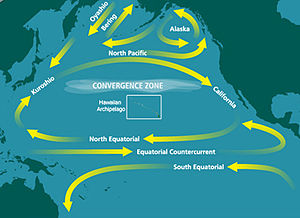
Among the plastic bits and bobs discovered inside the dead whale: a clothes hangar, an ice cream tub and two small flower pots. Such a diet makes for grim narrative flow.

TOXIC NARRATIVE GYRE

TOXIC PLOT


Texture

This week, an extraordinary documentary produced by the BBC in tandem with The Guardian appeared online:

A MAN OF TEXTURE

CLICK FOR VIDEO LINK

Through a careful accumulation of eyewitness interviews and supporting corroborative evidence, the documentary clearly establishes the link between US advisors and Iraqi paramilitary torture/death squads, transpiring beneath the dead eyes of veteran dirty war expert James Steele, who had seen it all many times before. His CV (as published in The Guardian) reads as follows:

JScv

Steele’s career trajectory perfectly encapsulates the pitch black philosophy of counterinsurgency that has guided the actions of the US military for over fifty years. In his recently published book on US war crimes in Vietnam book, Nick Turse identifies the core tenet of this philosophy as “kill anything that moves”. But there is a secondary imperative: to extract as much “intelligence” as possible through torture prior to final disposal. Even if the information ultimately proves worthless, torture provides a potent form of teaching, for those left alive.

Early on in the video, we took note of a reference to a September 2005 memo written by Donald Rumsfeld to then-president Bush, forwarding a report from boots-on-the-ground Citizen Steele. Rumsfeld titled the memo “Texture”. Rumsfeld writes, “The attached memo is from a person we have sent into Iraq from time to time essentially to work with the Iraqi police. He is smart, tough and a keen observer. Nonetheless, you have said you like ‘texture,’ and this is texture.”

CLICK FOR ENTIRE DOCUMENT

CLICK FOR COMPLETE TEXTURE MEMO

In his report, Mr. Steele seems anxious to distance himself from “thugs” such as the commander of the Wolf Brigade and their death squad militia – yet it was Steele himself who was instrumental in arming and empowering these same militia to perform wet work on behalf of the US military. Was he engaging in a bit of track covering, anticipating eventual investigations into possible war crimes? Or did he fear meeting with a similar fate as that of his compatriot torture teacher, Daniel Mitrione?

THE NAPPING POST-MODERNIST DREAMS OF ELECTRIC SHEEP
THE SECRETARY DREAMS OF ELECTRIFIED SHEEP

Following a series of links in search of more information on the relationship between Steele and members of the Bush administration, we came across the transcript of a speech given in December 2005  by Donald Rumsfeld at Johns Hopkins University, on the subject “The Future of Iraq”. The entire speech is worth reviewing, above all in light of the extensive documentary evidence of the systematic torture and abuse of civilian detainees; for now let us focus on one excerpt from the Q & A:

rums

First, we note that Mr. Rumsfeld appears to suggest that a belief in one’s mind that something is true is sufficient to establish truth, regardless of empirical evidence to the contrary.  Second, if the US claims that international law does not apply to “the terrorists and the people who blow up children”, who decides – and by what criteria – which individuals qualify as members of this extralegal category of “terrorists”? Those who are accused as such by terrified detainees, while they are being tortured by sectarian death squads?

Let’s assume that every individual who was tortured was in fact a member of a terrorist group; have we officially discarded the bothersome notion that basic human rights are “inalienable”? Forgive the rhetorical question – we know the answer.

IRAQ WAR TEXTURE, 2005

THIS IS TEXTURE


This Flexible Being

FLEXIBILITY CLASS

FLEXIBILITY CLASS

montes

Evolutionary psychologists tell us that neuroplasticity and malleability of consciousness provide humans with certain survival advantages. Whether as individuals or in groups, being able to “go with the flow” (and to understand where and what the flow consists of) often presents the key to assuring genetic posterity. Of course, such flexibility may also set the stage for moral dilemmas, when by conscience or conviction an individual chooses to swim against the flow, even at the risk of being swept away and becoming the washed out end of the line.

In the world of ideas, the varied media of connection and communication shape the direction and intensity of the flow – sometimes even the taste of the water. Given the prevailing ubiquity of the internet, it is not surprising that the phrase, “the smartest person in the room is the room”, should become one of the more irritating commonplaces of recent years.

By their own intrinsic nature, most interactive networks will rank the value of individual contributions to the flow, one way or another; those ideas that “click” with the consensual inclinations of the network will bob up magically from the bit torrents, while dissenting or contrary views will achieve minimal splash (no thumbs up), and be shunted off.

With the number of potential participants limited only by demographics, global networks (scientific, financial, political, administrative or whatever) eventually become so complex that no single individual comprehend them, resulting in a tendency to abdicate all agency to collective “wisdom”, typically expressed as an algorithm. Thus the network becomes ever stronger while the solitary labors of individual minds are systematically devalued, and fade to black.

A number of years ago, Nicolas Carr posed the rhetorical question “Is Google Making Us Stupid?” Are individual citizens becoming more simple-minded as the social brain becomes ever more complex, while acting on our behalf? Is such networked complexity really “intelligent”, or something else altogether?

PROTOTYPE FOR THE WIRED ESSENCE

MEDIUM FOR A PAST SINGULARITY

Carr argues that the media we use for research and communication will inevitably have strong impacts on our plastic, flexible neurobiology. Through constant exposure to the network and its own evolutionary imperatives, the neural pathways that are conducive to slow, deep philosophical reflection will be diminished in favor of the sparky buzz created by instant feedback. Through time, individual intelligence may thereby become extremely narrow, fast and thin – pancake subjectivity.

Qualities such as moral discernment and cross-cultural empathy require neural pathways that may no longer be present for network participants; nor may the ability to distinguish virtue from tyranny. Carr suggests that such intellectual qualities depend on a very different sort of media environment, one that supports solitude and reflection, and one where idiosyncrasy, dissonance and polyphony are valued rather than diminished.

David Weinberger’s Too Big To Know (for which the phrase “smartest person in the room is the room” provides part of the lengthy subtitle) has the virtue of logic and lucidity in describing how and why the room got so smart, so fast. Yet for all his nuanced and persuasive examples, Weinberger omits one extremely important dimension – the close entanglement of knowledge with relationships of power. Considering the intimate ontological affiliation between the internet and the vast apparatus of national security, such a glaring omission makes the author sound like a naive cheerleader at a Steubenville pep rally.

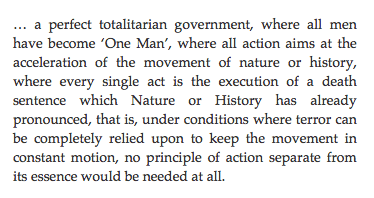
In the past, forgetting that knowledge and power often wrap each other in death embraces has not worked out very well for intellectuals, above all when the orderly voice (and all-seeing eye) of the One flattens the clamor of distinct individual voices. In her masterful study, Origins of Totalitarianism, Hannah Arendt describes

arendtone

Principles of action govern individuals, one by one; when there is only the One (the condensed expression of all singularities into one throbbing Singularity), individuals are robbed of their autonomy and become nothing but storage vessels, conveying the essence of a totalized power.

From the scattering and splintering of thought assembled into an illusion of community emerges the sort of ecstatic groupthink oblivion that typically ends in a bloodbath. This is not to say that networked media and communications will lead inexorably to totalitarianism; rather, there is a sort of alignment of cognitive rhythms that may quite suddenly and violently explode into a fury of state terror and enforced conformity.

Flexibility and autonomy are erased, and from then on, the writing will be straight and uniform. Those who see it coming will be the first to disappear.

FULLY NETWORKED AND ON THE MOVE

FULLY NETWORKED AND ON THE MOVE

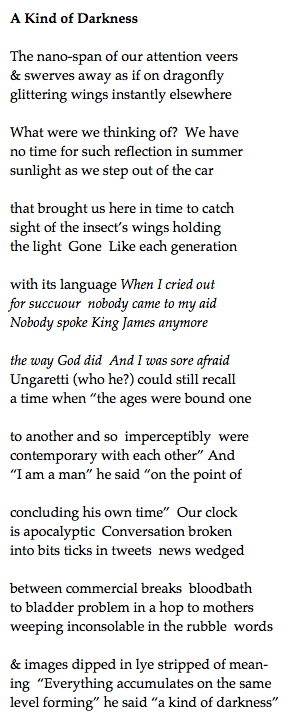
In closing, Jon Swan, one of our favorite poets here at DP, and a man who scrupulously avoids smart rooms, releases a new poem into the flow:

swanKOD

AGAINST THE FLOW

AGAINST THE FLOW


The White Rose

whiterose

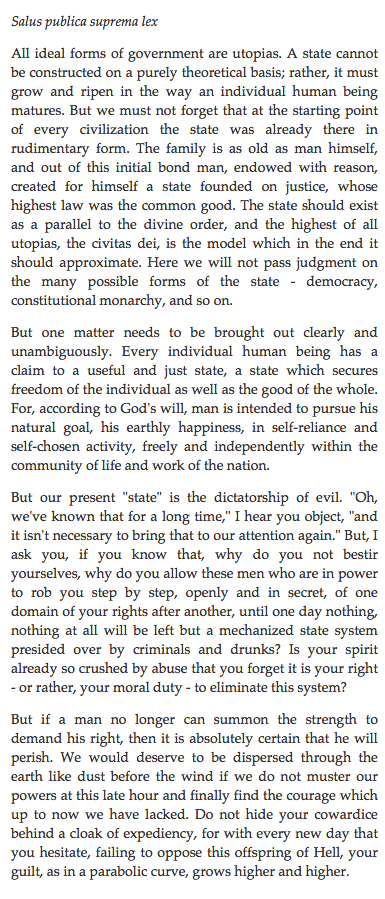
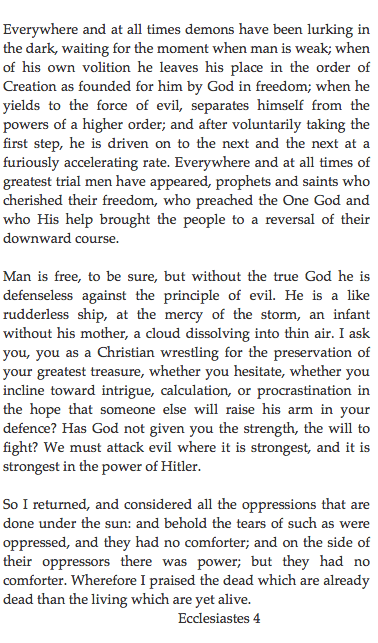
Seventy years ago today, men wearing top hats guillotined the heads from three members of the anti-Nazi student movement known as The White Rose: Hans and Sophie Scholl, and their friend Christoph Probst. Having spent the morning reading their six leaflets, we offer the following excerpts, with ideas that remain strikingly relevant for the year 2013:

FROM LEAFLET I

wr1

FROM LEAFLET II

WR2einz

Then follow (remarkably) two quotes from Lao-Tse that may have experienced a degree of internal distortion in the course of multiple translations. Working back from the somewhat convoluted German,  we are guessing that the authors intend reference to chapters 58 and 59 of the Tao te Ching:

lao

WHITE ROSE PRESS

FROM LEAFLET III

WR3 
FROM LEAFLET IV
WR4
WHITE ROSE IN BLOOM

WHITE ROSE IN BLOOM

FROM LEAFLET V
WR5
FROM LEAFLET VI
WR6
NAZI HONOR GUARD

NAZI HONOR GUARD

Hans and Sophie Scholl are buried inside the Friedhof am Perlacher Forst, together with Christoph Probst and their father, Robert Scholl. Nearby there is s special memorial cemetery consisting of 44 stone tiles, beneath which are interred 4000 urns containing ashes from victims at Dachau, Auschwitz, Buchenwald and Flossenburg.

During our morning researches, we were interested to discover that The White Rose was in part inspired by sermons delivered by Bishop Clemens Graf von Galen (known as “the Lion of Münster” for his early, brave and quite lonely opposition to National Socialism) regarding the eugenistic T4 program, among whose administrators could be found a former provincial policeman named Franz Stangl, the “ordinary man” who would later become the Kommandant of Sobibor and Treblinka. He died of a heart attack while in prison, following a long series of dialogues with Gitta Sereny; we have been unable to determine the present disposition of his remains.

Their Sun Still Shines

THEIR SUN STILL SHINES


Memory and Justice

BLAH BLAH

FIRM AS A MONKEY TAIL

Now comes “Baby Doc” Duvalier, with a request to postpone a hearing regarding a long list of crimes against humanity. The grounds? It seems he does not wish to discuss such things on the anniversary of his departure for Paris in 1986, under cover provided by the CIA.

According to his lawyer Reynold Georges, “He wants the date to be changed. A lot of organizations and human rights people are saying, a bunch of ‘blah, blah,’ that if the court chooses that date, it’s because they want to throw out all the charges against him. We have nothing to hide. He will be cleared.”

Among those in the “blah blah” bunch, we find Reed Brody of Human Rights Watch, “The law is very clear. Haiti has a legal binding obligation to investigate, and if appropriate, prosecute the crimes committed under Duvalier.”  The underlying principle: There must be no statute of limitations for crimes against humanity.

With this in mind, and closer to home, descendants of the Sand Creek Massacre continue to press their own case for justice in response to the slaughter of 163 Cheyenne and Arapaho Indians, most of them women and children, on November 29, 1864. Bodies were mutilated, with various body parts cut off and placed on display inside a Denver theater.

Article 6 of the 1865 Treaty of the Little Arkansas officially acknowledged that “gross and wanton outrages” were inflicted upon “certain bands” of Cheyenne and Arapaho. Compensation was promised, yet never delivered.

GUILTY, BUT NOT AS CHARGED

GUILTY, BUT NOT AS CHARGED

At the close of her painstaking investigation into the case of John Demjanjuk (summarized here, but published in its entirety as a chapter in The Healing Wound), Gitta Sereny writes:

“But although the crimes are now and must remain a part of history, the Naz1-crime trials must cease. The alleged criminals, the survivors and the witnesses are too old: these are now men and women in their eighties; memories and evidence become flawed. Prosecutions are not safe. The survivors of that terrible period, with a pain of the soul that none of us can imagine, and their children who inevitably had to share it, must be allowed and indeed allow themselves to let go of it — to rest.”

Sereny is concerned about the quality of prosecution; that is, that crimes against humanity not be compounded by miscarriages of justice. In the case of Demjanjuk, facts proved elusive; in the case of the Sand Creek Massacre, however, there is no longer any question about what happened. There, the dispute is over compensation as articulated in the 1865 Treaty, though unqualified recognition of the event as an atrocity took well over a century, as documented in a fascinating recent study by Ari Kelman.

In the matter of Baby Doc, we are confronted with a rather different question: whether the Haitian legal system is able to break with the long tradition of permitting despotic rulers to get away with murder.

As stated by Amnesty International’s Javier Zuñiga,“The arrest of Jean-Claude Duvalier is a positive step but it is not enough to charge him only with corruption. If true justice is to be done in Haiti, the Haitian authorities need to open a criminal investigation into Duvalier’s responsibility for the multitude of human rights abuses that were committed under his rule including torture, arbitrary detentions, rape, enforced disappearances and extrajudicial executions.”

scmassacre

ALL AMERICAN WOUNDSCAPE 1864


Into the Fog

THIS STRANGE MIXED AFFAIR WE CALL LIFE

THIS STRANGE MIXED AFFAIR WE CALL LIFE

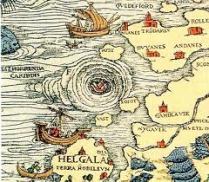
Over the past year, Desperado Philosophy offered a sort of dead reckoning navigation through often difficult conditions, with one hundred bearings taken along the way.

Though the 2012 maiden voyage has come to an end, time goes on despite all prophecies to the contrary, and DP will remain an open enquiry, though unfolding in a slower tempo, with fresh bearings taken whenever we feel like knocking off people’s hats.

            Onwards into the fog of 2013 and beyond …

VIEW FROM THE CROW'S NEST

VIEW FROM THE CROW’S NEST


Now That We Know

WATCHMAN, WHAT OF THE NIGHT?

WATCHMAN, WHAT OF THE NIGHT?

The looming of DP began with two images from 2011: the vicious pepper spraying of a small group of students who were attempting to slow the transformation of their university into a delivery system for banking services; and the pinched face of Jon Corzine, who had engaged in what seemed a massively fraudulent transfer of wealth from the many to the one – himself.

As of this writing, the recipients of the large dose of oleoresin capsicum have been awarded a million dollar settlement for their troubles, while Mr. Corzine remains at large. We hereby nominate Jon Corzine as the Poster Boy for our increasingly bifurcated legal system, one where the poor receive instant incarceration while the rich pay fines or make donations to the coffers of political campaigns, and then return with impunity to the Grand Casino.

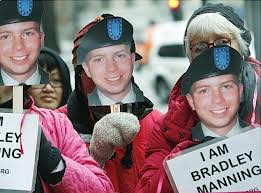
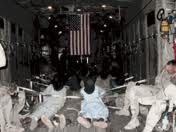
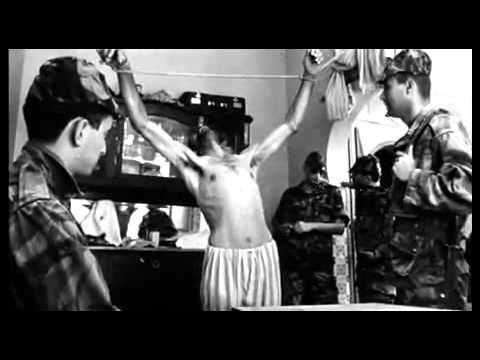
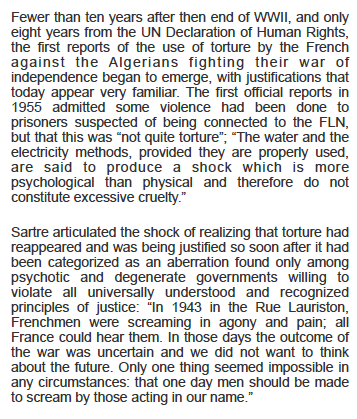
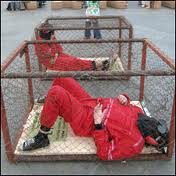
For much of the year, we have been digging into the deformed conscience of the American imagination; forensic archaeology in search of clues for how a republic founded on the celebration of life, liberty and the pursuit of happiness could transform itself, all too seamlessly, into a rogue state that sanctions torture and remote control murder, executed in the name of “national security”. What begins in secret rendition and foreign black sites gradually becomes domestically mainstreamed, with the treatment of Bradley Manning offering a transitional experiment in how much the sleepwalking American public is willing to accommodate.

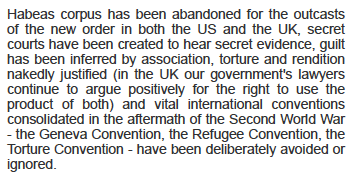
In this final DP post for 2012, we submit a montage of excerpts from an excellent essay by the tenacious and skilled attorney Gareth Peirce, author of Dispatches from the Dark Side: On Torture and the Death of Justice:

gp1

EARLY EXAMPLE OF A STRESS POSITION

EARLY EXAMPLE OF A STRESS POSITION

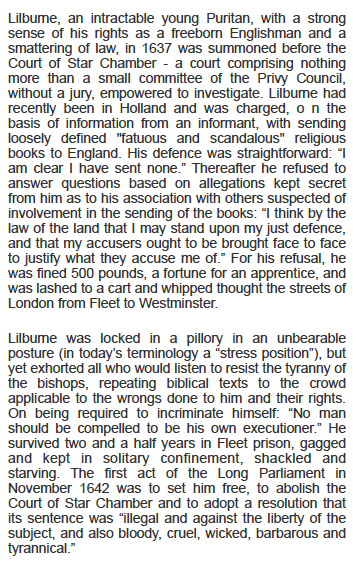
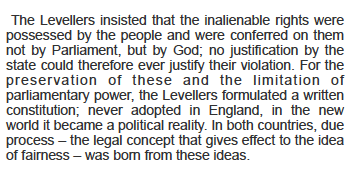
By reviewing the 17th century case of the revolutionary Leveller John Lilburne (“Freedom John”), Ms. Peirce urges our consideration of the deep relationship between the rejection of barbarous and tyrannical treatment of individuals and the development of due process:

gp2

IN TORTURE WE TRUST

IN TORTURE WE TRUST

Fundamental to both the English and the American revolutions is the Leveller conviction that basic human rights are inalienable:

gp3

NAUSEA

Déjà Vu

Memory is short, when the political body floods itself with rage, or racism, or the hunger for revenge:

gp4

tip3

THE TIPTON THREE

Acting through whatever remains functional within the legal system, a handful of individuals forced the truth to the surface, documenting a wide range of abuses suffered by often completely innocent captives at Guantanamo Bay and other “facilities”:

gp5

HIGH ENTERTAINMENT VALUE?

AWARD WINNING ENTERTAINMENT

Ms. Peirce closes with the question that is also our question, as we look ahead to 2013:

gp6

Screen Shot 2012-12-27 at 2.54.41 PM


Pedagogy for a Dead Conscience

WHAT IS GOOD

WHAT IS GOOD?

In a recent Tomgram op-ed, former State Department official Peter Van Buren takes note of our extraordinary (can-do!) capacity for avoiding the uncomfortable implications of our most definitive actions:

VB1

The nightmare of torture is a far cry from Life, Liberty and the Pursuit of Happiness. How did we get here? Way back in 1979, the brilliant Eva Brann wrote an exceptional (thus largely ignored) treatise, Paradoxes of Education in a Republic, in which she argues:

EB1Anticipating the familiar objection that such an education would be considered by many to be an unsupportable luxury, Ms. Brann writes:

EB2The tone of her book indicates that Ms. Brann thought that the situation could hardly get any worse than it was in 1979; alas, the precipitous disintegration was just getting started. Within a generation, the notion of a classically defined liberal arts education available by right to all citizens now seems like a remote and impossible dream. Instead, we have conceived an education system derived from the most narrow conception of instrumental utility, one that could hardly be expected to produce engaged and informed citizens within a vibrant republic. As chronicled by the dissenting Henri Giroux:

gir1

Within such a suffocating pedagogy, the sorts of inquiries and dialogues necessary for the sustenance of an evolved moral and ethical consciousness – itself fundamental for the civic life (and civic conscience) of a constitutional republic – wither and die. Eva Brann’s “driving impetus”, the basic human question of what is good, fades into the most brutally degraded instrumentality: the philosophical disposition for black sites, rendition, supermax isolation and torture.

The price for such degradation is steep. Returning once again to Mr. Van Buren:

pvb

STARS AND STRIPES

SCHOOLED