Author Archives: DP

The Unblinking Eye

Almost exactly a decade ago, in November 2002, DARPA released a hot new brand into the marketplace of national security: Total Information Awareness (TIA).

With its motto Scientia Est Potentia, intended to convey in primitive Latin the commonplace idea that knowledge is power, TIA would be directed by former perjurer John Poindexter to “imagine, develop, apply, integrate, demonstrate and transition information technologies, components and prototype, closed-loop, information systems that will counter asymmetric threats by achieving total information awareness useful for preemption; national security warning; and national security decision making.”

As it happens, TIA went too far with too much, and too soon. The program was officially terminated; the website deleted; and Poindexter faded into richly deserved obscurity. Yet bit by bit and year by year, the comprehensive surveillance infrastructure of TIA has without any fanfare (and well beneath the dull radar of the mainstream media) become fully operational, with data storage and analysis conducted through the NSA.

With its all-seeing eye at the apex of its pyramid of power, and with the entire planet transfixed by its radiant gaze, the unblinking eye of TIA represents a sort of globalized penetration of the “principle of inspection” conceived by Jeremy Bentham in 1787 — a date neatly (and ironically) sandwiched by the American and French revolutions.

SMALL SCALE MODEL FOR TIA

Of course, Foucault’s analysis in Surveiller et Punir – which the DP editorial staff devoured while undergraduates – articulates the key features of Panopticism, while also tracing its historical genesis from the fear of plague and contagion. Though there have been reams of texts contesting this or that aspect of Foucault’s research, his emphasis on how power becomes internalized as subjective consciousness remains valid and useful in coming to grips with ever more hypertrophic technologies and networks of state surveillance, and the corresponding compression of private space.

In any event, the primary text from Bentham himself could hardly be more forthcoming; after all, it was written as a sort of sales pitch in search of a lucrative commission, thus there would be no value in obscuring the design’s fundamental intent. Through a series of letters (we had not previously noted that they were scribed from White Russia) Bentham articulates the “inspection principle”, from which specific environments and architectures might then be derived:

In his introductory remarks, Bentham himself underscores the key point in his design: that the object of inspection be kept in the dark as to exactly when inspection is to occur. The uncertainty that exists “during every instant of time” for the prisoner assures that the behavioral objectives of surveillance become internalized; not something imposed from above but far more potently as conceived by each prisoner, as part of their own response to potentially constant — yet unverified — inspection.

Bentham further elaborates how the design of the panopticon regulates transparency and light, such that the prisoner becomes a pacified object of information generating behavioral data:
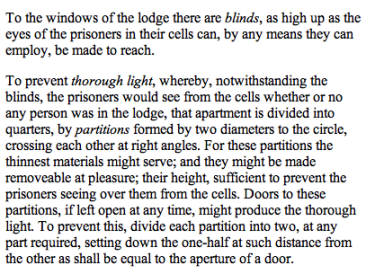
In sum, the power of the inspection principle derives from retaining control over visibility as the key to sustaining the uncertainty which in turn produces the desired state of passive self-regulation (or “learned helplessness”, in today’s terms) that is optimal for the efficient management of a subjugated animal mass.

ARE YOU BEING WATCHED RIGHT NOW?

To change to a different stream of information, redaction provides possibly the most compact expression of panopticism: only eyes that have been thoroughly inspected and approved may view the document, while the public mass can only access fragments. Wikileaks threatens to take the power of redaction away from the domain of the Inspection House (CIA, NSA, etc.) and thus must be silenced, through criminalization or demonization, a process in which much of the mainstream media has eagerly participated.

LIGHTS OUT

In his quietly brilliant way, Oliver Ressler explores the issue of blacked out sites (geographic redaction) in part three of his film/installation project, What Is Democracy. With a focus on Area 52, Ressler records a lucid analysis by artist/geographer Trevor Paglen, posing the fundamental question: how can democracy possibly function when there exists a network of sites that are designated as outside the bounds of the discursive polity, and (even more importantly) outside the law.

WHAT IS DEMOCRACY, PART 3

Now comes the Petraeus Affair, to introduce phrases like “digital forensics” and “internet traffic analysis” into the everyday lexicon of American politics. Will those who labor under the delusion that we still live in a constitutional republic finally wake up to the murky reality of the Surveillance State? And has the dark web of TIA become so complex, with its limitless potential for abuse and malice, that it will inevitably begin to consume itself?

If someone like King David can be consumed by the surveillance web, through events set in motion by a  “favor” granted to a socially ambitious hostess, then what protection will average citizens have should the unblinking eye cast its paranoid gaze upon them?

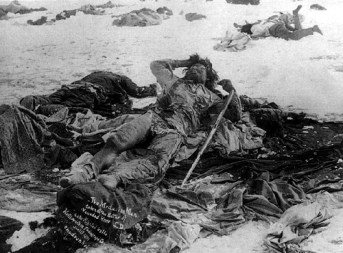
To be clear: we never believed the Petraeus Myth. If we are to consider his brutal “surge” as some sort of triumphalist “win”, then  should we also count the massacre at Wounded Knee as the crowning achievement of our manifest destiny? Forget the tacky romp with his own hagiographer; focus on the real history of the murderous “surge”, and its legacy of corruption and betrayal, together with the unmitigated strategic disaster of Surge II in Afghanistan.

Petraeus was a master of manipulating the media and the broader public craving for a Hero, any Hero, please give us a Hero. Now he learns that those who live by smoke often die by fire.

___

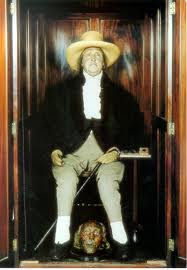
Following his death and in accordance with his express wishes, Bentham’s body was embalmed using Maori techniques and put on display at the University College, London. Unfortunately, the embalming of the head was unsuccessful, and it continued to decompose. A wax replica was then used to crown the auto-icon, while the real head was placed between the legs, as depicted below.

In 1975, the same year as the publication of Foucault’s Surveiller et Punir, the head was stolen by a group of students who demanded that a ransom of 100 quid be paid to a homeless shelter. UCL eventually coughed up a tenner, and the rotting head was returned to its case.
FOUR UNBLINKING EYES


Like This We Descend

CLICK FOR COMPLETE TRANSCRIPT OF EVENT

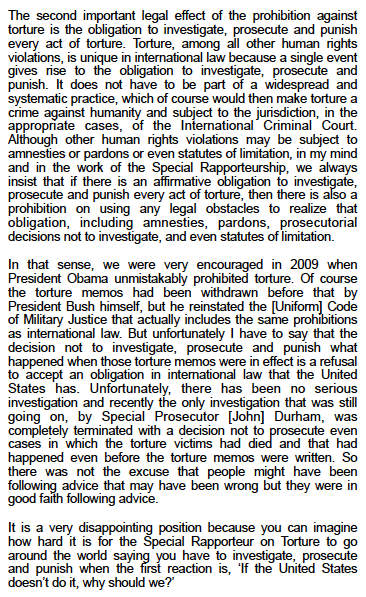
On September 10, the honorable UN Special Rapporteur on Torture, Mr. Juan Méndez, delivered an important address at an OAS policy roundtable held at Chatham House in London.

Foremost among his concerns: the gradual migration of torture from a zone of absolute moral rejection into a zone of programatic resignation. Such a migration provides political support for a climate of legal impunity, which in turn fosters a darkly fertile breeding ground for fresh generations of torturers.

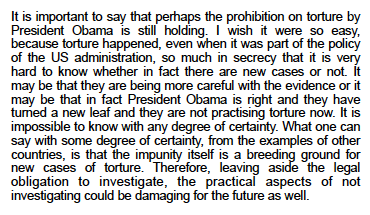
The text is worthy of extensive citation, with a few DP editorial images (with links to essential supporting documentation) affixed:

Mr. Méndez’s cautious optimism regarding eventual abolition is laudable, though he would likely agree that the evidence so far this century describes a descent into ever darker shades of moral relativism, and into a cynical-fatalistic acceptance of “inevitable” human brutality. (His declaration that slavery has been universally abolished also strikes our ear as somewhat premature.)

Mr. Méndez proceeded to remind the assembled dignitaries that the 1984 Convention Against Torture affords zero wiggle room whatsoever to the self-appointed pragmatists:

Plausible deniability offers a mode of transport to convey torture away from the tight box of unqualified rejection and into the vast boglands of national security, into which any lingering moral qualms instantly sink.

RHYTHMS OF MORAL COLLAPSE

WHAT’S NOT TO LIKE?

Recent research on trauma suggests that psychological torture inflicts injuries to the brain, psyche and soul of the victim. One could then make a persuasive case that any prison  environment which creates sensory disorientation through the total control of stimuli functions as a de facto torture chamber.

NO TOUCH TORTURE

“Very disappointing” indeed, for a country that still pretends to be the global standard bearer both for the rule of law and for the defense of inalienable human rights. Such a position is not without consequences, and relies upon a ceaseless suppression of historical fact:

REDACTION AS A BLACK SITE

The breeding ground created by the legal impunity granted the architects of state torture in the early years of this century will undoubtedly hatch a new breed of operatives able to break the will and psyche of fellow human beings. Yet there will be other offspring , too – in the genus of “unknown unknowns”. Like this, step by slippery step, we descend into the dark.

Take the Square

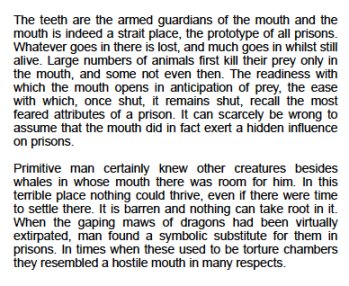
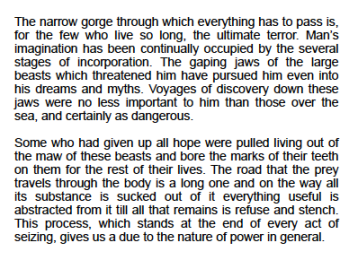
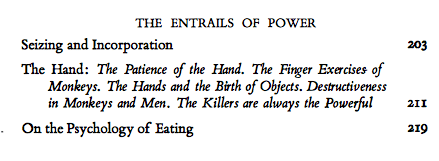
We are indebted to Chris Hedges for reminding us of an astonishing passage from Elias Canetti’s masterful study Crowds and Power, a book that has long made conventional political science queazy, as the author subjects the vertically aligned Body of the Ruler to a painstakingly thorough colonoscopy.

We located the quoted passage inside our own well-chewed volume, and hereby provide its full context, slightly re-formatted for readability (with images added by DP, not EC):

THIS DESIGN HAS TEETH

EXPLODED ALIMENTARY CANAL

INGESTED MORSEL

LARGE INTESTINE

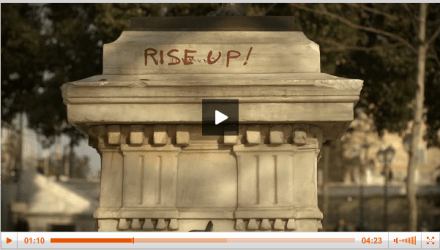
Against the draining of all resistance from the bodies of the ruled by the gluttonous eater at the top of the food chain, we turn to an alternative vision of the polity, as communicated through an important video installation project by Oliver Ressler: Take the Square.

Ressler’s subject matter shapes his aesthetic; he is not afraid simply to let people talk amongst themselves, and to discover unexpected ideas through dialogue. From a position within the production process that is open, respectful and generous, Ressler documents many beautiful and lucid conversations among activist-citizens who are deeply immersed in meaningful horizontality.

Since no central thesis is being pushed down the tube, viewers also have the space to find a way in (and out), and come to their own conclusions. The “Rise up!” photo links to a page on Ressler’s own site, where it is possible to view a four minute excerpt from the installation:

Later this morning, alas, the entire editorial staff of DP shall trudge to the local polling station, to participate – if sluggishly – in our own vertical digestion.

THE ULTIMATE END OF VERTICAL POWER


In Quiet Refusal

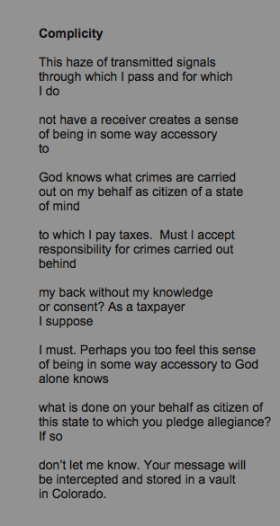
The following poem by Jon Swan caught our ear the first time we heard it (read by Mr. Swan), as it so perfectly captures one of the most bewildering dilemmas of our present moment. A gnawing sense of being an “accessory” bleeds into a second sense that we have no idea what is going on:

“God alone knows” to what we are an accessory, after the fact — and that fact remains ill-defined, ciphered, beyond empirical verification.

We live in a perpetual “haze of transmitted signals” that resonate and radiate through us, and within us, even if we might find their meaning and destination repellent. When the actions of the state are obscured or willfully misrepresented, the question of personal responsibility – difficult even in the best of times – becomes literally inconceivable. If the true nature of the polis lurks somewhere beyond perception, how can we speak of personal ethics?

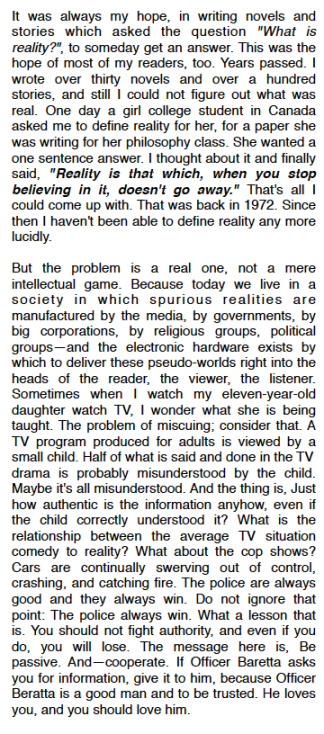
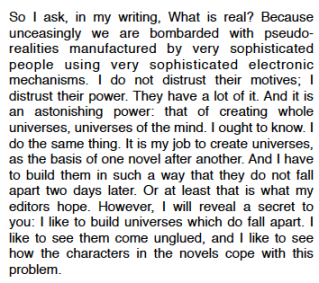
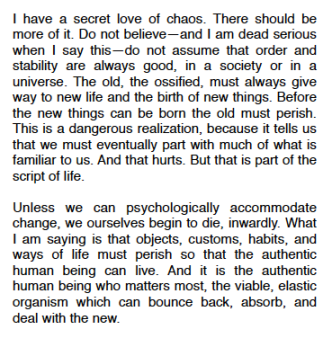
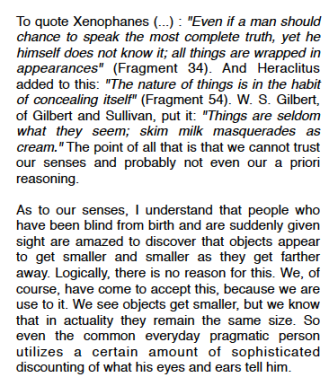
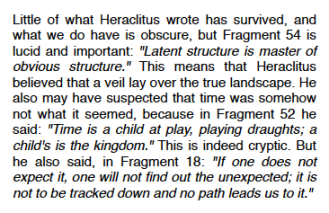
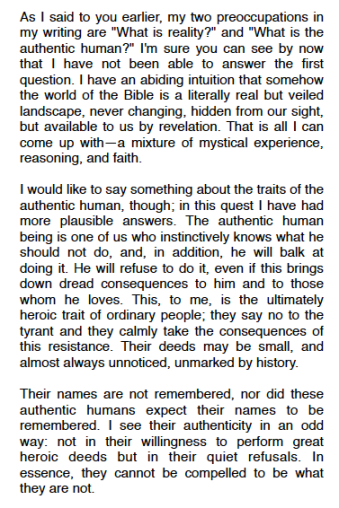
A world in which humans struggle to retain some degree of autonomy while stumbling as best they can through a deadly empire of signs sounds like it might have been scripted by Philip K. Dick. Indeed, in a talk dated way back in 1978, How to Build a Universe That Doesn’t Fall Apart Two Days Later, PKD elaborates upon how the question of “the real” knots up with what it means to be an authentic human.

The entire talk is worth close reading; for DP we offer a slightly edited and re-formatted montage of excerpts:

HAZE OF TRANSMITTED SIGNALS

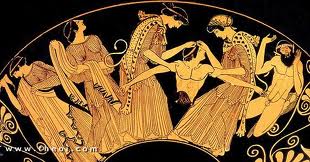
SPARAGMOS ALWAYS HURTS

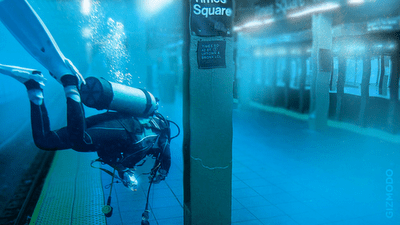
HUMAN ADJUSTING TO A NEW ENVIRONMENT

THIS IS NOT TOAD HALL

Béatrice Coron, A WEB OF TIME

That last bit bears repeating, an idea that resides at the very heart of desperado philosophy:


All Hail the Denominator

Tracy Strong, who is the author of Politics Without Vision: Thinking Without a Bannister in the Twentieth Century, has brought to our attention an important idea from the writings of Hannah Arendt:

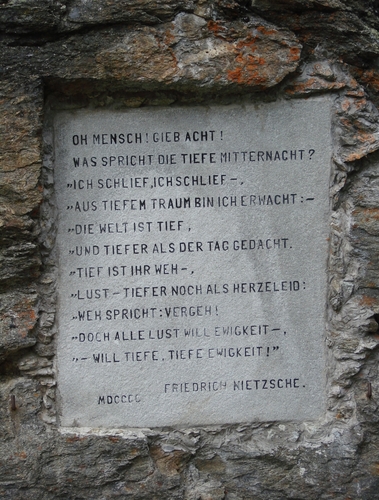
As Strong points out, Arendt’s lost yardsticks are an echo of Nietzsche’s lost hand-rails in Zarathustra: “Have not all hand-rails [banisters] and foot-bridges fallen into the water?” Nietzsche certainly knew very well Kant’s insistence to follow deines eigenes Weg, to follow one’s own path; to be in an engaged dialogue with one’s self as to what the path consists of at every step.

Yet to follow such a path of thought, one must also be keenly aware of one’s own essential beginning, one’s own existential origin, such that any judgments remain authentic to that experience, and not be snuck into consciousness through the back door of customary rules and morality.

ZARATHUSTRA WITHOUT HAND-RAILS

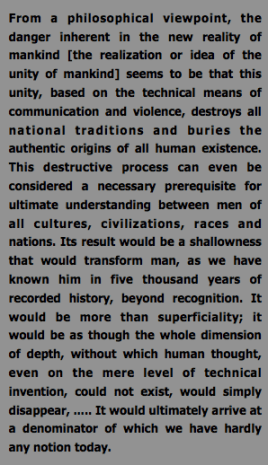
Strong’s careful, subtle exposition is worth close study, but for now we shall focus on a second citation from Arendt, taken from her study of Karl Jaspers:

In other words, the conditions for closer dialogue among groups, or the ambition of their ever more complex aggregation, may actually serve to undermine and even destroy the conditions for individual judgment. Depth of thought disappears into width of “understanding”, a re-cognition that must necessarily be shallow, measured to a denominator “of which we have hardly any notion today.”

Decades have passed since Arendt followed this path of thought. Today, we can very definitely fathom the negative implications of such a base common denominator, for they are everywhere around us!

EARLY TWENTIETH CENTURY  IDENTITY KIT

Reduction in local, regional and national linguistic and cultural diversity leads inescapably to a reduction in depth of cognition. As we become ever more “linked in” and “united”, we become ever more superficial in our self-knowledge, and thus in our ability to grasp the truth in others, whose most truthful differences become wholly unrecognizable.

The “essence of our beginnings” can no longer find a path, and thus we have nothing “of origin” to express. When harmony is achieved through reduction of complex polyphony, rather than through the navigation of dissonance, the most meaningful and consequential overtones within the relationship are lost to perception.

1905: PARADE PROTOTYPE FOR GLOBAL UNITY

For Arendt (and we find no reason to quibble with her) the reduction in depth of thought and subsequent slippage into an endless shallows of discursive and cultural common denominators eventually find political correlation with tyranny and totalitarianism, however “inverted” (Wolin) or camouflaged they may be. Absent thought (where depth of subjectivity counts for everything), the precise definition of what is “common” will always be a matter of power, imposed from above, and not through dialogue among equals.

*******

Strong closes the chapter with a quote from Augustine:

Meanwhile, it appears that the hurricane has passed, leaving a little light left unput out. Time for a long walk before darkness overtakes, and to seek our eigenes Weg, without hand-rails.


Iktomi, Deerslayer and Clouds

IKTOMI IN HIS WORLD WIDE WEB

We pause to note the passing of the Lakota warrior Russell Means on October 22, a journey he faced bravely:

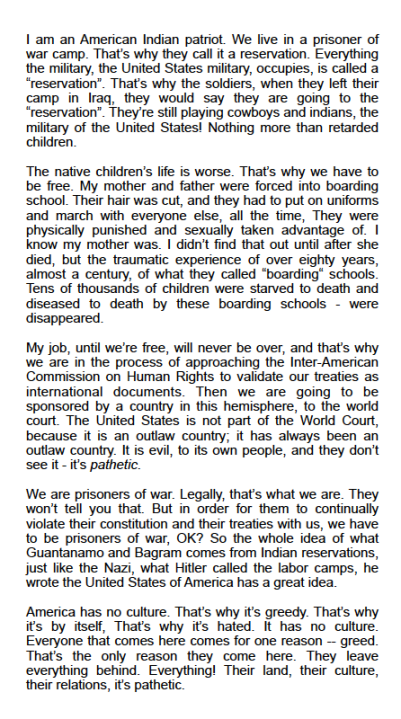
“I’m not going to argue with the Great Mystery. Lakota belief is that death is a change of worlds. And I believe like my dad believed. (…) When it’s my time to go, it’s my time to go. I’ve told people after I die, I’m coming back as lightning. When it zaps the White House, they’ll know it’s me.”

In researching recent interviews with Means, we discovered a remarkable video of a conversation with Amir Payam of BBC Persian, during which Means looks deep into the “integral soul” of his imperial wardens. Below the link, we offer our own slightly abbreviated transcript:

TESTIMONY OF AN AMERICAN INDIAN PATRIOT

Enter Iktomi, the spider:

Pine Ridge Reservation opens Chris Hedge’s lucid analysis of “sacrifice zones” in his book, Days of Destruction, Days of Revolt. He summarizes his journey through the assorted devastated zones in an interview with Bill Moyers:

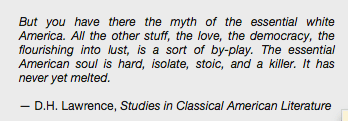
One of the epigraphs for Hedges’ chapter on Pine Ridge is taken from D.H. Lawrence:

We were curious about the extended context for the quote, so we tracked down Chapter 5, a discussion of Fenimore Cooper’s Leatherstocking novels, with editorial emphasis added in bold to the last line:

EXAMPLE OF A BREAK FROM STATIC ISOLATION

The products of disintegration are everywhere; imbeciles and braggarts rule the day, under the influence of Iktomi. Now the integral soul – Deerslayer – becomes restless, hungry to make things clean again and restore order. Let us hope that on the day when yet another “new move” shakes the world, there will be abundant sacred lightning in the sky to put an end to it.

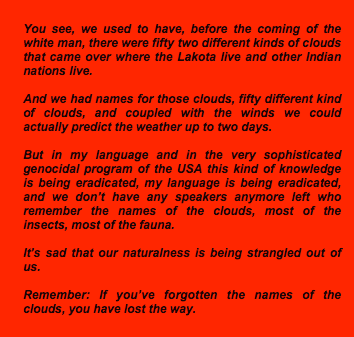
In his last video, or at least the last that we have been able to find online, Means references a book on Lakota philosophy, co-authored with philosopher and Master Mariner Bayard Johnson:

IF YOU HAVE FORGOTTEN THE NAMES OF THE CLOUDS


Violence of the Hobbled

Hertzen’s thought has certainly not outlived its day, for we appear to be inhabiting a world that ever more vividly resembles the Czarist Russia in which he lived: Czars of “national security” and manipulated markets at the apex, and increasingly immiserated serfs laboring under close surveillance everywhere else.

The insidious hegemony of today’s class of corrupt plutocrats depends on total control of what used to be called “the public sphere” – the instant obliteration of even the most minute acts of rebellion, such as critical chalking on a public sidewalk – rather than on psychologically embedded obedience to the divine right (and divine body) of the Czar. Nonetheless, the Czar/serf result of extreme inequality of experience (with ease of movement and expression reserved for a tiny minority) appears to be a global trend so powerful that it takes on the character of an immutable natural law.

Yet attempts to manufacture consensus through emotional manipulation, misinformation and suppression of dissent are inherently unstable, and dominion over individual will remains persistently incomplete.

Cracks open up everywhere; through those cracks grow new forms of life, bearing truths so evident that they cannot be suppressed. The response from those in power must then become increasingly disproportionate to the perceived threat, an impulse to overkill that is rooted in a deep anxiety that these isolated utterances might soon assemble into a chorus (such as Occupy), all the more powerful for its complex polyphony and even dissonance.

TENACITY (Photo by Liza Carter)

A beast may well be hobbled, but still have the strength to lash out through increasingly concentrated  and desperate violence, should the beast (unconstrained by trivial matters such as the rule of law) sense power slipping away. Herzen only came to fully appreciate the nasty bite of the hobbled beast later in his life; and one year after his death, intense counter-revolutionary violence crushed the nascent Paris Commune, whose moment of vibrant autonomy did not survive the resulting carnage.

CRUSHED BY THE HOBBLED

In our own time, we witness increasingly perverse innovations in the technologies of crowd control (such as sound cannons); increasingly cruel technologies of detention and incarceration such as the Communication Management Unit, specifically designed to isolate and destroy autonomous voices, even  (or should we say particularly) those voices joined in prayer:

Restricted for the moment to designated “terrorists”, such as the demonized John Walker Lindh,  could anyone doubt that the use of CMUs would become far more widespread should there be more widespread clamor for a more equitable and just society?

At DP, we have been proposing (among other things) that history is a struggle over what bodies retain the right to move freely, and what bodies are restrained. History is also a struggle over what bodies have the right to freely express their subjectivity, and what bodies must be disciplined into silence. Hence the significance of Lawrence Weschler’s brilliant insight, shaped through long and close study, that torture is a form of pedagogy – a teaching designed to unravel a coherent subjectivity whose expression of the self becomes inconvenient for the desire of rulers and their agents to retain their freedom to rape and plunder, unimpeded.

We do not use the word rape rhetorically; in recent days, we have been made aware of the important documentary, The Invisible War, in which a group of tenacious young men and women refuse to observe the code of silence used by certain viciously corrupt military units that have engaged in repeated sexual assault of fellow soldiers.

How does a chain of command become so twisted that such acts were not just covered up, but in some cases positively sanctioned, if not routinized? How do we come to grips with a command mentality that then inflicts even deeper abuse through blaming/demonizing the victims and through mobilizing bogus psychological assessments?

Whatever the psychopathology of this particularly abysmal history of abuse, when some better future emerges from the inevitable wreckage of our rotten and morally vacant society, we will need to find strength and inspiration in such individual and collective acts of brave refusal; the refusal to obey a corrupt order of things by vocal and tenaciously autonomous human beings, the ones who refuse to play along with the rulers and their agents, in all their violence.

Hobbled enough, and the beasts will eat their own, and then each other. Such are the morbid symptoms of a terminal condition.


Severe Harmony

HEAD MOLE FOR SOULFUL SOIL

We sing today our praises for the extraordinary work of Karinne Keithley Syers, an artist-philosopher in the very best of senses; one who uses all her senses.

While doing a bit of ruminative slogging through the dense sediments of the web several years ago, during a time when we thought creative brain activity on planet earth had ceased, we chanced upon Keithley Syer’s Basement Tapes of the Mole Cabal, and they cheered us up considerably and left us wanting: more.

Perhaps a wired bird reached her ear with our request, for it seems Ms. Keithley Syers has recently renewed her basement excavations, available for a very modest fee:

__________________________________________

The announcement of a resurfacing of the Mole Cabal prompted us to ask all those questions we had wanted to ask upon first hearing the gentle excavations of this delightfully curious creature:

DP     First, can you venture a brief description of the basement tapes, in terms of the different categories of material, and the process you follow for assembling such hauntingly beautiful bits of thinking/singing/tunneling?

KKS     I think of them as ten minutes of audio floating, like being let into a walled landscape for a balloon tour. There is always a kind of ground made of a combination of sampled sound and sampled instrumentation (I play instruments but then plunder the recordings and manipulate the sound), and then some ghost voices captured from public archives. You will always move into and then pass out of the vicinity of a song. So the process begins with collecting, and then sifting and separating, and then turning that into a drone that can either be manipulated into a skeletal bass line through simple pitch shifting, or just looping, at which point I catch the nearest word or image I can find, and start improvising a song. I usually build a line, and then build its harmony, before making the next line. When the thing is around ten minutes, I end it.

LIVE WITH THE LIVING

I should say too that the way the sound functions as a landscape is directly in relation to my own work as a choreographer making my own sound, and as a sound designer for other choreographers. Sometimes I plunder my own dance scores and reassemble them into basement tapes, other times I plunder my basement tapes and reassemble them into dance scores. If I was to choose any model to point to, it would be Bill Holt’s Dreamies, which I stumbled across during a period of my life when I went to Other Music regularly just hoping to find some music to make dances to. The guy making work on his four track in his garage is definitely a hero of the mole cabal.

DP     So, Hamlet hears the ghost, and says. “Well said, old mole! canst work i’ the earth so fast? / A worthy pioneer!”  The basement tapes have a sense of speedy digging, yet also deep digging. Can you describe your first thoughts for the series; what led you into this particular ghosted basement?

KKS     Most of the tapes were made over the course of one or two evenings, as this week’s episode (not that they ever came out weekly, but they always had a sense of being an installment). So it’s slow because it becomes a practice; the appetites for combination evolve slowly. I think the first thing I wanted to do was just find a venue for making things that wasn’t burdened by the problems of live performance — I was going through a period of disappointment with the professional performance life and looking for ways to keep shuffling along in the space of my own home (also the materialization of the mole totem, this private shuffling and digging).

The subscriber serial (I know it’s called podcasting but… ) has a weird kind of tenderness. You make it on headphones, you imagine it being listened to on headphones; it’s very intimate. Yet at the same time it’s a message in a bottle and you can expect that message both to travel and to survive in a way that live performance can’t. Emotionally I wanted a place to keep working, and at that time it had to be underground. My first episode was called “Music you can dance to,” which one of my first subscribers thought was a joke. It wasn’t actually; it was taken from the music I had made for the end of my show ASTRS (about a rabbit revolution in eternal return), built by plundering a Faust track.

Around the same time, for the work on another dance score, David Neumann gave me a copy of a cd of short wave radio calls, which show up in many of the episodes. I’d say the first ten tapes are pretty accidental, and then the form began to emerge. By this time I’d discovered the Library of Congress American Memory collections, where I found a lot of my early sources. More recent tapes have had specific events that I’ve trawled – the Columbia explosion, the Iran hostage crisis.

The tapes then went through a shift in a second period of digging, after a personal crisis. This was the point at which all the things I already knew about creative practice as a form of life and health was really disentangled from creative practice as a profession, because at that time I took a kind of sabbatical from my professional performance life, even as I started making more and more things at home – the tapes, my stop motions, and cutup series like the Ghost Host Pigeon Post. The tapes and the paper cutups became both a means of digging into the sound of other catastrophes, and a way of setting those sounds into little lotus ponds, even as they remained a kind of cryptic messaging system, at first to the agent of that crisis, and then I guess to anyone.

EVERYTHING WORTHY

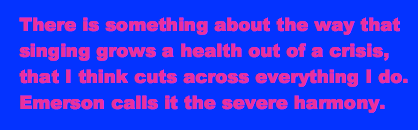
Years later I am working on this corner of my dissertation on the riddle of Ralph Waldo Emerson’s concept of impersonality, which has to do with this same knot where private digging is the scene of an experience of drastic commonality. This scene is both relieving and obliterating. There is something about the way that singing grows a health out of a crisis, that I think cuts across everything I do. Emerson calls it the severe harmony.

DP     Going back to the “worthy pioneer”, which Hegel later takes up as spirit and Marx puts back on terra firma with revolution: the first pioneers were foot soldiers meant to clear the way for the main army. Among their activities – mining. Yet one of the many layers of poetic reflection in the basement tapes conducts something of a mine sweeping. You have  a rare gift for defusing certain histories by bringing them into your soundscape, though not erasing them. Remembering and recuperating certain “loaded” spaces in a way that also drains their corrosive power, a quality that caught my ear from the very first episode. 

KKS     I think that has to do with the grain of the voice as it survives recording, compression, preservation, and historical distance. When I hear political speech in the present, I can’t separate out its entanglement with forces that I am somehow agitated by, whether for or against. But somehow the phenomenon of the person returns with the distance, and I think that I cannot not empathize with any person. I felt heartbroken at the Nixon Library, for example. And then pairing those returned persons with music takes a kind of atomic mass measurement of their failures.

I don’t mean to suggest that we should drop all of our skepticism about political violence, or that we should forget the way that historical violence structures present violence, but there is something to just measuring the atmospheric pressure in the lungs of our own or anyone else’s failure, that I think if we can’t hear it and ingest it and to at least some extent take it personally (I mean incorporate it, not take it as an offense), then we’re just reenacting a lazy form of venomous blame. Wallace Stevens has this line, “man’s intelligence is his soil.” I seem to be making a rationale for an alternative form of history based on eating our own soil. We get, at least, the song as a reward for our humility.

DP     Then there is the aspect of the “cabal”; your “mystical interpretation” has such poetic lucidity, even when the lights are dim. At times, you seem to be meditating on the rhythms of thought and feelings themselves, and we are permitted to hear your self thinking/sparking the mine. This sense is then underscored by the presence of the songs and by your own voice, which has a special quality all its own. Is there some metaphysical map for all these “mines” or are you moving through the murk by dead reckoning? 

KKS     One way I have described my creative work is as philosophy in various media. I’m particularly drawn to what falls under the rubric of process philosophy (versus philosophy as a set of definitions or proofs). I try to stay as dumb as possible when I’m making things, by which I mean I try to quiet all the forms of projection and the counsel of expertise. I have a cellular level of patience as I wait for things to emerge and take pleasure in their recession — this is grown in a person by among other things the very gentle and exploratory work done on the fringes of dance. So there is no map, but I recognize the emergence of paths and patterns as they’re happening, and that gives me a lot of happiness.

I make almost everything I do improvisationally; it’s the only way I could make as much stuff as I do. But that also has to do with a belief that things belong to their season of making. (The worst thing about writing a dissertation is that it’s not too amenable to improvisation. So I’m cultivating these forms of slow, recursive improvisation to get through it.)

DP     Cabal suggests collaboration or co-conspiracy, though in your case, the collaboration is more across your different materials and using all your varied talents and voices in a way that has the energy of an ensemble yet the delicacy of a private journey. This quality is something I have noted throughout  your work. How do the basement tapes resonate, for example, with your literary and theater poetics?

KKS     Originally the mole cabal was supposed to be a group of people working on performance projects, but schedule is a beast. I suppose I liked the fiction of being part of a posse of moles, so I never dropped the cabal. And I’m suspicious of the proprietary or expressive frame around creative work. In my mind, the mole cabal is not the proletariat or anything, but does expand beyond just me, connecting I’m sure to other cabals. We’re not plotting, just trying to survive (like the Wombles of Wimbledon). Or maybe plotting in the older sense of plot, as a garden plot, a patch of worked earth.

I was trained as a choreographer and I still think of myself as a choreographer, but one working in other media. (If the brain exists so we can move, as Andy Clark says, then this is an unproblematic restatement of the assertion that I’m a philosopher working in other media.) Sound was the first region I strayed into — I could never find the right music, so I had to start making my own. Then text, then images, then video, now forms of installation.

I love to be a beginner and to go through a learning curve, and I also like to trust my instincts and appetites for combination that grew up in dancing, as I take them into other media. It keeps me free of the new rules while still having a kind of structural intuition.  What I mean to say is that I’ve been able to tap into a vein of true amateurism by staying on the move, and so it has a choral effect. In any project, whether I’m writing or making sound or making theater, I do the same thing: start somewhere and then putter along until it feels like it’s singing. In fact the one medium it’s really hard for me to work in is dance, because my training still circumscribes my sense of freedom. My most recent project is to return to dancing and do battle with that restricting mind.

DP     In the meantime, we are delighted that the mole cabal of KKS will be digging and dancing and singing through the soul-soil, and may you be buried in fresh subscriptions!

THIS BIRD


Aliens at the Gate

We note with relief that Gary McKinnon will not be extradited to the US, on human rights grounds, as stipulated by the Human Rights Act. The full statement by UK Home Secretary Theresa May can be accessed through the Guardian video link, with a (slightly abbreviated) transcript provided below:

Much of the reaction following Ms. May’s announcement has focussed either on the legal implications regarding other past and future extraditions or on her mistaken reference to Asperger’s Syndrome as an “illness”, which of course it is not.

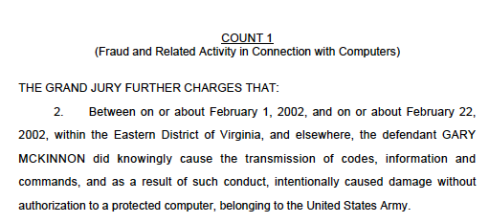
Though we have followed the McKinnon story from the beginning, we had never read the original indictment in its entirety until today. The document presents the UFO researcher as a highly dangerous enemy of the state, one whose eyes (and keystrokes) had penetrated firewalls considered by government prosecutors as critical for the protection of national security.

CLICK FOR COMPLETE PDF

While the legal charges center around alleged transmission of codes and destruction of data (hacker mischief and vandalism), the deeper threat is not hard to decrypt: That little nerd saw stuff — and knows stuff. 

In an interview with Wired News back at the time of the indictment, Mr. McKinnon elaborated in some detail about what he saw, and what he knows:

Of course, any mention of “Roswell” in polite intellectual circles, and the eyes glaze over, and whoever might have dared to utter the word is instantly consigned to the discursive looney bin.
Here at DP, we take no fixed position on whether or not there is intelligent life elsewhere in the universe; we are baffled enough by the human mysteries of our immediate neighborhood. Nonetheless, we do like to follow twisting paths, connect obscure dots, and stumble around in the fog. Thus we chanced upon a fascinating video that may help explain how the intense curiosity of a harmless young man should lead to his designation as a dangerous enemy of the state.

Try to screen out the annoying Twilight Zone voiceover (how do these narrative tropes become so entrenched?) and focus on the interviews with the various researchers, including those who are skeptical:

NON-TERRESTRIAL OFFICERS IN ACTION?

In any event, following the statement by Ms. May, a former counsel to the White House named David Rivkin made statements of his own, which we can relay courtesy of the excellent Guardian live blog:

And then this …..

Forgive me, Mr. Rivkin, but apparently you are unaware of the “precise situation” of our criminal justice system. Your comments are laughable. Mr. McKinnon himself displayed a finer understanding of the brutal reality in a rare interview with the Guardian in 2005:


One for the Thumb

FOREIGN POLICY THINK TANK

The Twittersphere typically passes us by. Every now and then, however, someone emits tweets so foul that we cannot screen them out. It’s as if we are sitting next to a man at a raw bar who suddenly burps up a couple of punky oysters – and they land on our napkin.

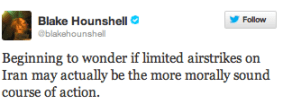
So it goes with recent tweets from a hashtag named Blake Hounsend, who lists himself as the managing editor of Foreign Policy, a publication that those who fancy themselves part of the global ruling elite like to leave on their desks to feign gravitas.

The context? A discussion of the devastating effects of economic sanctions on the civilian population of Iran. In the perverted logic of imperial DC, the death of a “couple thousand” Iranians becomes a “humanitarian” alternative.

Burped up oyster number 1:

Burped up oyster number 2:

The notion that we should rather follow a policy that refrains from harming innocent civilians, most of whom are living barely above subsistence, appears to have been edited off the page by Mr. Hounshell and his ilk.

On the Foreign Policy website, we find the following bio:

We suggest that Mr. Hounshell’s capacity for moral discernment is as mangled as his Arabic. In place of a functioning conscience, we find a hollow shell; in place of thought, we find a thumb. Lamentably, such qualities make him a man for our times. Chalk one up for the thumb!

As Glenn Greenwald points out in his forensic analysis of the same two burped oysters:

Greenwald closes with a question that Foreign Policy is unlikely to contemplate in its next, or any, issue —