Carved and Painted

Now comes a brief dialogue with distinguished artist and DP friend Morgan Bulkeley, regarding an extraordinary series of carved and painted reliefs completed during the Covidzeit, with an Autumn 2021 show at the Yezerski Gallery in Boston.


Images by Morgan Bulkeley; video by Hans Teensma.


LUCY


FRITTERING WITH MY FACE


UNTITLED IVORYBILL SCULPTURE


˜˜˜˜˜˜˜


Where Philosophy Begins

We continue our celebration of the literary philosophy and philosophical literature of Olga Tokarczuk with a few excerpts from a recent essay that roams through diverse “eccentricities” in search of a fresh way of thinking through the world. She begins with an engraving, published in 1888 by the French astronomer Camille Flammarion.


˜˜˜˜˜˜˜˜


Against the Unimaginable

For the next two weeks, we bend our ears to two remarkable essays from the exceptionally gifted Polish novelist Olga Tokarczuk, the first of which was delivered as her Nobel lecture in 2018.

No need for visuals, save for a screen snap of the author in full command of the Nobel podium. 


Following our reading of Flights, we suggest that such a storyteller, one who writes vividly and generously into and through the wounded world with a restless sense of limitless imaginative possibility, may already be among us. Her name is Olga Tokarczuk.

˜˜˜˜˜˜˜


Gila On Fire

Here at DP, we have a special fondness for the Gila Wilderness, being one of the very last truly wild places within what are known as “the lower forty-eight”. Thus our ears were caught and hearts fired up by the following missive from WildEarth Guardian Leia Barnett.

Images relayed from the highly informative website of the WildEarth Guardians.


As their mission statement, the WildEarth Guardians write:

We are Guardians.

We protect and restore the wildlife, wild places, wild rivers, and health of the American West.

We envision a world where wildlife and wild places are respected and valued and our world is sustainable for all beings.

We believe in nature’s inherent right to exist and thrive. We speak for the wild life, places, and waters that have been dominated and abused to serve the interests of a greedy few. Bit by bit, we are restoring the balance.

We are now, as always, A FORCE FOR NATURE.

˜˜˜˜˜


Downward Toward Barbarism

In the aftermath of yet another lethal school assault, twenty three years after Columbine, we highlight a brief response from The Atlantic staff writer David Frum, with the opening paragraphs  demonstrating that even a notorious warmonger known mostly for coining the spectacularly unhelpful phrase “axis of evil” can, on such a tragic occasion as Uvalde, strike the right notes.


We also take note of a public statement made by the honorable coach of the Golden State Warriors, Steve Kerr, providing an exemplary embodiment of what it means to speak truth to power.


˜˜˜˜˜˜˜


When Hope Becomes Toxic

While roaming through the fertile and abundant archives of Green Dreamer, always worthy of a close listen, we came across a fascinating passage from post-Humanist philosopher Báyò Akómoláfé, author of These Wilds Beyond our Fences: Letters to My Daughter on Humanity’s Search for Home.

On the welcoming homepage of his highly engaging website, Dr. Akómoláfé writes:

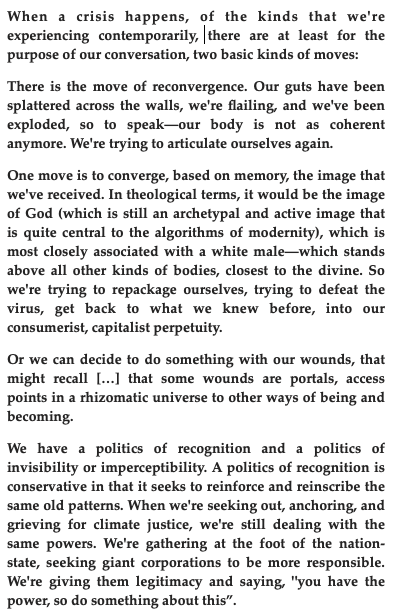
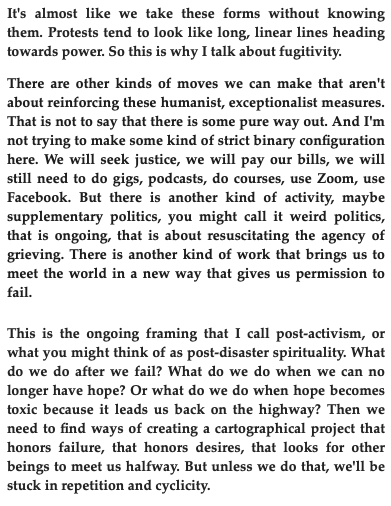
May this decade bring more than just solutions, more than just a future – may it bring words we don’t know yet, and temporalities we have not yet inhabited. May we be slower than speed could calculate, and swifter than the pull of the gravity of words can incarcerate. And may we be visited so thoroughly, and met in wild places so overwhelmingly, that we are left undone. Ready for composting. Ready for the impossible. Welcome to the decade of the fugitive.

˜˜˜˜˜˜˜˜˜˜


Here Come the Carbon Bombs

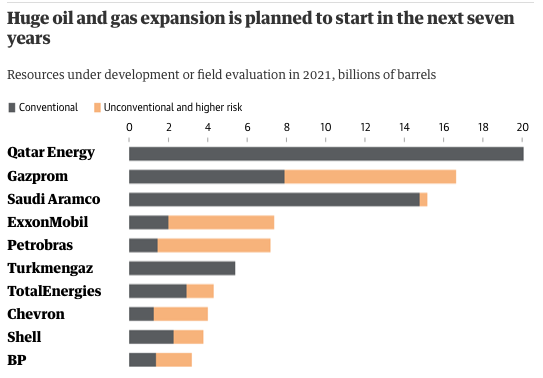
This week, we urge careful consideration of timely and essential reporting from The Guardian, detailing a series of fossil fuel “carbon bomb” projects presently underway, or in advanced stages of planning.

These hyper-extractive projects, launched beneath the cover of a looming world war, threaten to push us well past irreversible tipping points, into the terminal stage of global environmental breakdown.

A few graphics relayed below; they speak for themselves.


Standing against the impending environmental bombscape, we find brave activists such as the formidable Janet Alkire, Chairwoman of the Standing Rock Sioux Tribe, who sent us the below update earlier today:


Aŋpétu wašté. I bring you an update today about our fight to stop the Dakota Access pipeline (DAPL). As you’ll see in our new video, the Tribes of the Oceti Sakowin are united in this mission, and with organizing help from the Great Plains Tribal Water Alliance, we recently gathered to strategize about the best way to achieve our goal of stopping DAPL before it spills and poisons our water. I also recently met with Assistant Secretary of the Army Michael Connor to discuss the disturbing lack of progress and demand transparency with DAPL’s environmental process.

Watch: leaders from across the Oceti Sakowin came together recently to discuss our #NoDAPL strategy.

So far, none of our concerns are being addressed, and the process is compromised by secrecy. Standing Rock has requested a number of basic documents and plans, such as DAPL’s oil spill response plan for the Missouri River. We have received no information whatsoever, and the failure to cooperate with our Tribe and our emergency managers is unacceptable. DAPL, of course, continues to operate illegally, with no permit for its crossing under Lake Oahe on Standing Rock Nation’s doorstep.

I also called upon the Army to consider the Notice of Violation issued by federal regulators against the pipeline’s parent company, Energy Transfer LP, for its repeated violations of pipeline safety rules with DAPL. The only right course of action is for the Army Corps of Engineers to shut down the pipeline now and properly address these violations in the upcoming Environmental Impact Statement (EIS).

For now, the EIS is mysteriously stalled, even as Energy Transfer and its related companies continue to display a distressing pattern of oil spills and safety violations. Over a recent 8-year period, nine pipelines owned and controlled by these companies experienced nearly 300 spills — including 50 large spills in High Consequence Areas such as Lake Oahe.

You can see why Tribal leaders are unified in our concern about protecting our water and our resolve to do something about it. I ask you, as a friend in this fight, to stay connected with us and ready to take action as soon as the EIS is released. You’ll be hearing more from me soon. By staying strong together, can we still win justice for Standing Rock and all of the Oceti Sakowin. Mni wiconi — water is life.

Wopila tanka — thank you for staying united with us!

˜˜˜˜˜˜˜


Vertigo Against Oblivion

Now comes a long overdue visit to a powerful installation by artist John Akomfrah, dating from 2015. The below statement, excerpted from an interview within the ever-illuminative Histories of Violence project.

The second image links to a video that provides a useful orientation for Akomfrah’s vertiginous journey.


About the installation, the curator of The Towner Art Gallery writes:

Akomfrah was born in Ghana and grew up in Britain, where he studied sociology at Portsmouth Polytechnic. He came to prominence with his documentary film Handsworth Songs (1986), made with the Black Audio Film Collective, which he co-founded in 1982.

Vertigo Sea, which premiered at the Venice Biennale in 2015, presents a multilayered narrative across history and geographical locations with the sea as a linking theme. Among the subjects explored in the film are the history of the sea as a burial ground, often for exploited or displaced peoples, as well as its dark record as a killing field, particularly for the whaling industry.

By depicting scenes of African migrants risking their lives to cross the ocean, Vertigo Sea speaks to current traumas such as the refugee crisis, modern slavery and ecological concerns. The narrative jumps backwards and forwards in time, with references including the Zong Massacre of slaves in 1781, as well as literary works such as Herman Melville’s Moby Dick and Virginia Woolf’s To the Lighthouse.

Vertigo Sea is a joint acquisition by Towner Art Gallery and National Museum Wales, both organisations with coastal sites and historic collections featuring seascapes.

˜˜˜˜˜˜˜

Of Icebergs and Lifeboats


ICEBERG DEAD AHEAD

One hundred and ten years ago, at twenty minutes before midnight in the North Atlantic, an unsinkable dream machine named Titanic struck an iceberg and sank within three hours, with over 1500 lives lost. The iceberg carried on as before, true to its own implacable nature.

Here at DP, we have long interpreted the story of the Titanic as an early warning for what happens when arrogant hubris obliterates our collective ability to anticipate or even comprehend the consequences of our limitless capacity for technological invention, a condition that Günther Anders called “inverted utopia.”

With regards to the climate emergency, some in well-insulated positions of geographic or economic privilege still quibble over whether we have struck the iceberg quite yet, though surely nobody with a basic grasp of the data fails to see the ice cubes raining down on the foredeck. Many in the global south are already suffering severe consequences, slow violence that will become ever more deadly in years to come.

At least on the Titanic, Captain Edward Smith tried to avert collision, though the physics of speed and mass intervened in favor of the berg. He surely felt a magnified degree of urgency given his knowledge that there were nowhere near enough lifeboats for passengers and crew, and that the crew had received scant training in how to abandon the magnificent vessel on her maiden voyage. Why bother to think about lifeboats when you are unsinkable?

Today, when we are not pretending that the iceberg is a mirage, we try to convince ourselves that the iceberg can be averted by our own unsinkable dream machine: Net Zero before 2030; Carbon Neutral before 2050; the Green New Deal; blah blah blah. Alas, there are those same naggingly inescapable problems of speed, mass and momentum. The good ship USS Mammon, she’s a hard hulk to steer, aye.

We are also burdened by that same nagging problem of lifeboats: not enough of them, with unequal access to those few that exist; little or no training on how to manage the panic and chaos of countless numbers of people attempting to secure a severely limited number of chances to survive; inadequate supplies of food, medicine and rudimentary survival gear on board the lifeboats; and a pronounced paucity of skilled leaders for emergency evacuation and forward navigation.

Titanic survivors were brought on board the Carpathia, whose passengers included a gentleman named James Fenwick. Mr. Fenwick somehow came into possession of a lifeboat pilot biscuit; in 2015, that inedible survival biscuit was sold at auction for 15,000 British pounds. Inverted Utopians prefer not to discern lessons from our hubristic disasters; so much more fun to sell the memorabilia for whatever price the market will bear.

The lessons, inevitably, will thereby become ever more severe.


COLLAPSIBLE BOAT D IN THE MIDST OF THE UNIMAGINABLE