A Broken System

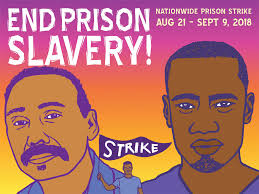
As the political circus continues to release one tragic clown after another into the remnants of the public sphere, we urge DP readers to turn attention away from the delusional ringmaster and focus on the national prison strike now underway.

Demands are listed here.

From all the many important voices that have come to the surface, we relay an excerpt from an anonymous “jailhouse lawyer” representing the organization Jailhouse Lawyers Speak, addressing issues of racial terror and prison slavery:


Next follows an excerpt from a Democracy Now interview, transcribing the voice of  made by Heather Ann Thompson, author of Blood In the Water: the Attica Prison Uprising of 1971 and Its Legacy.


To repeat the last part of Ms. Thompson’s final sentence:

People standing together to let us know this system is broken and we’ve got to change. 

˜˜˜˜˜


Call and Response

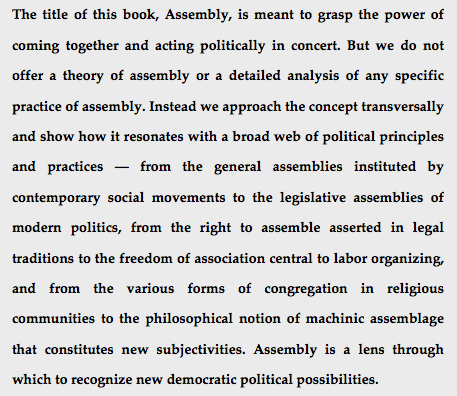
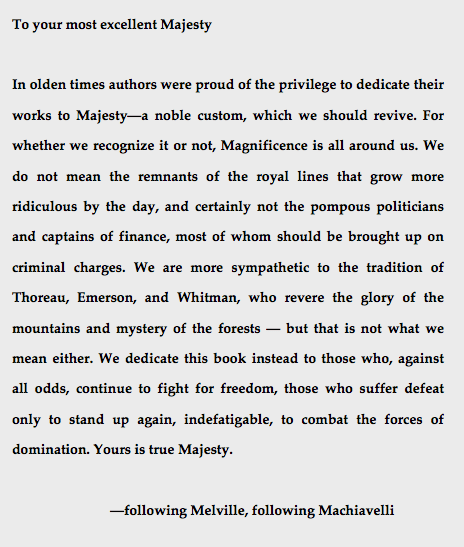
We do not always judge a book by its epigraphs here at DP, but the below coupling most certainly captured our attention:

The book is titled Assembly, another (following Empire, almost twenty years ago, among others) fascinating collaboration between Antonio Negri and Michael Hardt, who turn their attentions to the possibilities and ambiguities of resistance movements as they attempt, in their “hive” multitudes, to both confront power and escape from it.

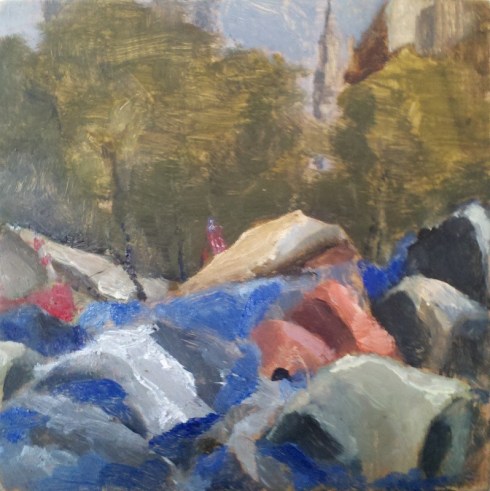
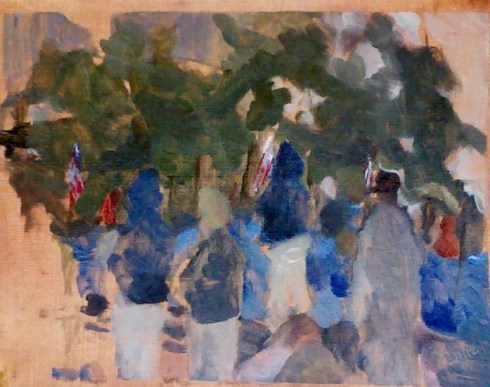
The entire book is available for perusal online; excerpts below, with images (added by DP) from the studio of Karen Kaapcke, whose extraordinary series of paintings from the days of Occupy capture the allure of the commons: vaster, partial, incomplete and ever expanding.


˜˜˜˜˜

The book also carries an unusual and laudable dedication, which we amplify here through the DP megaphone, such as it is:


To which, in call & response style, we loudly sing:


What It All Means

On this day, seventy-three years following the second use of atomic weapons against a largely civilian population, we turn to Günther Anders with an excerpt from a presentation delivered to the Sixth World Congress of the International Physicians for the Prevention of Nuclear War in 1986; the untitled painting (added by DP) is from the imagination of Kazuo Shiraga, and dates from 1962.


The entire address is worth close consideration, and might well have been written following Fukushima, or even yesterday, and let us meditate on these lines in particular:  

For what has to be done is to harass these people who are both not very bright yet also all-powerful and capable of deciding at their whim whether or not humanity will exist; we certainly have to curtail their power.


˜˜˜˜˜


The Burning World

Now comes JG Ballard with a passage from a novel that was initially published in 1964 as The Burning World, then revised and expanded the following year into The Drought. We suspect that if Ballard were around this summer, he might consider reverting back to the first title.

The below excerpt, with images added by DP, might well have been written yesterday, given recent scientific research that confirms the relationship between an ocean saturated with plastic and the acceleration of greenhouse gas emissions.


firenado

ACROSS THE CRYING LAND


firenado3

A SIMPLE JUSTICE


firenado4

ENOUGH TO TANTALIZE MANKIND

˜˜˜˜˜


Before and After

This week, as we continue our summer meditations on the splats and spasms of human supremacism, we simply relay information regarding a laudable exhibition assembled by curator Randy Jayne Rosenberg. Titled Ethics, Excess, Extinction, the exhibition took “meat space” within the El Paso Museum of Art until this past May, yet is still available for online perusal via Artworks For Change, for whom Ms. Rosenberg serves as executive director.

Rosenberg’s curatorial statement is excerpted below, with two pinged images from the contributions of Gale Hart.


YOU DON’T PICK HOW THEY ARE KILLED


BEFORE AND AFTER


˜˜˜˜˜˜˜


Dreams of the Scourge

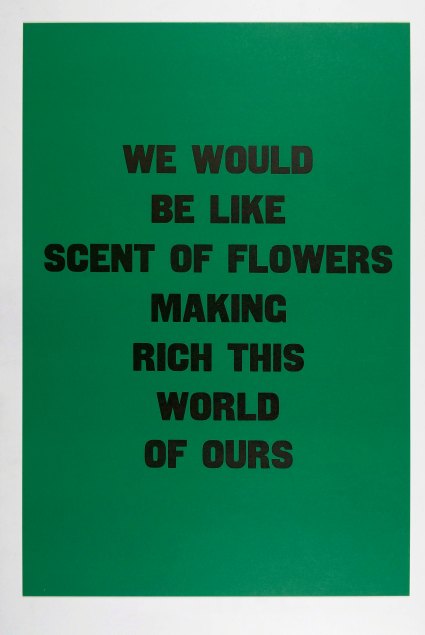
During a strange New England summer of extreme heat waves, monsoon rains and an unnerving paucity of flying insects and pollinators, it is difficult to avoid slipping into the dark selfie-swamp of radical dystopia, the one where we (homo sapiens) disappear from the universe; thus we turn to an illuminating excerpt from an essay by China Miéville, exploring the interplay between apocalypse and utopia.

The images are pinged from the studio of Ruth Ewan, selections from a series of nineteen woodblock prints titled Unrecorded Future, Tell Us What Broods There.


˜˜˜˜˜

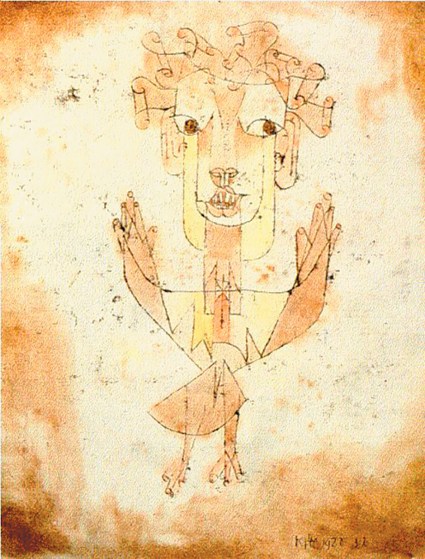
Miéville adds texture to the debris rotting beneath the Angel of History in an excellent interview that appeared earlier this year in the pages of the Boston Review:


˜˜˜˜˜

And finally, from the hand of Paul Klee, and with a nod to Walter Benjamin:

Paul Klee: <i>Angelus Novus</i>, 1920

ANGELUS NOVUS


˜˜˜˜˜


Let the Daydreams Grow

As much of the world continues to boil and burn in a La Niña heat wave, we stay with the theme of how literature responds to climate change. A DP correspondent steered us to Amy Brady’s consistently engaging Burning Worlds column in the Chicago Review of Books, and in particular to her interview with poet Megan Hunter regarding her first novel, The End We Start From.

Hunter’s replies to Brady are excerpted below, followed by a passage from Ernst Bloch and an image from the studio of Antii Laitinen.


On making dystopia personal:


On floods at the beginning and at the end:


On finding the scraps of hope:


˜˜˜˜˜

From Ernst Bloch’s introduction to The Principle of Hope:

˜˜˜˜˜

And finally, a drowned selfie:

SELF-PORTRAIT ON THE SWAMP

˜˜˜˜˜


Agency of the Nonhuman

Staying within the pages of the Los Angeles Review of Books, and within the theme of how art responds to the Sixth Extinction, consider the following thoughts from novelist Amitav Ghosh. Images are from the studio of Nathalie Miebach, with a project titled The Floods.


BUILD ME A PLATFORM, HIGH IN THE TREES, SO I MAY SEE THE WATERS


DETAIL, BUILD ME A PLATFORM


DETAIL, BUILD ME A PLATFORM


˜˜˜˜˜

Nathalie Miebach writes:

My work focuses on the intersection of art and science and the visual articulation of scientific observations.  Using the methodologies and processes of both disciplines, I translate scientific data related to astronomy, ecology and meteorology woven sculptures. My method of translation is principally that of weaving – in particular basket weaving – as it provides me with a simple yet highly effective grid through which to interpret data in three-dimensional space. 

By staying true to the numbers, these woven pieces tread an uneasy divide between functioning both as sculptures in space as well as instruments that could be used in the actual environment from which the data originates.

˜˜˜˜˜


Hold Still and See

Every now and then, we come across web-embedded voices that elicit audible shouts of affirmation throughout DP’s vast editorial complex. Such was our reaction upon reading a recent dialogue in the Los Angeles Review of Books between Everett Hamner and Richard Powers, roaming deep forests of ideas in the vicinity of Powers’ recently published novel, The Overstory.

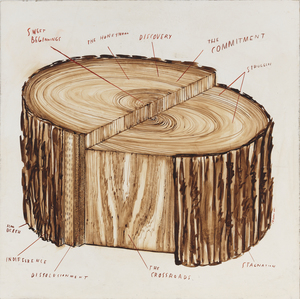
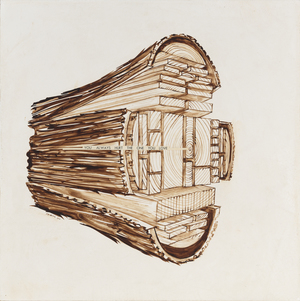
We highly recommend consideration of the entire exchange; a few brief excerpts below. Images are from the studio of Lora Fosberg, whose work we also highly recommend.

Now comes Richard Powers, on the role of literature (and the moral responsibility of fiction writers) in the time of the Sixth Extinction:


HEARTACHES


SWEET BEGINNINGS


YOU ALWAYS HURT THE ONE YOU LOVE


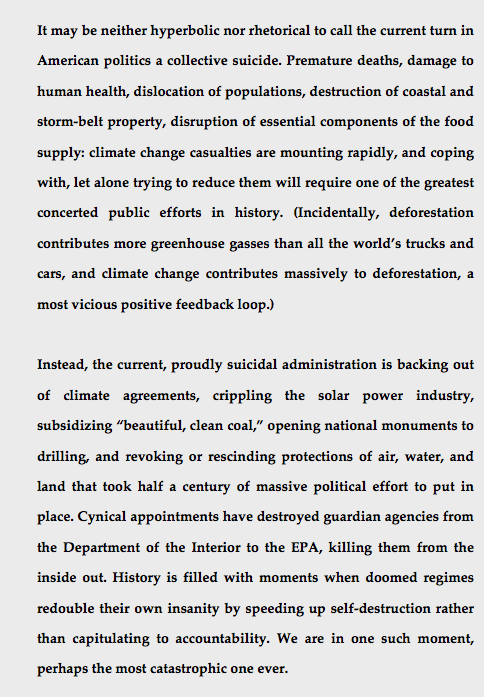
On the actions of a “proudly suicidal” (!) administration:


EVERYTHING MEANS EVERYTHING


YES


˜˜˜˜˜


Sanctity and Revenge

Slightly over a week ago, the White House press secretary Sarah Huckabee Sanders, asked to justify the unconscionable separation of immigrant children from their mothers, stated that “it is Biblical to enforce the law.” With her words fresh in mind, we turn this week to philosopher Catherine Malabou, with excerpts from a recent essay titled Repetition, Revenge, Plasticity.

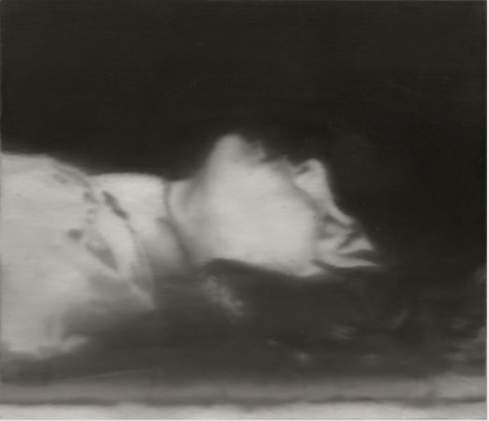
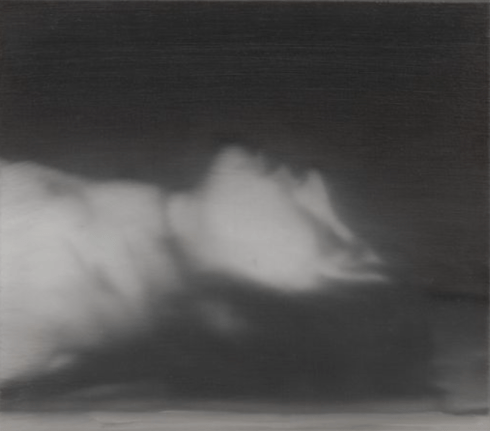
Images are from Gerhard Richter, three paintings completed in 1988, each one titled Tote (Dead).


TOTE


TOTE


TOTE


˜˜˜˜˜

Regarding the three Totes, we find the following explication on the Richter website:

The three paintings are based on photographs depicting the terrorist Ulrike Meinhof, a founding member of the Red Army Faction, that were taken after her suicide in prison in Stuttgart-Stammheim on 9th May 1976. The images were published in the magazine stern on 16th June 1976 and show close-ups of the head and upper body of a lying woman, whose eyes and mouth are partially open. Her dark hair is almost undistinguishable against the dark background whereas the bright clothes and pale skin of her face brightly stand out. Her somewhat overstretched neck reveals a dark deep line left by the noose.  

The three works show an almost identical image segment with only the angle and the proportions varied slightly in each painting. Besides their format, the three images also vary in their painterly execution. While the facial features of Ulrike Meinhof are relatively clear in the first version of Dead, they are blurred almost unrecognizably in the last painting, with bright and dark shades merging, contrasts paling and the overall black background fading to a uniform dark grey. Moreover, the position of the head seems to be slightly altered in each version. While the first painting is guided clearly by the original photograph, the second version shows the head with a slightly raised chin and the eyes almost completely closed which is carried forward even further in the third work. Because of the increasing blurring and the changing position of the head, Ulrike Meinhof seems to be removed further and further from reality with every painting, her mouth and eyes seem to close slowly. In death, she is withdrawn from the gaze of the public, the terrorist is given back a part of her human dignity that was taken from her by exhibiting her dead body in mass media. At the same time the dramatic effect is increased by the multiplication of the subject and the increasing blurring of details that seem like a cinematic fading out. The dead body seems to sink into the surrounding, impenetrable grey.

The three likenesses appear like a search for an appropriate way of representation, carefully and gradually approaching death. The distinct close-ups set the paintings apart from other depictions of dead RAF members in the cycle and create a certain intimacy that affiliates the work with Youth Portrait [CR: 672-1][7]. Furthermore, Meinhof’s apparent isolation and loneliness are underlined by focusing solely on her face and upper body. In regard to iconography, the body lying parallel to the image plane is evocative of representations on predellas and hence creates a connection to a traditional European iconography of death. This prevents the paintings from being seen as ideological images or to turn into icons of martyrs. Instead, the works pose the question as to the why of the events. As no other painting in the cycle the painting speaks of sadness, and “[…] sorrow, […] sorrow for the people who died so young and so crazy, for nothing.”

˜˜˜˜˜