Tag Archives: anthropogenic climate breakdown

The Endangerment Finding

Now comes Earthjustice with another update, this time regarding their critically important defense of both settled science and established environmental law:

The Trump administration announced {July 29} that it is acting to repeal the most important provision authorizing the federal government to fight climate change.

In 2009, the Environmental Protection Agency (EPA) determined that greenhouse gases are air pollutants that endanger public health and welfare by driving climate change. As such, gases like carbon dioxide and methane are subject to regulation under the Clean Air Act.

This determination — rooted in scientific consensus and affirmed by the Supreme Court — is known as the endangerment finding. It is the foundation of several Clean Air Act protections that limit climate pollution from such sources as power plants, cars and trucks, and fossil fuel drilling operations.

Now, the Trump administration is denying both settled science and the government’s responsibility to address climate change. This, despite Americans facing increasing and intensifying droughts, wildfires, and other climate-change fueled disasters. Trump’s EPA announced it will rescind the finding, and by extension, eliminate greenhouse gas standards for vehicles.

“With today’s announcement, the EPA is telling us in no uncertain terms that U.S. efforts to address climate change are over,” said Earthjustice President Abbie Dillen. “For the industries that contribute most to climate change, the message is ‘pollute more.’ For everyone feeling the pain of climate disasters, the message is ‘you’re on our own.’”

Our coalition of Earthjustice, Natural Resources Defense Council, the Environmental Defense Fund, and Sierra Club has been preparing for this unlawful action. We’ll see the Trump administration in court.

Read on to learn more about where the finding came from and why it matters.

A Supreme Court order and a pile of scientific evidence

The EPA’s determination was the result of a historic Supreme Court case. In 2007, the court ruled in Massachusetts v. EPA that the agency had the authority to regulate greenhouse gases under the Clean Air Act.

This meant that the EPA was required to determine whether greenhouse gases pose a risk to public health and make rules to protect the public if so. Faced with a trove of scientific research that links greenhouse gases to a warming, chaotic climate, the agency released the endangerment finding in 2009. Since then, it has served as a basis for rules limiting greenhouse gas emissions.

The case for the finding has only gotten stronger

As of 2024, the last 10 years have all been the hottest on record amid increasing extreme weather events. The cost of natural disasters driven by climate change is skyrocketing. As just one example, the wildfires that ravaged L.A. this winter are estimated to have caused more than $250 billion in damage. Climate-fueled disasters are driving up insurance rates on homes and businesses, and insurers are exiting high-risk markets.

Meanwhile, the endangerment finding has withstood several industry-backed legal challenges, including one that Earthjustice helped defeat in court. In 2023, the U.S. Circuit Court in D.C. unanimously rejected the most recent challenge by an oil industry group and a collection of climate deniers, and the Supreme Court declined their request to appeal.

What’s next for the endangerment finding?

The administration released its proposal for rescinding the endangerment finding on July 29. The agency said it would comply with its legal obligation to hold a public comment period on the proposal. Earthjustice will be working with clients and partners to submit comprehensive legal and technical comments. This is also a chance for you to weigh in.

After the EPA reviews the public comments and drafts the final rule, it will be sent to the Office of Management and Budget for review. The final rule is expected before the end of the year.

Some of the major regulations that depend on the finding:

Limits on vehicle emissions

At the same time it attacked the endangerment finding, the Trump administration proposed to eliminate climate emissions standards for cars, trucks, and other vehicles.

Transportation is a giant source of carbon dioxide. Emissions from gas-powered vehicles make up the largest source of CO2 in the country. In March 2024, the EPA finalized new car pollution standards that move us towards a pollution-free future. The agency lowered the maximum amount of tailpipe emissions allowed from new cars, starting in model year 2027. This isn’t a ban on gas cars; instead, it pushes automakers to increase the amount of zero-emissions vehicles per fleet each year to balance out emissions from gas-powered cars and light trucks.

In reversing course, the administration is making our economy less competitive. The world is already electrifying its cars and trucks, and the Trump administration is seeking to tie American manufacturers to an old and dying technology.

Limits on power plant emissions

Power plants are responsible for roughly a quarter of climate pollution in the country — particularly carbon dioxide. Yet until last year, these plants had a free pass to dump climate-warming emissions into the air.

In 2024, the EPA proposed standards that require new gas and existing coal-fired power plants to reduce their carbon pollution by 90%. The agency projected that the new standards would cut annual carbon emissions by the same amount as taking 328 million gas-powered cars off the road. The rule also has significant public health benefits, potentially averting up to 1,200 premature deaths a year by 2035.

In June, Trump’s EPA proposed a rollback of these power plant standards.

Limits on methane emissions from oil and gas drilling

As the country transitions to a clean energy economy, the fossil fuel industry has tried to frame “natural” methane gas as a climate-friendly energy source. It’s not: Methane traps over 80 times more heat in the atmosphere than CO2. It is responsible for approximately one-third of the global warming we are experiencing today.

Each year, fossil fuel companies leak or deliberately vent 13 million metric tons of methane into the atmosphere during oil and gas operations. In 2024, after years of legal advocacy by Earthjustice, the Biden administration adopted a rule that cuts 80% of methane from those oil and gas facilities, which are the main source of methane emissions.

The standards address the biggest sources of U.S. oil and gas methane pollution, requiring regular leak monitoring at existing and new well sites and a shift from intentionally emitting devices to widely available zero-emission equipment. The rules also include a program to quickly address the largest leaks and malfunctions — known as super-emitters — and require companies to curtail wasteful flaring (burning off excess gas).

The Trump administration is moving to delay the rule this summer and then revise or revoke it.


For decades, Earthjustice’s litigation has helped strengthen the laws that protect communities from dirty air and reduce climate pollution. We will not cede this progress.

Human Lasagna

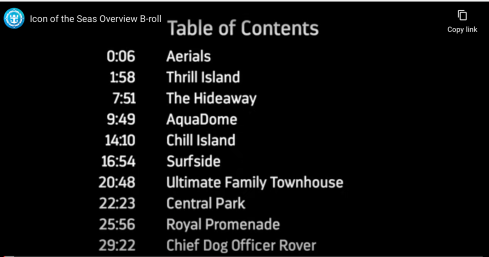
No, we are not referencing the village of cannibals among The Walking Dead, but rather the world’s most recent spasm of human supremacist oblivion, being a bloated vessel christened by “iconic” genius of global footie Leo Messi, here transmuted into a feckless shill for commercial whatevs; a megametamaxi casserole of kitsch launched (perversely) as “Icon of the Seas.” Below, a few images from the promo video; captions added by DP.


MOTHER OCEAN NOT WELCOME INSIDE THIS STORY


ICON OF THE ME, ME & ME: STICK A FORK IN IT


PASSENGER PREPARES TO BE FLUSHED


SO MUCH PASTA REQUIRES A LENGTHY DIGESTIVE TRACT


BAKE FOR TWO WEEKS AT 350 DEGREES FAHRENHEIT AND THEN PROCEED TO THE VOMITORIUM


APPARENT SIMULACRUM OF A GHOST MALL IN PARAMUS NEW JERSEY INVADED BY A HOVERCRAFT IN THE SHAPE OF A SUPPOSITORY.

Bon voyage!

˜˜˜˜˜˜


Nothing Untouched

Now comes entomologist Diana Six, speaking her truth from the front lines of climate emergency:


˜˜˜˜˜


With Ferocious Love

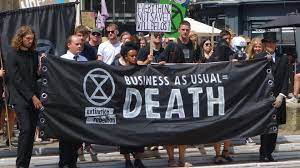
In full support of the extensive non-violent civil disobedience unfolding in London and throughout the world, we relay Extinction Rebellion’s  Declaration of Rebellion, together with a few images from recent actions.


Time is running out; in fact, there is a large volume of data that suggests that time has already run out, and that we are now in the midst of an irreversible environmental unravelling. So-called elites must be pressured to rearrange their calendars, grasp the urgency of the climate breakdown, and declare an emergency. Even then, the challenges will be staggering and relentless.
Cheers to those thousands of extinction rebels for putting their bodies on the line, in the spirit of peace, and in ferocious love for the whole of life.

˜˜˜˜˜


Nothing Goes One Way

Slightly over a year ago, Ursula Le Guin returned her vibrational richness to the universe. Below, a transcript of remarks delivered as the keynote for a 2014 conference, with a video link as well. Her words and her voice, raised on behalf of the whole of life, resonate more strongly and urgently with each passing day.


Our brutal reign as Lords of Creation is swiftly coming to an end; let us seek fresh connections to the whole of life.


Listen to the Mountains

This week we welcome the publication of a new book by the experienced environmental journalist Dahr Jamail, The End of Ice.

As climate “change” accelerates into climate breakdown, much of the data referenced by Jamail is already obsolete in a book published just last week, with new data implying significantly worse impacts than at the time of his writing. Yet Jamail most definitely walks the walk, or in his case — as a lifelong mountaineer — climbs the climb; his knowledge of dramatic changes in glacier ecology is intimate, deep, up front and personal. In the end, his love for the mountains calls him to draw the line and take a stand.

An excerpt from the book’s introduction below, with images of iced flowers from the studio of Azuma Makoto.


Such is the present moment:

Where do we draw the line?

Where do we take a stand?


Last Holiday

Now comes a guest essay by our roaming poet-correspondent Jon Swan, with images added by DP:

An ancient film – it came out in 1950 – called Last Holiday and featuring Alec Guinness, tells the story of a modest farm-equipment salesman who, diagnosed as having a fatal form of cancer, withdraws his life’s savings, buys a set of handsome second-hand clothes and a car, and drives off to spend his last holiday at a posh resort, where he meets and charms influential people, falls in love, and encounters a cancer specialist who assures him that he has been misdiagnosed and has years to live. Overjoyed, our hero hurries back home to prepare for his new life and, swerving to avoid a dog lying in the middle of the road, crashes, and is killed.

Now, here we are – nearly three quarters of a century later and it seems that all those who can afford to travel are hurrying off to spend one last, or next to last, or just one more holiday – in Amsterdam, for example, which was visited by 18 million people in 2016 (a million more than the total population of the Netherlands); or Barcelona (population: 1.7 million), which last year attracted more than 32 million tourists; or the sinking city of Venice (permanent population: 55,000), which annually attracts 20 million milling tourists; and so on. These massive visitations substantiate the observation of German novelist and poet Hans-Magnus Enzensberger: “Tourists destroy what they are looking for by finding it.”


WE FOUND THE CANAL!


It’s not only the presence of so many people in such little space that creates havoc with local customs and prices, as well as the costly problem of collecting and disposing of waste; it’s the way the hordes are arriving, especially those disgorged by cruise ships.In a recent report, NABU, Germany’s Nature and Biodiversity Conservation Union, pointed out that, while cruise ship companies try to make cruising appear an environmentally friendly tourism sector, “one cruise ship emits as many air pollutants as millions of cars.” The press release explained: “This is because sea-going vessels use heavy fuel oil for their engines, a fuel that on land would have to be disposed of as hazardous waste. Heavy fuel oil can contain up to 3,500 times more sulphur than diesel that is used for land traffic vehicles.”

Furthermore, NABU reported,cruise ships lack the kind of exhaust- abatement technologies that are standard in trucks or passenger cars, and the stuff they spew from their snow-white chimneys – black carbon, in particular — contributes “massively” to global warming. “Almost 50 percent of the warming of the Arctic is attributed to black carbon,” the report points out. Coincidentally, an August 29 Rolling Stone article by Jeff Goodell noted: “The Arctic has been heating up faster than any other place on the planet. Last winter, temperatures in the Arctic were 45 degrees Fahrenheit above normal.” The article bore the headline: “The Melting Arctic Is a Real-Time Horror Story — Why Doesn’t Anyone Care?”


CRYSTAL SERENITY ON ICE


While the cruise ships befoul the air at one level, the airplanes that ferry the well-to-do to their vacationland dreams are laying down layers of global-warming C02 in the skies above. In July 2017 The New York Times published an article by Tatiana Schlossberg that bore the headline Flying is Bad for the Planet. You Can Help Make It Better and that starts off by stating:  “Take one round-trip flight between New York and California, and you’ve generated about 20 percent of the greenhouse gases that your car emits over an entire year.” According to some estimates, Schlossberg notes, “about 20,000 planes are in use around the world, serving three billion passengers annually. By 2040, more than 50,000 planes could be in service.” Meanwhile, perversely if not irrationally, to encourage “brand loyalty,” airlines reward frequent fliers with so-called free miles.

On July 5 of this year Medium, an on-line platform, published an article by Douglas Rushkoff, a highly regarded media theorist, which bore the headline Survival of the Richest, with the subhead stating The Wealthy Are Planning to Leave Us Behind. It was promptly picked up by The Guardian, which ran the piece under the headline How Tech’s richest plan to save themselves after the apocalypse. The article describes the author’s surprise at being invited, for a hefty fee, not to give a talk but to take part in a series of one-on-one meetings with hedge-fund millionaires anxious to know, for instance, which region will be safest during the coming climate crisis, or how do I maintain authority over my security force after The Event – this being their euphemism for environmental collapse, social unrest, nuclear explosion, and so on.  Aware that they would need armed guards to protect their compounds, they wanted to know how would they pay the guards once money was worthless.

They were, Rushkoff writes, “preparing for a digital future that had a whole lot less to do with making the world a better place than it did with … insulating themselves from a very real and present danger of climate change, rising sea levels, mass migrations, global pandemics, nativist panic, and resource depletion.”


SURVIVAL SUPPOSITORY


Both those wealthy enough to cruise or fly in pursuit of happiness and the super-rich are, in all likelihood, not unaware of the diagnosis for our survival as a species on planet Earth – doomed unless we radically alter our priorities, including reducing our dependence on fossil fuels — but appear unable to break the habits that have become symbolic of affluence and proof of our standing in society, or are just part of doing business as usual. We have been everywhere, and now look where we are – our foot on the pedal, going faster and faster, unable – unwilling — to swerve in time to avoid the smash-up of our civilization, not to mention the demise of our reckless species.


lh.png

˜˜˜˜˜˜˜