Last Holiday

Now comes a guest essay by our roaming poet-correspondent Jon Swan, with images added by DP:

An ancient film – it came out in 1950 – called Last Holiday and featuring Alec Guinness, tells the story of a modest farm-equipment salesman who, diagnosed as having a fatal form of cancer, withdraws his life’s savings, buys a set of handsome second-hand clothes and a car, and drives off to spend his last holiday at a posh resort, where he meets and charms influential people, falls in love, and encounters a cancer specialist who assures him that he has been misdiagnosed and has years to live. Overjoyed, our hero hurries back home to prepare for his new life and, swerving to avoid a dog lying in the middle of the road, crashes, and is killed.

Now, here we are – nearly three quarters of a century later and it seems that all those who can afford to travel are hurrying off to spend one last, or next to last, or just one more holiday – in Amsterdam, for example, which was visited by 18 million people in 2016 (a million more than the total population of the Netherlands); or Barcelona (population: 1.7 million), which last year attracted more than 32 million tourists; or the sinking city of Venice (permanent population: 55,000), which annually attracts 20 million milling tourists; and so on. These massive visitations substantiate the observation of German novelist and poet Hans-Magnus Enzensberger: “Tourists destroy what they are looking for by finding it.”


WE FOUND THE CANAL!


It’s not only the presence of so many people in such little space that creates havoc with local customs and prices, as well as the costly problem of collecting and disposing of waste; it’s the way the hordes are arriving, especially those disgorged by cruise ships.In a recent report, NABU, Germany’s Nature and Biodiversity Conservation Union, pointed out that, while cruise ship companies try to make cruising appear an environmentally friendly tourism sector, “one cruise ship emits as many air pollutants as millions of cars.” The press release explained: “This is because sea-going vessels use heavy fuel oil for their engines, a fuel that on land would have to be disposed of as hazardous waste. Heavy fuel oil can contain up to 3,500 times more sulphur than diesel that is used for land traffic vehicles.”

Furthermore, NABU reported,cruise ships lack the kind of exhaust- abatement technologies that are standard in trucks or passenger cars, and the stuff they spew from their snow-white chimneys – black carbon, in particular — contributes “massively” to global warming. “Almost 50 percent of the warming of the Arctic is attributed to black carbon,” the report points out. Coincidentally, an August 29 Rolling Stone article by Jeff Goodell noted: “The Arctic has been heating up faster than any other place on the planet. Last winter, temperatures in the Arctic were 45 degrees Fahrenheit above normal.” The article bore the headline: “The Melting Arctic Is a Real-Time Horror Story — Why Doesn’t Anyone Care?”


CRYSTAL SERENITY ON ICE


While the cruise ships befoul the air at one level, the airplanes that ferry the well-to-do to their vacationland dreams are laying down layers of global-warming C02 in the skies above. In July 2017 The New York Times published an article by Tatiana Schlossberg that bore the headline Flying is Bad for the Planet. You Can Help Make It Better and that starts off by stating:  “Take one round-trip flight between New York and California, and you’ve generated about 20 percent of the greenhouse gases that your car emits over an entire year.” According to some estimates, Schlossberg notes, “about 20,000 planes are in use around the world, serving three billion passengers annually. By 2040, more than 50,000 planes could be in service.” Meanwhile, perversely if not irrationally, to encourage “brand loyalty,” airlines reward frequent fliers with so-called free miles.

On July 5 of this year Medium, an on-line platform, published an article by Douglas Rushkoff, a highly regarded media theorist, which bore the headline Survival of the Richest, with the subhead stating The Wealthy Are Planning to Leave Us Behind. It was promptly picked up by The Guardian, which ran the piece under the headline How Tech’s richest plan to save themselves after the apocalypse. The article describes the author’s surprise at being invited, for a hefty fee, not to give a talk but to take part in a series of one-on-one meetings with hedge-fund millionaires anxious to know, for instance, which region will be safest during the coming climate crisis, or how do I maintain authority over my security force after The Event – this being their euphemism for environmental collapse, social unrest, nuclear explosion, and so on.  Aware that they would need armed guards to protect their compounds, they wanted to know how would they pay the guards once money was worthless.

They were, Rushkoff writes, “preparing for a digital future that had a whole lot less to do with making the world a better place than it did with … insulating themselves from a very real and present danger of climate change, rising sea levels, mass migrations, global pandemics, nativist panic, and resource depletion.”


SURVIVAL SUPPOSITORY


Both those wealthy enough to cruise or fly in pursuit of happiness and the super-rich are, in all likelihood, not unaware of the diagnosis for our survival as a species on planet Earth – doomed unless we radically alter our priorities, including reducing our dependence on fossil fuels — but appear unable to break the habits that have become symbolic of affluence and proof of our standing in society, or are just part of doing business as usual. We have been everywhere, and now look where we are – our foot on the pedal, going faster and faster, unable – unwilling — to swerve in time to avoid the smash-up of our civilization, not to mention the demise of our reckless species.


lh.png

˜˜˜˜˜˜˜


How Fascism Works

This past week saw the injection of even more toxins into the already stressed American body politic. At a recent campaign rally, the cheerleader-in-chief made the wild claim that insurgent Democrats (led by dangerous extremist Taylor Swift) were planning on implementing an economic plan similar to that of Venezuela. Then yesterday, going one step farther, two Arizona Republican staffers tried to bait a local Democrat’s campaign into receiving a contribution from “communists”.

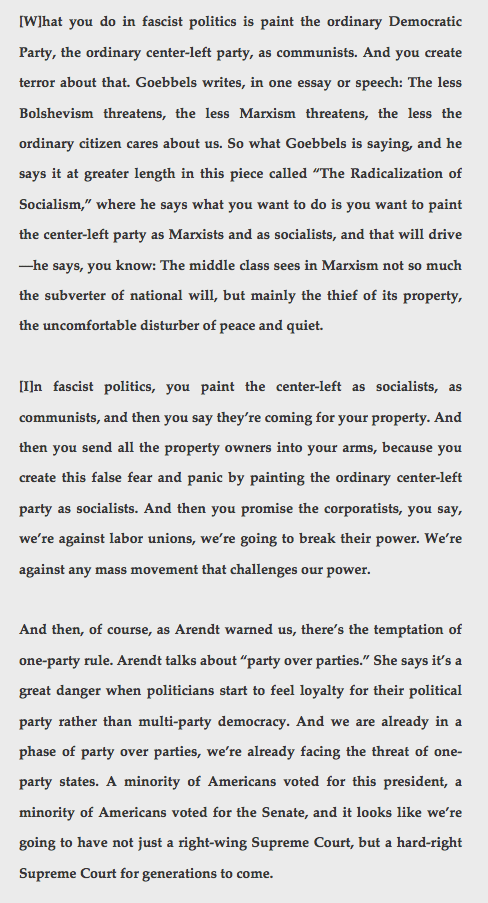
Such rhetoric and actions are taken straight from the Fascist playbook, as described in an illuminating October 5 interview with Yale professor Jason Stanley, author of How Fascism Works. The image is from John Heartfield.


˜˜˜˜˜

HAVE NO FEAR – HE IS VEGETARIAN


˜˜˜˜˜

Also yesterday, speaking on Democracy Now, Stanley listed what he identified as the Ten Pillars of Fascism:

[N]umber one, a mythic past, a great mythic past which the leader harkens back.

Number two, propaganda. There’s a certain kind of fascist propaganda where everything is inverted. The news is the fake news. Anti-corruption is corruption.

So, three, anti-intellectualism. As Steve Bannon said, it’s emotion—rage gets people to the polls. We got elected on “Lock her up!” and “Build the wall!” 

Number four, unreality. You have to smash truth. So, reason gets replaced by conspiracy theories. 

Hierarchy. In fascist politics, the dominant group is better than everyone else. They were like the loyal—the great people in the past who deserve respect just for being them.

Victimhood. In fascism, the dominant group are the greatest victims. The men are the greatest victims of encroaching feminism. Whites are the greatest victims of blacks. Germans are the greatest victims of Jews.

Law and order. What are they victims of? They’re victims of the out group, who are criminals. What kind of criminals are they? They’re rapists. Sexual anxiety.

Pillar nine is Sodom and Gomorrah. The real values come from the heartland. The people in the city are decadent.

And pillar ten is ”Arbeit macht frei“—work shall make you free. The out group is lazy. They’re not just criminals; they’re lazy. And social Darwinism. It’s all about winning.

˜˜˜˜˜

Once all ten pillars are in place, we are ready for the latent core architecture to become fully manifest:

prison1

MAGABOX


˜˜˜˜˜


A Wild Sovereignty

On a day when large numbers of people appear to celebrate, endorse and reward malignant narcissism, we turn to the laudably contrarian pages of Emergence Magazine, with excerpts from an essay by Kara Moses, written after an immersion in the last surviving forest wilderness in Europe, Białowieża.


˜˜˜˜˜

Answers to what ails us cannot be found within the human community, and surely not among the delusions and deceptions of the anointed ruling elites; yet elsewhere, among the remnants of the wild, if we can find the courage to listen, observe and be still, we might find some other path through the infinite woundscape of the anthropogenic affliction.

˜˜˜˜˜


Something Deeper

During a week that has starkly exposed the ethical and spiritual crisis of our times, and as we continue to consider the implications of fresh data confirming the accelerating death spiral of anthropogenic climate breakdown, let us bend our ears to the soulful voice of Terry Tempest Williams, presently Writer in Residence at the Harvard Divinity School.

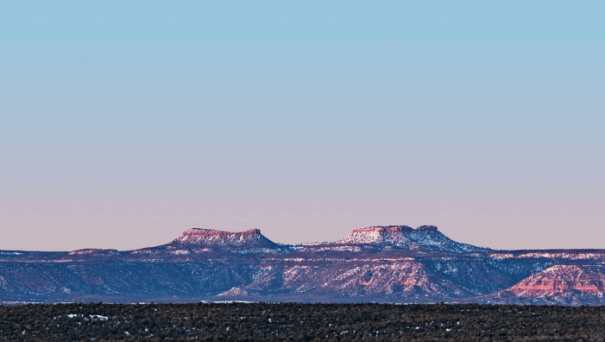
Below, excerpts from a recent interview, with images from Bear Ears country.


˜˜˜˜˜

DP commends Harvard Divinity School for taking the lead on forthrightly and compassionately engaging with the deep ethical and spiritual crisis that threatens to envelop us, as human supremacism comes up against its own inherent limits, and as toxic neoliberalism begins to cannibalize itself, having exsanguinated, commodified, consumed and evacuated everything else.

˜˜˜˜˜


Absence and Emptiness

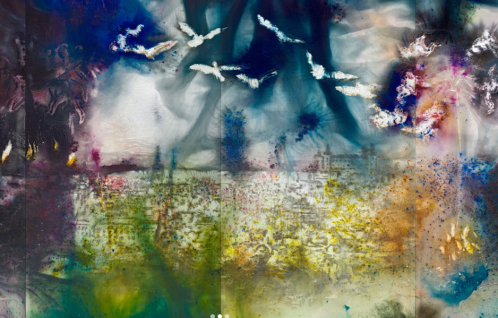
This week, we note the death of fellow desperado philosopher Paul Virilio. Below, a montage of excerpts from a 2012 interview, bristling with ideas that have become ever more urgently relevant, as the world careens into dark spirals of toxic algos and avatars.

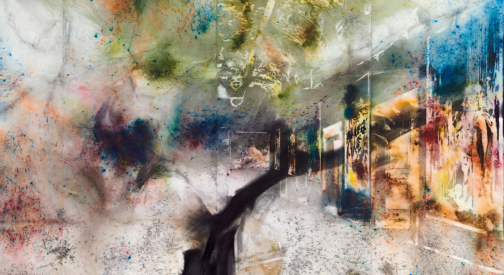
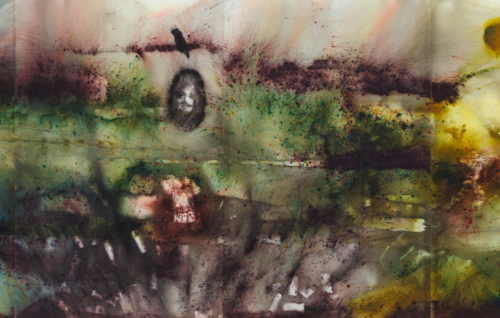
The images are details pinged from the extraordinary gunpowder paintings of Cai Guo-Qiang, featured at a recent exhibition at the Prado.


Virilio writes in Open Sky that one day the day will come when the day will not come; that day has come for him, in this fleeting iteration. May his ideas reverberate through the cosmos, jamming the fear.


˜˜˜˜˜˜


Child Of That Hour

Today, as Florence makes landfall and releases her vast quantities of water, we offer a poem by Conrad Aiken, Hatteras Calling.

Cape Hatteras defines a southerly coastline for Hatteras Island, among the barrier islands of the so-called Outer Banks and in the path of over one hundred hurricanes during the past century and a half. In August 1889, a surgeon named William Aiken and his very pregnant wife embarked on a voyage along the North Carolina coast. One account reads as follows:

Their ship was caught in a hurricane, floundering against the rocky shore off Cape Hatteras, and William and Anna were handed to safety with the air of a human chain formed by the crew only a short time before a wave washed away the deckhouse where their cabin was located. But Anna suffered no ill effects, and she and her husband reached their new home . There on August 5, 1899, their first child was born . ”

A child they named Conrad, who in 1942 would write the following lines:


˜˜˜˜˜

On the Brink of Biocide

Now comes law professor Fania Davis, with excerpts from prescient remarks delivered at the 10th Annual Howard Thurman Convocation in San Francisco, way back in 2005. Is it not high time to hear her words with fresh ears?

Images are from an intermedia installation titled Flow: Web of Interconnection, created by Beth Racette and Barbara Westfall.


That perilous future has arrived.

˜˜˜˜˜


Ever So Dangerous

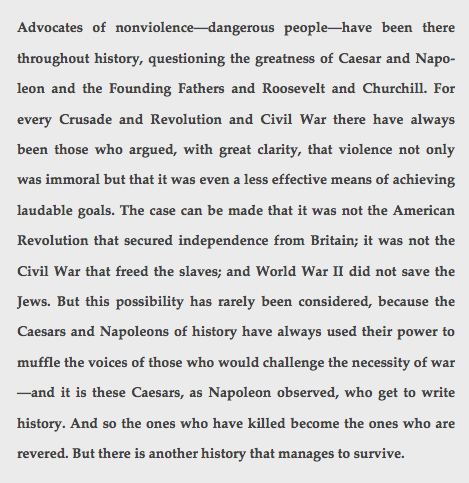
Now comes the venerable Mark Kurlansky with an excerpt from Nonviolence: The HIstory of A Dangerous Idea, dating from 2006 yet more relevant with each passing day of madness and mayhem. Interwoven iterations of Carl Fredrik Reuterswärd’s Knotted Revolver added by DP.


˜˜˜˜˜˜


A Broken System

As the political circus continues to release one tragic clown after another into the remnants of the public sphere, we urge DP readers to turn attention away from the delusional ringmaster and focus on the national prison strike now underway.

Demands are listed here.

From all the many important voices that have come to the surface, we relay an excerpt from an anonymous “jailhouse lawyer” representing the organization Jailhouse Lawyers Speak, addressing issues of racial terror and prison slavery:


Next follows an excerpt from a Democracy Now interview, transcribing the voice of  made by Heather Ann Thompson, author of Blood In the Water: the Attica Prison Uprising of 1971 and Its Legacy.


To repeat the last part of Ms. Thompson’s final sentence:

People standing together to let us know this system is broken and we’ve got to change. 

˜˜˜˜˜


Call and Response

We do not always judge a book by its epigraphs here at DP, but the below coupling most certainly captured our attention:

The book is titled Assembly, another (following Empire, almost twenty years ago, among others) fascinating collaboration between Antonio Negri and Michael Hardt, who turn their attentions to the possibilities and ambiguities of resistance movements as they attempt, in their “hive” multitudes, to both confront power and escape from it.

The entire book is available for perusal online; excerpts below, with images (added by DP) from the studio of Karen Kaapcke, whose extraordinary series of paintings from the days of Occupy capture the allure of the commons: vaster, partial, incomplete and ever expanding.


˜˜˜˜˜
The book also carries an unusual and laudable dedication, which we amplify here through the DP megaphone, such as it is:


To which, in call & response style, we loudly sing: