If You Are Human

CALL ME ISHMAEL BUT SAVE ME FIRST

In the final chapter of Moby Dick, Ishmael survives to tell the tale as the Pequod‘s lone survivor by clinging to Queequeg’s elaborately carved coffin:  “Buoyed up by that coffin, for almost one whole day and night, I floated on a soft and dirge-like main. The unharming sharks, they glided by as if with padlocks on their mouths; the savage sea-hawks sailed with sheathed beaks. On the second day, a sail drew near, nearer, and picked me up at last.”

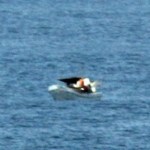
Ishmael’s savior turns out to be the whaleship Rachel, still searching for the lost son of her grief stricken Captain, a search that Ahab had refused to assist just a few days before. Now comes Adrian Vasquez, who has filed a lawsuit in Florida accusing Princess Cruises of negligence. Vasquez survived 28 days adrift in the Pacific on board Fifty Cent, his disabled ten foot fishing vessel. The ordeal included watching helplessly as his two friends and fellow fishermen died of dehydration and heat stroke.
CODE RED

On the sixteenth day, the three men spotted the cruise ship Star Princess, which they then vigorously flagged using a red sweater and orange flotation jackets. Two cruise passengers saw the distressed boat through their birding scopes, and immediately informed a cruise sales representative, who in turn assured them that the ship’s crew and Captain would be notified. However, the ship did not alter course, and made no effort to aid the distressed fishermen.

Article 98 of the UN Convention of the Law of the Sea clearly states:

Princess Cruises has subsequently claimed that the captain, was in fact not informed of the existence of the fishing boat:

“The preliminary results of our investigation have shown that there appeared to be a breakdown in communication in relaying the passenger’s concern. Neither Captain [Edward] Perrin nor the officer of the watch were notified. Understandably, Captain Perrin is devastated that he is being accused of knowingly turning his back on people in distress. Had the Captain received this information, he would have had the opportunity to respond.”

One of the birders, an American named Judy Meredith, attempted to contact the Coast Guard, but received no response. She later followed up with the cruise line and was told that the ship’s log had indeed recorded contact with nearby fishermen fearful for the safety of their nets. By this account, Star Princess then slightly adjusted her course to avoid the (nonexistent) nets, after which the fishermen waved their shirts in a gesture of gratitude.

Ms. Meredith refused to passively accept such astonishingly inept attempts to rewrite the narrative and will testify in support of the Vasquez lawsuit. Explaining her actions both on board the cruise ship and back on terra firma, she said: “If you are human, you do what you can.”

LAYERS OF THE FOOD CHAIN

While meditating upon the oceans of existential and political economic space separating the Star Princess from the Fifty Cent, we cannot help but to speculate whether the three young men on board the Fifty Cent were simply too far down the food chain for the Star Princess crew to perceive, indeed too insignificant to qualify as “persons in distress” worthy of the immediate assistance dictated by international maritime law. Since they were spotted through a passenger’s birding scope, well then perhaps they were just sea birds or other irrelevant beasts?

The two fishermen who died were named Fernando Osario (age 16) and Elvis Oropeza Betancourt. Panama is proceeding with a criminal investigation into the matter. One way or another, Adrian Vasquez will have his chance to tell the tale, and to seek compensation for the needless death of his two friends. If you are human, you do what you can.

VICTOR: I REQUIRE ASSISTANCE


Cronus With His Sickle

It appears that the vain quest for perpetual youth and immortality now includes the ingestion of a powder made from human babies. While contemplating the philosophical implications of such “health food”, we remembered a conversation many years ago with the famous purveyor of corporeal memorabilia Walter Sculley, and in particular his complaints (which seemed outrageous at the time) that so much quality material disappears from the memorabilia market straight into the digestive tracts of wealthy elders hankering for the vitality and priapic potency of days long gone.

Searching for some glimmer of illumination within the shadowlands of such a perverse scenario, we arranged a brief conversation with Mr. Sculley, who agreed to speak with us from an undisclosed location:

DP     A number of years ago, you complained in an interview about the impact of so-called specialty medicines on the corporeal memorabilia market. Now we hear news from South Korea about thousands of pills allegedly manufactured in China from pulverized fetuses and babies.

WS     Yes, well everyone knows about the rhino horns and the panda livers and what not, and the same thing has been going on with human materials for as along as I’ve been in the business, more years than I care to remember.

DP     Specific examples?

WS     OK, just last year, a perfectly good clump of Marilyn Monroe hair was floating around the wholesale market. I was doing my due diligence preparing a bid, then some nut job nobody ever heard of bought the clump, mixed it up with high fructose corn syrup, gelatin and other glop and then he churns up these batches of edible lozenges, sold them as Marilyn Love Drops or whatever. Well, maybe he was not such a nut job after all, because they sold for over a thousand a pop, and he made probably a few hundred of them, so that’s a hefty profit on a single clump of hair, no way he gets that kind of moolah from a legit collector.

DP     You sound upset about it….

WS     Yeah well the thing is, once you do that, it’s gone from the market for good, you can’t really pick it up again at the other end, if you know what I mean, so in terms of  market value, you have to consider that hair fully flushed. Now that’s a quality item, you could build a whole collection around a primo item like that. Very sad.

DP     So who are the buyers for this sort of thing, such as the Marilyn Love Drops?

WS     For the Monroe hair candy it’s men, maybe a few women, I mean I don’t have the invoices so I’m speculating here but I’m thinking it’s mostly men who want that little taste of intimate contact with her, and this is the only option that’s left until they cook up some sort of genetic resurrection, and rent her out by the night. You know, guys who wanted a tiny little suckle, and this little gum drop is as close as they’re ever gonna get. Other items, they’re looking for a little more punch in the pajamas, OK, and those little blue pills aren’t doing the job anymore, so they’ll pay a fortune for a JFK toenail or whatever, and chew on that for a while, and think they’re off to the races. Most of the time, it’s all in their heads, and the sad thing is if they would just whack a tennis ball around now and then, they might have the same effect but somehow they think, yeah, that JFK toenail, that’ll do the trick quite nicely, thank you very much.

DP     But it’s all in their heads.

WS     Yep. It’s like the relic is a trigger for the imagination, and the act of chewing pulls the trigger, then blam! they’re off to the races on a painted pony.

DP     In terms of long term trends, are you seeing more of this sort of ingestion of items that would normally be bought and sold as collectibles?

WS     Oh definitely. If not for performance pills, then for DNA speculation.

DP     What, you mean harvesting items just for the DNA?

WS     Yeah, that’s something that’s really spinning out of control. I mean there are even a few hedge funds set up, all chasing the same asset, celebrity DNA, so that the raw material is banked and ready, waiting for the science to catch up. Once that happens, presto chango, you pay the piper and you can have a baby Elvis or a baby God help us Kim Kardashian, or whoever you want.

DP     What’s your reaction to all that?

WS     It’s really depressing. I’m just glad I’m coming to the end of my career, because in a few years the memorabilia market will be ding dong kaput. I get contacted by young people wanting to intern here at the warehouse, learn the business, and I tell them forget about it, no future in the bone trade, poof.

DP     Any comment specifically about the pills filled with pulverized Chinese infants and fetuses?

WS     Horrific. I mean, what else can I say? I’ll tell you this, though – it looks like an extreme case and it turns my stomach, but let me ask you, isn’t it just a sign of the times everywhere?

DP     I’m not sure I understand.

WS     OK, as you know, I left the USA years ago because I just got fed up with the whole stinking enchilada, but I still consider myself a patriot. Shoot, I named my own private collection “Bones of the Founding Fathers”, so you can see where I’m coming from. Isn’t eating babies pretty much what we’re doing in terms of all the debt, spending the future? Sending young people off to ridiculous wars while the old codgers flip through the pages of their portfolios, same deal there, too. Might as well eat them when they’re born, get it over with from the get go.

DP     Those are harsh words…

WS     Harsh? I don’t think so. I mean, think of those kids who got pepper sprayed,  splashed full in the face, coated with the stuff. I saw that and I remember thinking damn, won’t be long before the fat cats get to slicing up those kids for pepper pot soup, and that’s no joke. So before anyone gets bent out of shape talking about the barbarian Chinese and all, I recommend taking a long hard look in the mirror.

CRONUS SITS DOWN FOR SUPPER


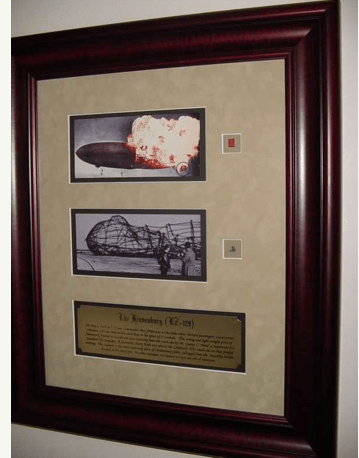
Luftschiff Hindenburg

May 6, 2012 marks the 75th anniversary of the Hindenburg disaster, which resulted in thirty six fatalities, including one member of the ground crew. Courtesy of the richly informative airships.net, we submit the following profile for the enormous airship, with a volume exceeding that of the Titanic:

MATHEMATICAL STRUCTURE FOR THE HINDENBURG OMEN

The Smithsonian National Postal Museum has organized an exhibition titled Fire & Ice that assembles various artifacts from the Hindenburg and Titanic disasters, including a promotional brochure for swift trans-Atlantic air travel, together with numerous pieces of airmail that failed to reach their intended recipients:

R-101 Tour of Inspection

Of particular interest to us here at Desperado Philosophy: the curious provenance and itinerary of the duralumin used for the Hindenburg’s construction. It seems that 5000 kilograms of the metal were purchased by the Germans as salvage from the wreckage of the British airship R-101, which crashed on October, 1930 in Beauvais, abruptly terminating its maiden voyage as a commercial enterprise. Duralumin from the Hindenburg wreckage was then salvaged once again, shipped to Germany and used in the construction of aircraft for the Luftwaffe. The fate of those aircraft is unknown, though it is not inconceivable that the duralumin returned to British soil.

Blünthner Schweinpiano

Also made from duralumin: a piano, manufactured by the Blüthner pianofabrik. Interestingly, the piano was covered with pale pigskin, intended to slightly muffle the tone while also eliminating reflective glare.

Though a fixture in the airship’s passenger lounge on numerous transatlantic voyages, the pig-piano was not on board the Hindenburg on the day of the disaster, having been placed on display at the Blüthner factory in Liepzig, where it was destroyed in 1943 by a British bombing raid. At the time, the factory was producing ammunition boxes, and not pianos, a tactical retooling implemented by authority of the Minister of Armaments, Albert Speer.

LOUNGE MUSIC FOR A NAZI  ZEPPELIN

Finally, we note the use of the Hindenburg as an aerial ornament within the pageantry of the Nuremburg rally on September 14, 1936; the zeppelin appeared over the congress on the final day, following a formation of conventional aircraft that had been organized into a swastika formation. We also note that a tiny remnant of the Nazi insignia on the Hindenburg is available for sale on Ebay.

TRIUMPH OF THE WILL AS A HYDROGEN BOMB

ALL THAT IS SOLID MELTS INTO AIR

RUIN VALUE

RUIN VALUE


The Answer My Friend

BLOOD LANE

Chapter 44 of Moby Dick finds Ahab in his cabin, fighting a vicious headache. Having announced the target of his predation to the Pequod’s crew, he now suffers from the inescapable fact that he cannot specify where Moby Dick rolls, sounds and wallows. At this moment, what heaps and tasks Ahab is not some abstract inscrutable malice but rather the whale’s carnal invisibility.

Even when given golden incentive through the doubloon nailed to the mast and entranced by their captain, the lookouts in the topmast can only scan a single migratory vein, with even such limited scrutiny possible only when weather conditions are optimal. The masts of the scattered fleet are not linked into a network of fixed haliographs, such as the one devised in a later decade by General Nelson Miles during his hunt for the most wicked indian who ever lived; nor are they able to transmit radiophonic signals, no matter how much lightning they may inadvertently conduct.

Unlike terrestrial hunting where the environment is stable and where the hunter might also remain silent and still while waiting for prey to roam into range, whaling is a hunt where all the variables are constantly in motion: the ocean is moving; the whales are in motion, sometimes with the currents, but often not; and the whale ship is in motion, too, dependent on winds that may or may not favor the systematic tracking of probable – but never definite – migratory patterns. Thus Ahab bends over his charts:

The charts store information about seasonal migrations and feeding patterns, and also identify specific sightings of Moby Dick, not only in his own past voyages but also those encounters recorded in the stories of his fellow captains in the whaling fleet. Sifting, weighing and balancing all these variables and probabilities inside his head, Ahab ultimately seeks to transform the pencilled vectors of his charts into a fountain of whale blood.

AHAB DECRYPTED

Let us now move away from the dark vortex of Ahab’s headspace and consider the shadowlands of our own national security obsessions, as represented in the vast surveillance octopus of the NSA. As described in an excellent Wired report, Stellar Wind is the catchy code name for the world’s largest data mine, now under construction in Bluffdale ,Utah.

BLOWING IN THE WIND

At the core of the project crunching the yottabytes will be the the world’s fastest supercomputer, generating so much heat that it will require 60,000 tons of cooling equipment, heat released by the creation of the most exhaustive behavioral map of a species ever conceived, a dynamic map that aims to capture every burp and twitch of the Naked Crowd. This lethal funnel of decryption and pattern analysis will eventually deliver an obliteration of individual privacy so thorough as to rip the notion of inalienable human rights from whatever remains of the American narrative, and leave us: where?

With a Stellar Wind blowing hard in our faces, we turn once again to Chapter 44, and to Ishmael’s astute diagnosis:

Eagle Mutation?


Sorry for the Inconvenience


On Wednesday, April 25, Slavoj Zizek delivered an address at The New York Public Library titled “The Year of Dreaming Dangerously”, a year that will apparently include publication of his new book, Less Than Nothing: Hegel and the Shadow of Dialectical Materialism. On his publisher’s website, the book is described as a “long-awaited masterpiece”.  On the website of the New York Public Library, our tireless research staff found a prior reference to Zizek as “the Elvis of cultural theory”.

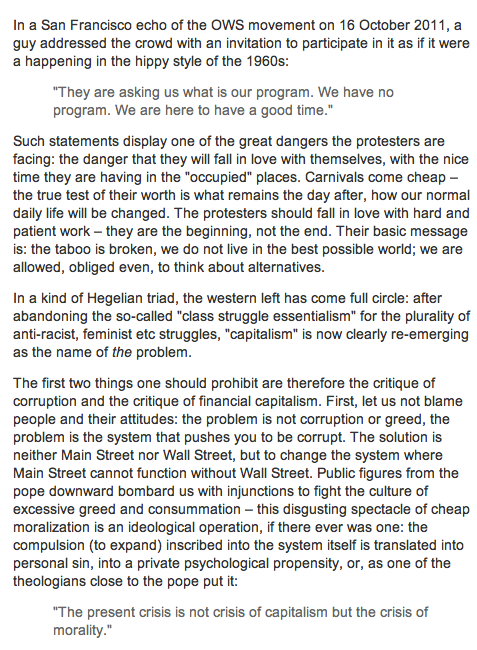
Unable to dispatch a reporter to attend his (sold out) lecture in person, we were grateful to find a synopsis published in the pages of The Guardian. In the midst of these remarks, he delivers the following caution to the Occupy movement:

Here at Desperado Philosophy, we have had a difficult time digesting this strangely paternalistic passage. Is he saying that anyone who attempts to raise issues of personal accountability is part of some vast Papist conspiracy of obfuscation? Is he saying that individual acts of resistance, truth telling and integrity are meaningless; that because “the system” propels us to be corrupt, our individual actions and attitudes are of no consequence? Far from Hegel, this sounds a good deal like the crude situationist reductionism of Philip Zimbardo, in which the problem of conscience is wormed from the turf.

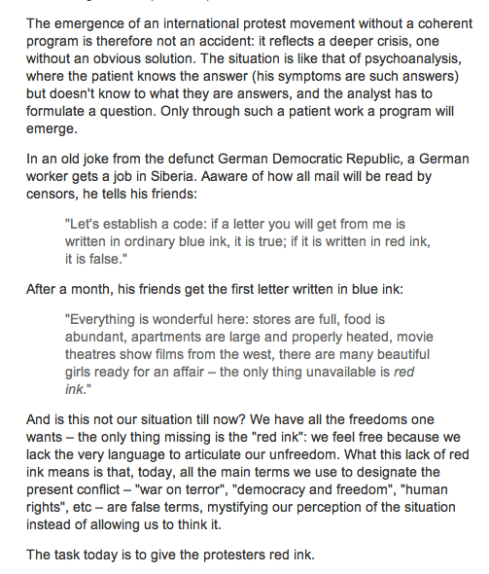
Is Zizek then also saying that the Occupy movement lacks seriousness because certain participants may be present on the scene for reasons of pleasure, connection and community? What if the experiences he wrongly dismisses as “the carnival” are absolutely central to “how our daily life will be changed”? Has Elvis left the building? Or is he just having us on? We know that Zizek loves a good joke, and indeed he closes his remarks with the following:

All very clever and amusing, but what does it mean? Is he telling the Occupy movement, whose media innovations have included the ingenious human megaphone, that what they really need is a medium of coded subterfuge, the red ink of a nod and a wink? Why?

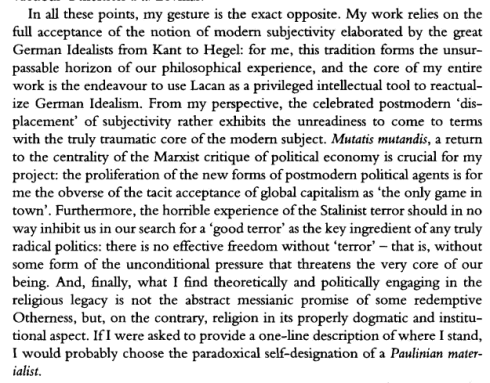
True, we have never really understood the Zizek phenomenon, though from time to time we venture into his copious textuality in search of clues for what it is all about. Here is one little nugget dug from his own preface to The Zizek Reader:

This peculiar and self-indulgent pronouncement left us so befuddled that we convened an emergency staff meeting to meditate, mutatis mutandis, upon the fate of Paulinian materialists, wherever they may be. Yet this is the very same fellow who cautions the mostly anonymous participants in the purposefully leaderless Occupy movement not to fall in love with themselves? Sigh. (And could someone please email us an explication of  Zizekian “good terror”?)

By contrast, on Sunday, April 22, Earth Day at Vermont’s Putney School, we attended a rather different sort of lecture, given by a different sort of man named Tom Wessels, whose subtle and profound books have nothing to do with wielding Lacanian tools to reactualize German Idealism. Wessels, who exudes the sort of joyful wisdom that comes from a lifetime spent in forests and in the mountains rather than at academic conferences and symposia mulling the End of Time and such, carried a rather different message.

Speaking without notes and entirely without pretense, Wessels urged the assembled Putney students, among whose ranks one would undoubtedly find delegates to OWS, to choose a life story of connection rather than consumption, and to choose commitment to community and the landscape over the narrow celebration of self. Referring to Black Elk Speaks, he pointed out that this New Story was in fact a very Old Story.

Since the prevailing story of consumption and possession of endless stuff is correlated with a high incidence of depression and anxiety often terminating in years of Lacanian analysis, Wessels also roundly endorsed having “a good time” while creating new forms of association and sustenance. Only through such good times can the Old/New Story gain heart, and life, and a future.

Though we neglected to bring our crack team of videographers to properly document the event, we discovered a video of the commencement  address given to the Antioch class of 2008, during which Wessels delivered essentially the same message, a message well worth repeating:

To close the afternoon, we then gathered around a piano to participate in one of the many beautiful rituals and traditions that make the school such a special place: sing. After having such a good time reconnecting with community and the landscape at Putney’s Earth Day carnival, we are confident that whatever future survives the present will be based in such joyful experiences, and not in the “good terror” of Slavoj Zizek.


The Willful Child

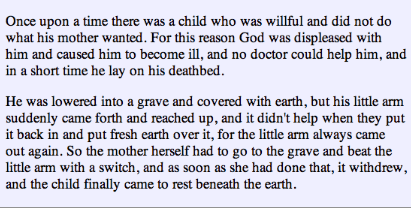
Many years ago, the distinguished German film maker Alexander Kluge brought to our attention a brief tale from the Brothers Grimm titled “The Willful Child” :

In German, the title is Das Eigensinnige Kind, and the etymologically complex concept of Eigensinn is central to Kluge’s nuanced, beautiful and therefore little known philosophy of history. Within this philosophy, the action and agency of the child’s buried arm offers far more significance than mother history’s punishing rod; all in good time.

Hans Magnus Enzensberger explores the tension between history and eigensinn in his extraordinary novel about the various modulations of resistance embodied by the family of Kurt Freiherr von Hammerstein-Equord during the years of the Third Reich, resistance that included espionage on behalf of the Red Army and the participation of two sons in Stauffenberg’s unsuccessful attempt to assassinate Hitler on July 20, 1944.

In a recent interview, Enzensberger explains, “Eigensinn is a word that doesn’t translate very well into English. It’s not selfishness. It’s not obstinacy. It’s not intransigence. You might say it’s a sense of having your own value system. That’s a quality that I find very interesting, because it’s almost beyond a person’s control. When I first came to England after the war, people used to speak of someone being a ‘man of character’: that might be a good translation. In spite of the pressures within his milieu, Hammerstein somehow didn’t budge. He couldn’t. It saved him from the opportunism of the other generals. Of course, they would have killed him off if he hadn’t died in 1943.”

In relation to our roaming investigations into the history and science of obedience, the person ‘of character’ might be described as an individual for whom there are no situational influences nor social expectations that will subsume her/his own conscience. As Enzensberger stresses, this is not a question of being stubborn or contrarian or merely idiosyncratic; rather, that certain behaviors and responses are simply not possible, entirely unscriptable for individuals endowed with abundant eigensinn. Such people are very difficult to transform into “agents” of another’s will, or to be sucked into fanatical movements, hysterias, security manias and other ideological delusions.

As Enzensberger writes about the aristocratic silence of the Hammersteins, “There remains an unspoken remainder which no biography is capable of unravelling; and perhaps it is precisely this remainder upon which everything depends.” During a time when the Naked Crowd remains ever ascendant, we pause to sing a hymn of quiet praise to that “unspoken remainder” and to the child’s arm pushing willfully through the dirt.

THE UNSPOKEN REMAINDER


Nothing to Hide

In his remarkably prescient book The Naked Crowd, published in 2004, law professor Jeffrey Rosen reports on an informal experiment conducted with groups of students and adults in the years following the events of 9/11. He asked them to imagine two machines designed to enhance public security at airports; a Naked Machine, which used microwaves to perform a virtual strip search, producing vividly naked three dimensional images of everyone who passed through the scanner, and a Blob Machine, which used simple software manipulation to extract images of any concealed objects from scanned bodies and project them onto a generic and sexless mannequin, creating “an unrecognizable and nondescript blob.”

Subjects were then given a hypothetical choice between the two machines, with all other factors – such as the length of the security queues – being equal. Rosen found a fairly consistent stream of people who preferred to go through the more invasive Naked Machine, with some describing “a willingness to be electronically stripped by the Naked Machine as a ritualistic demonstration of their own purity and trustworthiness in much the same way that the religiously devout describe rituals of faith.”

(As a brief digression, this psychological dynamic might also help to explain the behavior of sexual assault victim Louis Ogborn beneath the golden arches, who in the early stages of her ordeal seemed so eager to demonstrate she literally had nothing to hide, and thus complied with the perverse directives of the disembodied ventriloquist Officer Scott and his depraved puppets, within months of the publication of Rosen’s book.)

Crowds suspect individuals who stand apart, and if the crowd wants to be naked, then the individual who expresses a preference for privacy is immediately suspect. A number of years ago, we (the entire editorial staff of Desperado Philosophy) were asked in a public forum why we did not have any social media accounts. We responded that we did not want to subject ourselves to data mining; that social media were an extractive industry, not dissimilar to whaling in the nineteenth century; that we were unwilling for our patterns of curiosity, as reflected in daily community interactions or web navigations, to become part of a deeply camouflaged behavioral algorithm which would then be packaged and sold to marketers without any compensation to us, serving as the mine; and that future potential uses of such data for social manipulation and control were still unknown.

Our explanation for why we had “opted out” was greeted with considerable dismay and a touch of suspicion, with one person blurting out that “you only have to worry about privacy if you have something to hide.” Oh really?

FACEBOOK ACCOUNT PROTOTYPE

Rosen has the rare sort of fluid intelligence that combines the analytical precision of a legal scholar with subtle insight into the vagaries of mass psychology; his most provocative arguments concern the collapse of boundaries between the individual and the crowd in a media environment dominated by the internet.Law professor Noah Feldman made a similar point in the wake of the recent supreme court decision on whether police have the right to conduct strip searches, even for the most trivial misdemeanor such as violating a leash law or a minor traffic ticket:Reviel Netz’s idea of history as a wrestling match speaks to this posture: mammals and other living beings wrestling with each other in a confined and finite space open to constant negotiation and contestation. Yet there is a second wrestling match transpiring simultaneously, the match between the body of the Naked Crowd (that may transform into a bloodthirsty mob at any moment) and the body of the fully clothed and self-reliant individual, who stands apart, or wriggles free from the choke hold. We know, or should know from long history, that when the body of the Naked Crowd takes complete control of the ring, with the individual down and out for the count, the result does not tend to be touchy-feely Communitas.

Who benefits when privacy mutates from an inalienable human right into a suspect form of “hiding”?  In his shameless promotion of the Naked Machine, former Homeland Security secretary Michael Chertoff is one obvious beneficiary, though as Chris Hedges recently documents, the ascendence of the Naked Crowd has unleashed a vast new architecture for the military-industrial complex. Once the infrastructure for total information awareness is in place, it will not be long before loose talk about privacy as an intrinsic quality of human liberty will be considered not just eccentric, but criminal.

SLEEPING HAMMOCK FOR THE NAKED CROWD


Dimly, Hard to Say Why

Indubitable

Here at Desperado Philosophy, it has not escaped our attention that we are presently experiencing the one hundredth anniversary of the maiden voyage and subsequent sinking of the unsinkable Titanic. To mark the occasion, we have selected a montage of passages from the Cantos of Hans Magnus Enzensberger’s brilliant epic poem written across the debris field of the catastrophe, and other affiliated catastrophes.

First published in English in 1980, and now lamentably out of print, the poem is dedicated to the Chilean poet Gaston Salvatore. While studying sociology in Berlin, Salvatore became a leader of the German student movement, and later joined Enzensberger as editor of the monthly journal, TransAtlantik.

On this day (April 13), it was still party time on board; full steam ahead! As for the iceberg…

EXCERPT FROM SIXTH CANTO

TWELFTH CANTO

EXCERPT FROM EIGHTEENTH CANTO

EXCERPT FROM TWENTY NINTH CANTO

EXCERPT FROM THIRTY THIRD CANTO

Hans Magnus Enzensberger


The Way to Heaven

During Gitta Sereny’s extraordinary descent into the mind and memory of Franz Stangle, former Commandant of Sobibor and Treblinka, she explores the question of whether he might have made small gestures of mercy, small actions that might have indicated a degree of resistance to the regime of extermination, and thus slightly alleviated the suffering of the victims. At one point during this slow, careful examination, Sereny asks Stangl what for him was the worst place in the camp:

Once naked, the prisoners not only became objectified; they also became more vulnerable and compliant, making the terminal stage – driving the mass of bodies up the barbed wire and pine branch “Himmelweg” (the way to heaven) directly into the gas chambers – easier for the SS guards to accomplish. Shame and sexual humiliation were tools just as powerful as the sticks and whips used to drive the objectified herd up the chute to slaughter.

Sexual humiliation of prisoners has also featured within the regime of psychological torture deployed by the CIA and US military intelligence following 9/11, often under the category of “exploitation of cultural sensitivities”. Shower cubicles at Guantanamo Bay featured glass fronts facing the central atrium, exposing the forced nakedness of Muslim prisoners.

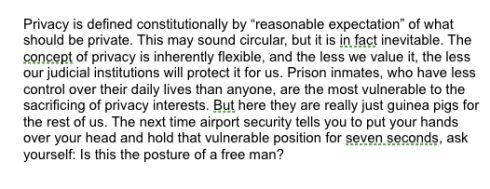
Taken in conjunction with the increasingly invasive protocols of the TSA , the recent decision by the US Supreme Court regarding strip searches provides a clear signal that this regime is now ready for homeland distribution. Citizens who have been arrested – not convicted, but arrested – for even the most trivial offense, can now be sexually humiliated and invasively inspected, in order to safeguard the “rights and interests” of jails and prisons.

Here is an excerpt form a New York Times article, reporting on the case, that began with the arrest of Albert Florence, who was from the very first moment completely innocent of any crime:

In his decision, Justice Kennedy wrote, “Every detainee who will be admitted to the general population may be required to undergo a close visual inspection while undressed.” The use of the word “detainee” is nothing short of ominous; it appears that Gitmo is coming home. How long will it be before our very own brand of himmelweg  takes shape?

In an interview for an article in the NJ Star Ledger, Mr. Florence stated, “I worry more so for my kids,” he said. “It’s something that I think we all — and I’m not talking about any particular race, or any particular class of people — but we all as American citizens should kind of come together and try and fight this thing.”

TRACES OF A NAZI DELIVERY SYSTEM


Pancakes and Worms

      The worm of conscience still begnaw thy soul.    Margaret, in Richard III

In a brief statement first published on Edge in March, 2005, dramatist Richard Foreman released an impassioned cri de coeur into the flow:

OLD STRUCTURE

The notion that hyperconnectivity creates a diminished subjectivity and reduces the depth of individual intellectual experience has been taken up by several others, most notably by Nicholas Carr in his book The Shallows, in which he persuasively outlines how web-based discourse and enquiry impacts our neurobiology: flattening cognition and emotions, thereby hollowing out our capacity for moral judgement and empathy. In what for me is the most significant passage in the book, Carr references the important work of Antonio Damasio, whose experiments suggest that such judgements and evaluations are inherently slow. As Carr writes:

In one recent experiment, Damasio and his colleagues had subjects listen to stories describing people experiencing physical or psychological pain. The subjects were then put into a magnetic resonance imaging machine and their brains were scanned as they were asked to remember the stories. The experiment revealed that while the human brain reacts very quickly to demonstrations of physical pain – when you see someone injured, the primitive pain centers in your brain activate almost instantaneously – the more sophisticated mental processes of empathizing with psychological suffering unfolds much more slowly. It takes time, the researchers discovered, for the brain “to transcend immediate involvement of the body” and begin to understand and to feel “the psychological and moral dimensions of a situation”. 

In Too Big To Know, David Weinberger argues that our traditional conceptions of authoritative knowledge, and of Foreman’s complex inner density, all derive from qualities and limitations intrinsic to the printed page and book, and that as we pass into “the expertise of clouds”, the nature and structure of knowledge production fundamentally changes. Thus we must rethink our understanding of intelligence within the context of networks, “where the smartest person in the room is the room.”

NEW STRUCTURE

We have no argument with Weinberger, as far as he goes. Indeed, his skillful discussion of how networks dissolve traditional power structures within academia and bureaucracies is accurate and illuminating. Yet strong as he is when discussing the impact of the web on scientific knowledge in particular, he evades the deeper dimensions of Carr’s critique, particularly regarding the “nobler instincts” of moral consciousness.

The worm of conscience needs a rich and dense soil to sustain its penetrations; the lifelong self-examination that is essential to our humanity. What sort of soil does webbed intelligence offer to the worm? Is the network Too Big To Gnaw?

Weinberger’s final chapter focuses on those qualities that make for good netizens, urging us to open access; provide hooks; link everything; include everyone; teach everyone. Laudable as such normative behaviors may be, what about those pesky ancient questions of virtue, justice and wisdom; the conduct of a good life, and the character of a civilization? Or perhaps the new structure of knowledge production is “too smart” for such old fashioned aspirations?

Towards the end of his book, Nicholas Carr writes:

What matters in the end is not our becoming but what we become. In the 1950s, Martin Heidegger observed that the looming “tide of technological revolution” could “so captivate, bewitch, dazzle, and beguile man that calculative thinking may someday come to be accepted and practiced as the only way of thinking.” Our ability to engage in “meditative thinking,” which he saw as the very essence of our humanity, might become a victim of headlong progress. The tumultuous advance of technology could, like the arrival of the locomotive at the Concord station, drown out the refined perceptions, thoughts, and emotions that arise only through contemplation and reflection. The “frenziedness of technology,” Heidegger wrote, threatens to “entrench itself everywhere”. 

It may be that we are now entering the final stage of that entrenchment. We are welcoming the frenziedness into our souls.

Returning briefly to Foreman and his theater: Over the years, we have had several occasions to witness the feverish lumberjacking taking place inside the darkened chambers of Foreman’s Ontological-Hysteric theater. Several of the devices used by Foreman to clear cut the dead wood of previous achievements from our assembled sensoria, including rapid and sudden changes in the intensity and volume of light and sound, all too closely resemble the sort of brutal wood chipping of existential platforms developed by the CIA (among others) within the Total Theater of “no touch” psychological torture.

On each occasion, we left Foreman’s theater of sensual and cognitive disorientation feeling exhausted, rather than illuminated; pacified, rather than provoked; flattened, rather than engaged. Come to think of it, we left his theater as less of a person, and more of a pancake. Could it be that the Ontological-Hysteric theater anticipated and represented for its audience Heidegger’s frenziedness of technology, the final stage of which Foreman now decries? The gods pound on our heads, and play with us all.

WAKE UP MR. SLEEPY